Duration
22 Days


 Unbeatable Holiday Offers - Save Up to 20% on Your Next Adventure!

Duration
22 Days
Trip Difficulty
Moderate
Max. Altitude
5563 Metres
Group Size
2-20 People
Best Season
Mar-May, Sep-Nov
Transportation
Flight
Accommodation
Teahouse, Hotel, Tent
Meals
Breakfast, Lunch and Dinner
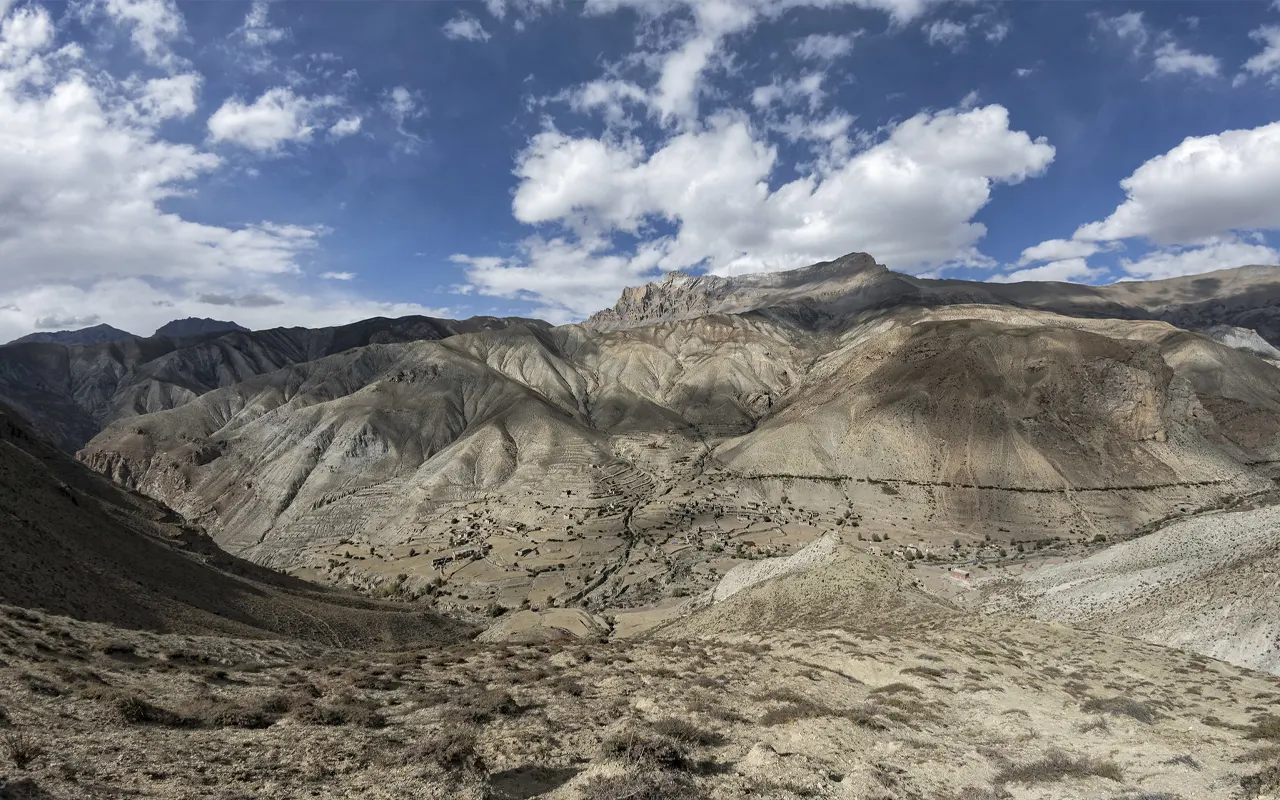
The Dolpo Rara Traverse Trek is one of the most adventurous and remote trekking journeys in Nepal. It is a great and extensive journey that links two of the most beautiful and remote areas of the country, Dolpo and Mugu. The trekkers go through the scenery of drama in the form of mountain passes, river valleys, forests, dry plateaus, and remote villages over a duration of three weeks.
The trail starts in the Dolpo area within the Shey Phoksando National Park and finishes at the serene banks of Rara Lake within the Rara National Park. On the way, one can see a rare blend of wild Himalayan nature and traditional mountain culture, which the trail uncovers.
The trek is known due to its unbelievable landscapes and cultural diversity. The Dolpo Rara Trek has one of the most beautiful features, the Phoksundo Lake, which is at an altitude of 3,612 m / 11,850 ft. The deep blue water, as well as the cliffs around it, form one of the most impressive Nepal landscapes.
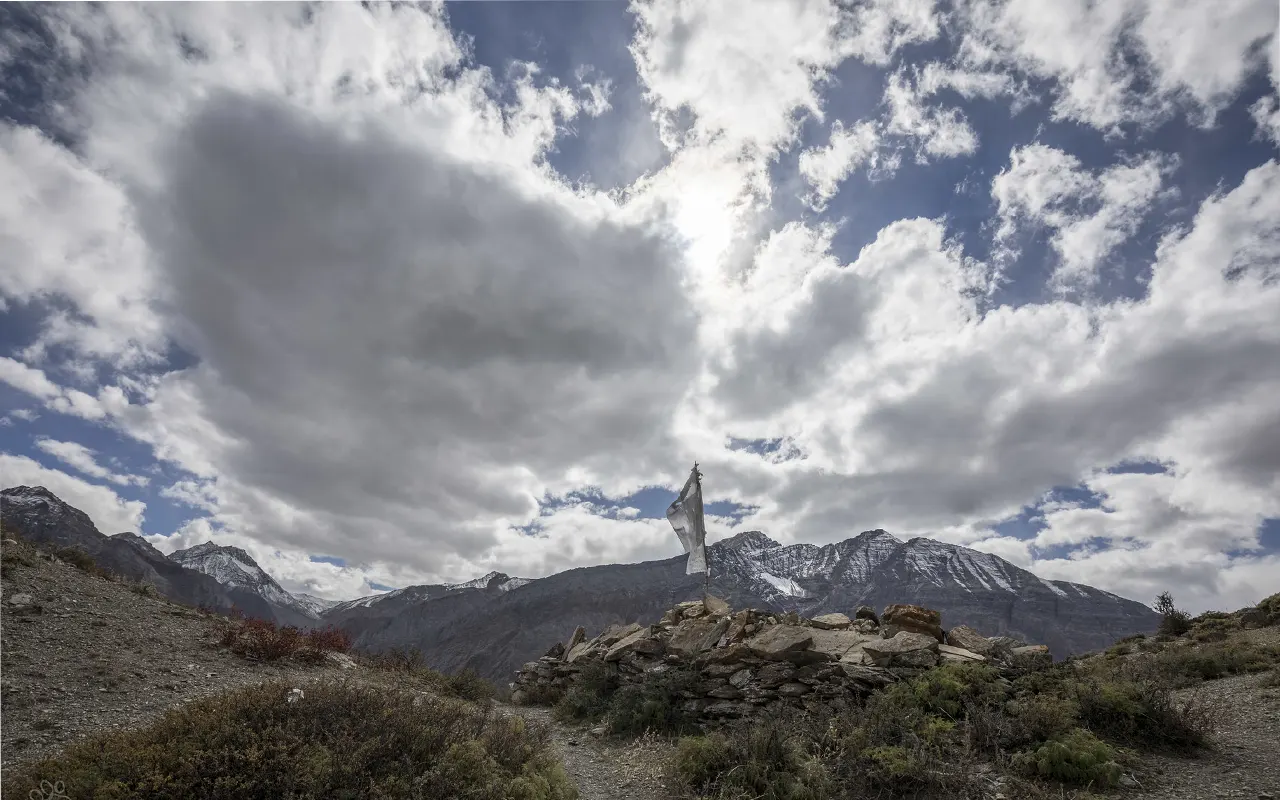
Trekkers also see the holy land around the Shey Gompa and Crystal Mountain that are very spiritual in the eyes of local Buddhist groups. You will see all monasteries, chortens, mani walls, and prayer flags, which provide a bit of insight into the ancient practices of Dolpo.
The landscape is gradually transformed as the journey proceeds. Trekkers traverse several high mountain passes of more than 5,000 m / 16,404 ft, cross isolated valleys, and pass through high pastures and forests of the Alps.
There is also a wildlife experience. The largest national park in Nepal is Shey Phoksundo National Park, located between 2,130 m / 6,988 ft and 6,885 m / 22,588.5 ft, and it has some endangered species like snow leopards, blue sheep, and Himalayan black bears.
The trek eventually comes to the Rara Lake at 2,980 m / 9,776 ft, the largest lake in Nepal. Rara is a scenic place with pine forests and rolling hills, and marks the peaceful ending of the Dolpo Rara Traverse Trek.
The Dolpo Rara Trek is not just a journey of scenery, but it is also a journey of adventure and strength. It is a distant camping trek and typically takes 22 days, which demands good physical condition and prior experience of trekking in high-altitude areas. Trekkers walk between 6 and 7 hours per day, and most of the nights are spent over 3,000 m / 9,843 ft. The reward of this strenuous trek is to visit some of the least-visited parts of Nepal.
The Dolpo Rara Trek will provide the experience of the real wilderness to people who desire to see something beyond the well-traveled trekking paths. To be organized and secure in the adventure, this trip can be planned with professional guides and support crew through Himalayan Pathways.

On the first day of your Dolpo Rara Traverse Trek, you are going to Nepalgunj by a scenic domestic flight from Kathmandu, which takes approximately 50 minutes. Nepalgunj is located in the western Terai at an altitude of 150 m 492 ft. This is a town near the Indian border, and the atmosphere is very lively, with busy markets, temples, and mosques. You will find the blend of Nepali and Indian culture in the food, language, and day-to-day life.
Once there, you are transferred to your hotel and can relax. During the evening, your guide will brief you on the nature of the trek and the path that you are going to take to the remote Dolpo region. This session will make you know the trail, precautions, and planning for the next few days of the trek.


In the morning, you take a flight to Jhupal after you have breakfast. The flight lasts approximately 45 minutes, and it provides great scenery of hills and mountains.
Your trek begins at Jhupal, which is located at approximately 2,475 m, 8,120 ft. Here, you get to see the support team and porters who will aid in the delivery of supplies. Have tea and rest, and then start walking along a pleasant path.
Before the checkpoint at Sulighat, where you enter Shey Phoksundo National Park, you have gone by small villages, rivers, and forested areas. The culture of Tibetan Buddhism is evident in the villages along the road. Keep on walking along the river till you arrive in the village of Chhepak at 2,680 m / 8,792 ft.
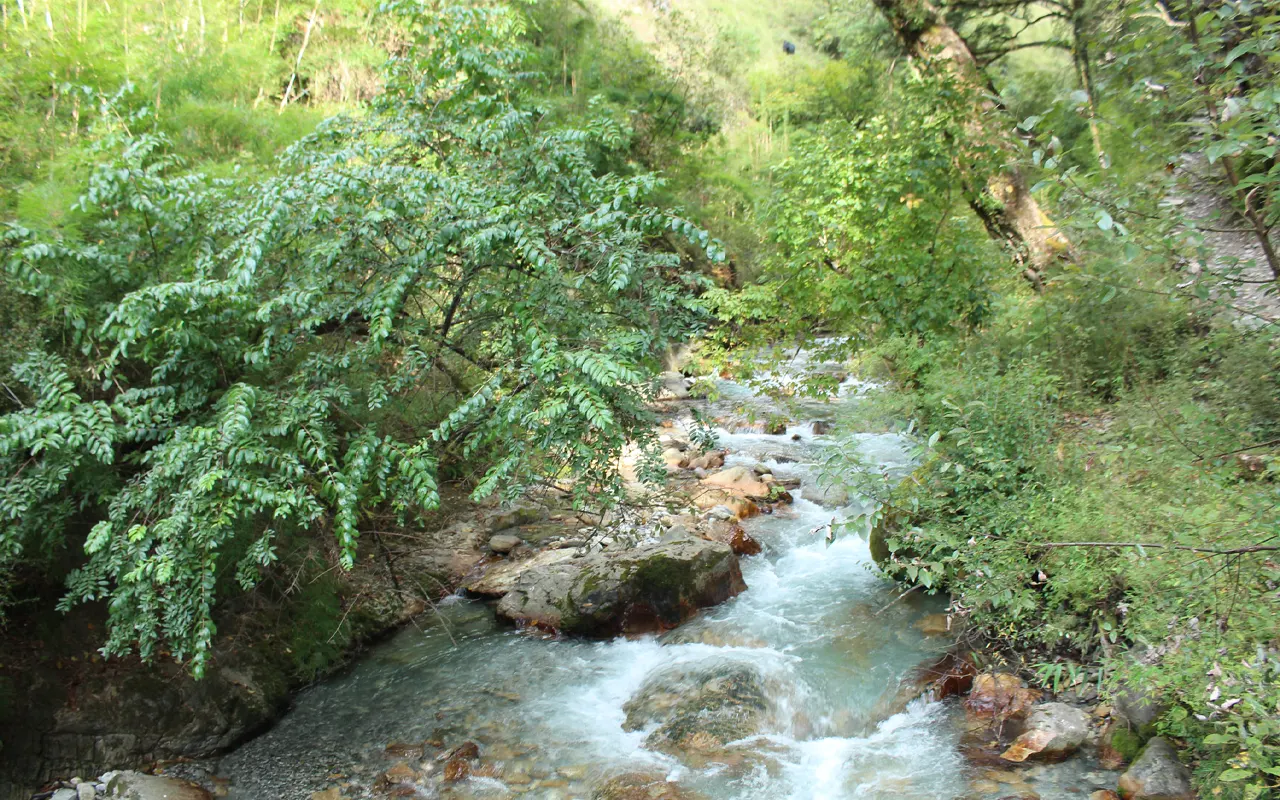
The current walk is along the beautiful Phoksundo Khola valley. The path is crossed by the river a number of times using small bridges and passes through wooded and rocky areas.
In the process, you can visit the Amchi Hospital that practices traditional Tibetan medicine using natural healing techniques and herbs. Such doctors are significant in the Himalayan isolated communities.
The path then proceeds to a winter village where the citizens of Ringmo village spend their winter. You go through the valley and, as you go further, you come to the confluence of the Phoksundo and Yulung rivers. It is a gentle trail there all the way up until you reach the small settlement of Chunuwar (3,130 m / 10,269 ft).
Today, the trail is slowly ascending towards the well-known Phoksundo Lake area. It is a scenic valley road with beautiful mountain scenery and the occasional waterfalls. Many hours later, you reach the traditional village of Ringmo at 3,612 m / 11,850 ft.
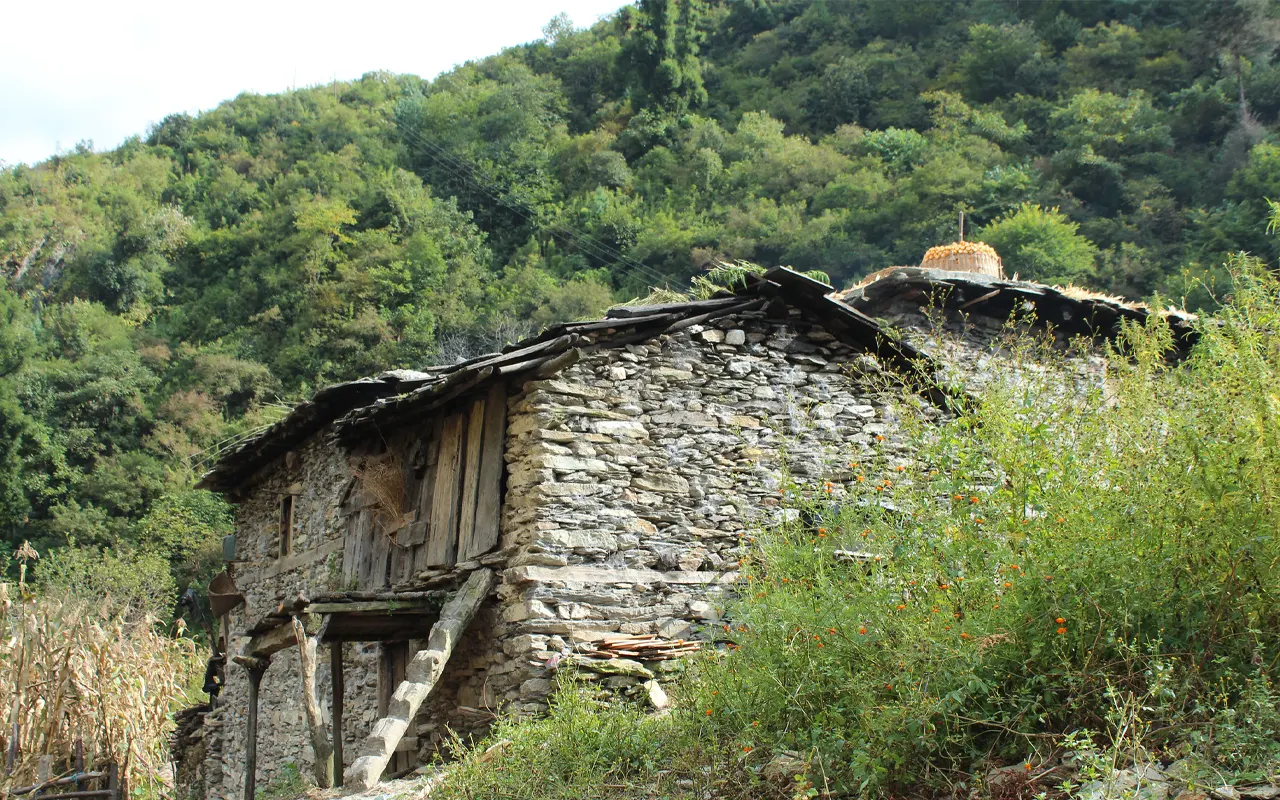
Ringmo is a stronghold of the Tibetan Buddhist culture. The village is covered with stone walls carved with sacred mantras on mani walls and chortens. The houses are constructed using stone and are in the typical Himalayan style. It is located close to the beautiful Phoksundo Lake, which is known for its deep blue water.
Once you are within the campsite around the lake, you can take a rest and enjoy the serene atmosphere and beautiful scenery around the village.
You will have an acclimatization and rest day at the beautiful Phoksundo Lake near Ringmo village at 3,612 m / 11,850 ft., which will assist the body to acclimatize to the thin air of the mountains before proceeding to higher altitudes within Dolpo.
You may go on a short walk around the lake, visit Ringmo village, or walk to Bon monastery, which is near the village. Bon is an ancient religion that existed before Buddhism, and there are still followers of the same in this place.
The lake is famous for its booming turquoise color and calm atmosphere. Most trekkers like to have a rest in this place, take pictures, or meditate and do yoga. This is also a day that you can have a glimpse of the landscape and to get to learn more about the local culture.
Leaving Ringmo (3,612 m / 11,850 ft), the trail today goes high above Phoksundo Lake. The scenery of the turquoise lake in the distance, as well as the mountains around are magnificent. In some areas, the path is very narrow because of landslides, and one has to be very careful.
The road then ascends to a ridge where the Kanjirowa Himal (6,612 m / 21,692.9 ft) is visible, as well as a tremendous panorama of Ringmo village and the lake. The trail then turns down to the lakeshore after viewing the scenery, and then ascends again on a broad valley. Juniper bushes and rocky landscape make the landscape more alpine.
Several hours of walking bring you to the camping grounds of Chunemba (3,639 m / 11,938 ft).
The trail leads on today further into the remote Dolpo. Leaving Chunemba, you move out of the Phoksundo Valley as it becomes narrower. There are high rock walls on both sides of the trail, which provide a dramatic and rugged landscape. The further one goes up the valley, the steeper the path.
The Snowfield Camp was named after The Snow Leopard, a well-known book by Peter Matthiessen who had traced through this area. As the vegetation covers are reduced and the rocky terrain is augmented, the scenery will further be more wild and remote.
A gradual ascent brings you to Snowfield Camp, where you may rest and take in the peaceful mountain scenery of high places.
The day is one of the most challenging of the Dolpo Rara Traverse Trek. At Snowfield Camp (4,400 m/ 14,435 ft), you start an early ascent to the high Kang La Pass (5,350 m/ 17,552.4 ft). It is a steep and slow climb because of the altitude, the view is spectacular, and it has wide panoramas of the Himalayan peaks.
Once you have seen the scenery, slowly walk down the trail, making your way to the historic area of Shey Gompa. One of the most sacred monasteries of Dolpo is Shey Gompa, which is 4,310 m / 14,140 ft. The monastery is located close to Crystal Mountain, which glitters because quartz stones are placed at its bottom, and is visited by pilgrims annually.
The trail then heads to the distant village of Bhijer after visiting the holy Shey Gompa region at an elevation of 4,310 m / 14,140 ft. The trail crosses open valleys and the traditional villages in which the Tibetan culture is still highly practiced.
On your way, you will see the distinct construction of houses in the area, with animals housed on the ground floor and families on the upstairs. The scenery is broader as opposed to the small valleys that had existed before the trek.
Bhijer is located at an altitude of 3,850 m / 12,631 ft, and there are a few cultivated fields with barley as the major crop. A small school, a shop, and a health post are available in the village to serve the residents.
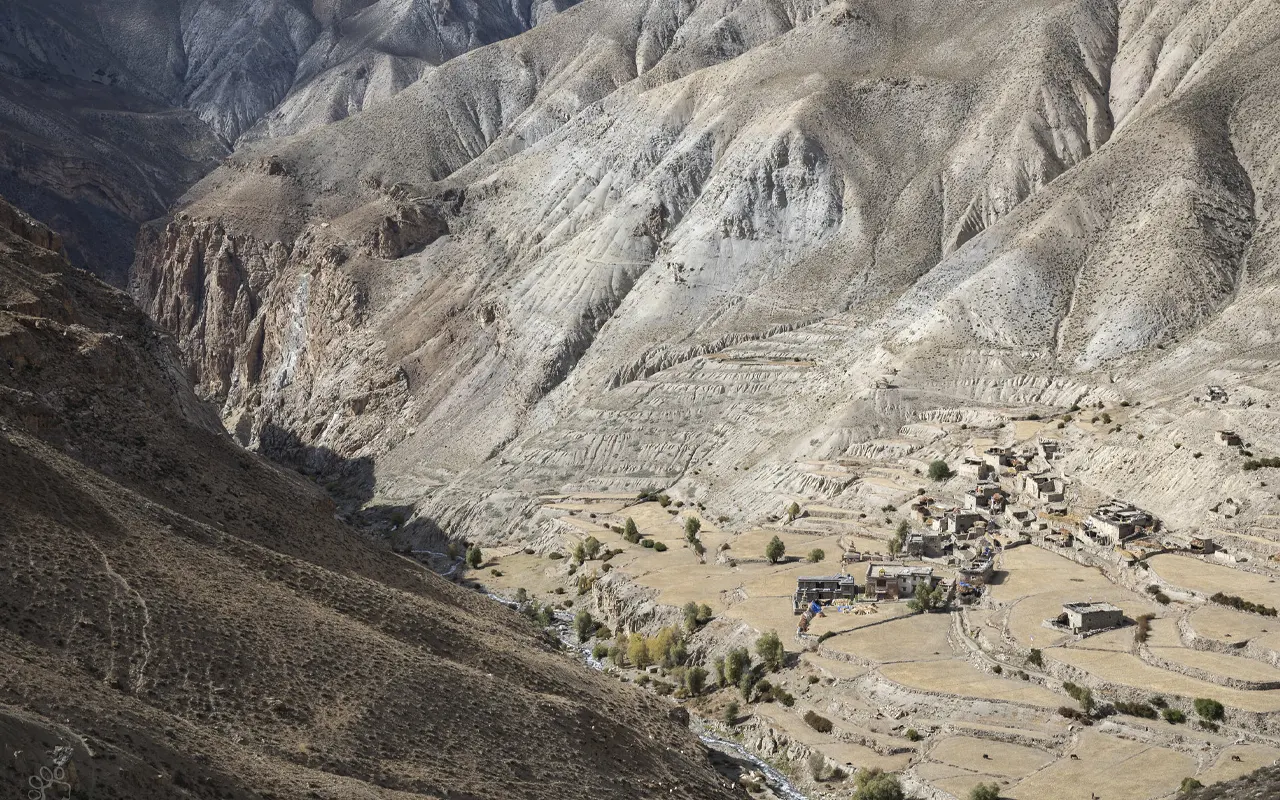
It is a long and difficult day of the trek. The trail ascends steadily above Bhijer. Much caution should be taken when going across these parts. On your way, you can encounter the deserted village of Potal, and then again go down to the Tora Khola. Beyond the river, the path is once again steep, heading towards the distant village of Pho at 4,087 m / 13,408 ft., the village of which is one of the most remote in Nepal, few in number, but still existing.
The mountainous terrain nearby is quite impressive, and the numerous wide valleys and dramatic mountain formations make the mountain trek seem serene, remote, and isolated.
The trail ascends uphill, leaving the village of Pho at 4,087 m / 13,408 ft to the Nyingma Gyachen La Pass at 5,563 m / 18,251.3 ft. The path consists of steep and rocky areas of loose scree. The pass is usually attributed to strong winds, and hence the climb needs to be gradual and careful.
At the summit, one can have splendid views of Kanjiroba Himal that divides the Dolpo region and Mustang. Dhauligiri and Churen Himal may also be seen in the distance on clear days.
Having taken time to have a view of the scenery, slowly start to go down the pass to the campsite at Pung Kharka (4,650 m / 15,255 ft).
This day starts with a slow journey from Pung Kharka to another high Himalayan Pass. The trail runs up the river of Swaksa Khola after breakfast through an uninhabited valley and then over grassy hills.
Little by little, you come to the Yala La Pass (5,250 m 17,224 ft), one of the high points of the Dolpo Rara Trek. Moving up, you can have sweeping views of mountains and valleys around. The trail then walks gradually down into the distant Chyandi Khola valley after spending some time at the pass.
Chyandi Khola campsite is at an altitude of 4,830 m / 15,846 ft. Due to the high altitude you are sleeping at this night, you need to be aware of such symptoms as headache or dizziness and report them to your guide in case of necessity.
This day’s path is also adventurous since no clear path is available in certain areas. You leave Chyandi Khola, take the rugged trail, and go along the river valley. You will have to pass across the river at some stages, in shallow water or with the help of stones. Your guide will seek the most appropriate way across the valley.
The trail goes high above the river and then goes down. Its landscape is rough and distant, having high mountains and silent valleys. Towards the end of the day, you walk through a serene birch forest until you arrive at Takla Khola, where you sleep at an elevation of 3,785 m / 12,417 ft., which is a relief to your body following the strenuous day of trekking.
From Takla Khola, the trail also requires crossing another mountain pass. The road ascends gradually through a barren and rocky terrain to Chyargo La Pass at 5,100 m / 16,732 ft. The Himalaya pass is several hours to climb, but the views you see of the surrounding Himalayan landscape are magnificent. Through the pass, one gets a view of faraway mountains and expansive valleys which extend into the Dolpo region.
Upon completion of the scenery, the trail goes down to a greener valley, and forests start to emerge once more. On the way, you cross several rivers before you come to the meadow land of Thaju Chaur at 4, 050 m / 13, 287 ft. Your stay over is in this serene area between hills.
The trail slowly leads off Thaju Chaur down to greener valleys today. The trail is in forests where you can observe various trees and mountain plants. There are several little streams to cross on the way, occasionally by plain wooden bridges.
The scenery gradually transforms as you proceed to walk further, from a high alpine scenery to a forested valley. The trail finally leads to a major local path followed by people of the village in the areas between Rara Lake and the remote villages of Mugu and Tibet.
A few hours of walking will bring you to Shilen Chaur Kharka (2,945 m / 9,662 ft) in the valley of the Mugu Khola, a calm place for rest.
This day’s walk is along the Mugu Karnali Valley. The trail begins at Shilen Chaur Kharka and descends gradually on well-worn tracks linking villages within the valley. Walking is more convenient and pleasant than it was in former days.
The landscape is composed of forests, rivers, and traditional villages where the locals carry on with their daily farm activities. The lower you go, the lower the altitude and the warmer the air. This will also make the journey more enjoyable, and your body is able to take a rest after a few days at an elevated altitude.
4 or 5 hours of walking will take you to the village of Tiyar at 2,418 m / 7,933 ft, where you will spend the night and have a fine evening.
Leaving Tiyar, today’s journey follows part of the famous Great Himalayan Trail. This is a long trail that runs across the northern mountains of Nepal and links most of the remote parts of the Himalayas. As you are walking through, you will come across trekkers who are trying to complete the journey of trekking through Nepal, which can take them over 150 days.
The road nowadays is a good one, and it goes through small villages, woodland, and open agricultural land. The altitude keeps on reducing, and the climate becomes warmer as you go on walking.
Today we are heading to Mangri village (1,950 m / 6,397 ft). This is where you are approaching the beautiful Rara Lake and one of the most picturesque natural spots in Nepal.
Today is a short and easy trekking day, with only a small altitude change from 1,950 m / 6,397 ft at Mangri to 2,095 m / 6,873 ft at Gamgadi. The path goes through the small villages and working fields where the local communities cultivate crops and bring up the livestock.
The district headquarters of Mugu is Gamgadi, which is the major trading and administrative hub in the area. In comparison with the cities of other regions of Nepal, it is a small and isolated town, even though it is an important one in the district.
There are a few small stores where you can purchase some snacks or other supplies. Once you reach Gamgadi, you can visit the village and rest.
Today, you leave Gamgadi and start the walk to the well-known Rara Lake. The trail goes into Rara National Park, which is the smallest national park in Nepal, yet most beautiful. The path cuts through calm woods with pine and rhododendron trees. The trail has some slight ups and downs before one reaches the lake area.
Rara Lake is at an elevation of 2,980 m / 9,776 ft, and it is nearly 11 square kilometers. The blue water and the forests around provide a spectacular landscape. Once there, you have time to rest, sightsee the lakeshore, take a picture, or have a quiet time appreciating the natural beauty.
You have a leisurely sightseeing day at Rara Lake today. Following breakfast, you hike to Murma viewpoint (3,800 m / 12,467ft), providing one of the best panoramic views of Rara Lake, forests and hills around. In the distance, the deep blue lake shines beautifully against the green landscape. On clear days, you can also see mountain peaks in the distance.
Once you have had enough time exploring the scenery and taking pictures, move down to the Murma village, where you will get an opportunity to see the Chaprun Mahadev Temple.
Later, go back to the lakeside camp to rest and take in the serene atmosphere of Rara National Park.
You leave the gorgeous Rara Lake at 2,980 m / 9,776 ft. after breakfast. You can have one last walk on the banks of the lake before you go or have one more brief boat ride on the smooth water.
The road then runs through woods and low hillocks to Talcha. This walk is a beautiful one, which gives a good view of the surrounding hills and forests of Rara National Park.
Talcha is located at 2,990 m / 9,809 ft and has a tiny airstrip that is used as the airport in the Rara Lake area. You will reach Talcha at lunchtime. It is possible to spend the afternoon resting and arranging the flight the next day back to the cities.
On this day, you 22 days long Dolpo Rara Traverse Trek is finally completed. The morning flight takes off from Talcha airport to Nepalgunj at 150 m / 492 ft. Once in Nepalgunj, you wait until you get your flight to Kathmandu.
It might be possible to have time to relax around the airport and have lunch, depending on the schedule. The second flight will bring you back to Kathmandu at 1,300 m / 4,265 ft, the ending point of the journey.
Upon arrival in the city, you will be taken to your hotel, where you can have a good evening. It is time to rejoice that your trip to the remote Dolpo and Mugu regions has been successfully achieved.


Spring and autumn are the best season of Dolpo Rara Traverse Trek. April to May and mid-September to the end of October are the most favorable times for the trail and mountain scenery.
Dolpo is a rain shadow area and thus receives less monsoon rain compared to most of Nepal, but Rara during the monsoon is not the best. Days tend to be sunny and clear, but nights may be cold, particularly those at high camps above 3,000 m / 9,843 ft.
The Dolpo Rara Trek is unpredictable, and therefore, warm clothes, a rainproof jacket, windproof light snow jacket should be carried.
Food in the Dolpo Rara Trek is basic, fresh, and nourishing. On the camping trek, Himalayan Pathways offers breakfast, lunch, afternoon snacks, and dinner. The food eaten commonly consists of porridge, bread, pasta, noodles, dal bhat, pizza, potatoes, and popcorn. Vegetarian meals are always available, and canned meat or tuna may also be carried.
Lunch is taken in the trail, and breakfast and dinner are at camp. There is tea, coffee, hot water, sugar, and powdered milk.
Drinking water is given out in boiled form on a daily basis. Alcohol and soft drinks are discouraged on the Dolpo Rara Traverse Trek, especially when sleeping above 3,000 m / 9,843 ft.
The issue of altitude sickness is part of the Dolpo Rara Traverse Trek since you will be staying several days and nights in the highlands. Much of the trail is above 3,000 m / 9,843 ft, and a few of the passes are above 5,000 m / 16,404 ft. Even experienced trekkers can get altitude sickness, but prior high-altitude trekking experience is very helpful.
The symptoms can be headache, dizziness, nausea, fatigue, and anorexia. The guides from Himalayan Pathways instruct you to walk at a slow pace, consume lots of water, intake food correctly, and inform your guide as soon as you feel unwell. In the Dolpo Rara Trek, one has to be properly acclimatized and paced to enjoy and be safe.
Dolpo Rara Trek is a strenuous camping trek that is not meant to be taken by a beginner, but by an experienced trekker. There will be days when you are walking about 6-7 hours, regularly on rugged trails, river crossings, steep scree slopes, and mountain passes.
The trekkers should be trained by hiking regularly, cardio training, leg strength exercises, walking with a daypack, and long walks. Experience of high-altitude trekking is highly recommended, particularly when sleeping above 3,000 m / 9,843 ft.
You also need to prepare in case of basic camping conditions and travelling remotely. In the case of the Dolpo Rara Traverse Trek, physical fitness is not the only thing that holds importance, since the trek is not only long but also wild and at times difficult. You will have to be mentally strong, too.
For the Dolpo Rara Traverse Trek, a Nepal visa is required, and so are trekking permits. A majority of the travellers can obtain a visa on arrival in Nepal by filling in the online form before travelling, or at the Tribhuvan International Airport, and carrying passport photographs and the amount to be paid in USD cash.
As far as the trek is concerned, there are permits such as the Upper Dolpo Restricted Area Permit, Lower Dolpo Restricted Area Permit, Shey Phoksundo National Park Permit, and Rara National Park Permit. The need for these is due to the fact that the path is enclosed by safeguarded and closed territories.
These permits are organised by Himalayan Pathways for the trekkers. The Dolpo Rara Trek would need at least two trekkers to obtain the permit, and as such, solo travelers should discuss arrangements in advance.
The Dolpo Rara Trek is very remote, high, and physically demanding, making it very important with regard to health and safety. Himalayan Pathways offers professional guides who are educated in first aid and are aware of the symptoms of altitude sickness.
You need to bring your personal medication, personal first-aid, blister care, and any tablets that you might be required to take in case of headaches or stomach issues. Consume at least 4 liters of water every day, eat, and do not disregard even the mild symptoms.
Use trekking poles on rough terrain and wear the clothes for the weather with the appropriate layers. During the Dolpo Rara Traverse Trek, never walk alone in any locations, as it is not very easy to navigate those areas without a guide.
A trip on the Dolpo Rara Traverse Trek incorporates 4 domestic flights and a lengthy trek between two remote areas. The trip begins with a Kathmandu to Nepalgunj flight, then another flight to the Dolpo side of the route.
After trekking to Talcha near Rara Lake, you take a flight out of the Rara region. A few short flights and a trek will take you closer to Rara and unite the two parts of the territory in a single lengthy journey.
These domestic flights are included in the trip cost of Himalayan Pathways. Sometimes, weather causes delays in flights, particularly around Talcha (2,990 m / 9,809 ft), and additional traveling days will be prudent.
Travel insurance is necessary to go to the Dolpo Rara Trek since it is a remote, high-altitude camping trip that is remote. The insurance should cover trekking in high altitudes, receiving emergency treatment, flight cancellations, and helicopter evacuation where necessary.
The route passes remote mountainous regions, so there are nights above 3,000 m / 9,843 ft; there should be a clear mention of altitude coverage in the insurance.
Himalayan Pathways highly recommends that you thoroughly look into the specifics before you travel, since not all insurance policies will cover remote trekking in Nepal.
You should also remember to have a printed and an electronic copy of your insurance documents. In the case of the Dolpo Rara Traverse Trek, appropriate insurance is one of the essential items in the trip preparation.
One can have some alternate options for enjoying some aspects of the Dolpo Rara Traverse Trek in case there is not enough time to complete the entire trail. Some visit just Phoksundo Lake (3,612 m / 11,850 ft) and Shey Phoksundo National Park. Some travelers visit only Rara Lake at 2,980 m / 9,776 ft, which can be reached by a flight followed by an easier trek, while Dolpo is more remote and challenging.
The other alternative to the trek is to continue the journey to Bardia National Park, which is close to Nepalgunj. The Dolpo Rara Trek can be designed to suit your time, fitness, and trekking experience with the help of Himalayan Pathways.
The Dolpo Rara Traverse Trek is an extensive trip that already includes transport, camping facilities, trail food, permits, a guide, and porters. Nevertheless, you are advised to bring some spare money in Nepali rupees for personal expenses.
You might wish to give donations in monasteries on the Dolpo Rara Trek, with some additional donations made on lighting butter-lamps. It might have some opportunities to purchase snacks or beverages, particularly around Nepalgunj.
Himalayan Pathways also recommends setting aside some money for tips to guides, cooks, and porters, as well as your visa, insurance, trekking equipment, and personal shopping.
In the Dolpo Rara Trek, communication is not complex yet meaningful. The Nepali language is commonly spoken, and in Dolpo and Mugu, you can also find local languages that are influenced by Tibetan.
Most individuals in the remote villages are not very fluent in English, and therefore having a guide is significant to assist them with communication. The Himalayan Pathways offers the services of guides who are able to describe local culture, everyday life, and the trail details in an understandable manner.
It is possible to learn some basic Nepali greetings in order to enjoy the journey and behave in a respectful way. A warm gesture, patience, and a smile are all you can do on the Dolpo Rara Traverse Trek when encountering local folks in these far-side mountain villages.
Dolpo Rara Traverse Trek has very limited internet and mobile network. It is a distant camping trek in the high mountain terrain, forests, and remote valleys; you cannot expect to have regular phone connectivity, and the internet to be consistent.
There might be no network for several days in many places on the Dolpo Rara Trek. The charging of gadgets is also restricted since you will be camping nearly all the nights. Himalayan Pathways suggests carrying a portable solar panel and a power bank, a headtorch, and spare batteries.
It is best to understand that this trek offers more nature and peaceful silence than internet connectivity.
Dolpo Rara Trek is a serious high camping experience, and thus, there are a few things you should not do.
Do not walk without informing your guide or walk away from the camp. Assess the symptoms of altitude sickness and do not overlook them, even when they are mild. Alcohol should not be consumed in high altitudes or above the sleeping level of more than 3,000 m / 9,843 ft. Never miss meals or consume less water, as they both may influence your strength and health.
During the Dolpo Rara Traverse Trek, do not bring extra weight and do not disrespect the local traditions of monasteries or villages. Himalayan Pathways promotes responsible, careful, and respectful travelling during the trek.
No, the Dolpo Rara Traverse Trek is not an easy one. It is a protracted and difficult camping trek, lasting over three weeks and going through extremely isolated mountains. You are going to walk 6 to 7 hours a day, cross rivers, go over high passes, and spend many nights at altitudes above 3,000 m / 9,843 ft.
For this reason, Himalayan Pathways recommends this trek for travelers with strong fitness and previous high-altitude trekking experience.
The trek is quite pleasant when you are well aware of how your body would respond to long days of trekking, cold weather, simple camping, and the thin air at altitude.
The Dolpo Rara Trek can be completed as another terrific traveling experience in the west of Nepal. Himalayan Pathways suggests visiting the Bardia National Park, approximately 80km/50miles away from Nepalgunj and a two-hour drive by a private vehicle.
Bardia gives a totally different scenery after weeks spent in the high mountains with warm lowland forests, grasslands, and wildlife safari. It is an excellent location for searching for Royal Bengal Tigers, Wild elephants, and various bird species.
A large number of tourists stay 3 days and 4 nights there. Other treks or tours are also available in Nepal, Bhutan, or Tibet, should you want to visit after the Dolpo Rara Traverse Trek.
Dolpo Rara Traverse Trek is a great place to take some good photographs. You can start at Phoksundo Lake at 3,612 m / 11,850 ft and then go down to the forests and shores of Rara Lake at 2,980 m / 9,776 ft.
Pack extra batteries and a power source, as you will not have many opportunities to charge your batteries on this camping trek.
In villages, monasteries, and near local people, always be considerate when taking photos. Before taking close-up portraits, it is always polite to ask.
In the case of drones, there are strict regulations in protected zones, as well as in national parks, and it is better to verify the permission in advance. Himalayan Pathways could help you with the local and practical advice on the Dolpo Rara Trek, especially parts that are restricted and in national parks.
The Dolpo Rara Trek goes through the regions of profound Buddhist culture, old monasteries, and solid local traditions. The full moon of July or August is one of the special cultural times when pilgrims go to the Crystal Mountain near Shey Gompa. This sacred mountain holds significance to a large number of Buddhists, and individuals visit it to walk around as a part of their religious activity.
The monastery of Dolpo, where Shey Gompa is located, is one of the most respected ones. Mani walls, chortens, prayer flags, and traditional village life are seen along the Dolpo Rara Traverse Trek due to Tibetan Buddhist influences.
Himalayan Pathways promotes good treatment of every religious place of worship and in the local events.
The Dolpo Rara Traverse Trek requires proper planning and expectation of the first-time visitors. It will be a long camping trek, and it is important to pack light and make your gear practical. Warm clothes, a waterproof layer, a four-season sleeping bag, personal medication, snacks, and a water treatment system are important.
Nepali rupees should be carried along for small gifts and personal purchases. Reach Kathmandu early enough to pack the final stuff and have some rest before the trek.
Flights during the Dolpo Rara Trek can sometimes be delayed due to weather conditions. Above all, take your time on a walk, listen to your guide, and enjoy.

Dolpo Rara Traverse Trek is one of the least traveled and most remote destinations in Nepal. It cuts across remote valleys, rural towns, and forests with minimal facilities.
The highest point is the Nyingma Gyachen La Pass, which is at 5,563 m/18, 251 ft. This is a part of the route that is most difficult.
The trail traverses four high passes, namely, Kang La, Nyingma Gyachen La, Yala La, and Chyargo La.
This is mainly a camping trek. Most of the nights, trekkers use tents set by the support crew.
Trekkers walk approximately 6 to 7 hours a day. There are short days, and others are long and demanding.
Yes. The acclimatization day is provided at Phoksundo Lake (3,612 m / 11,850 ft) to enable the trekkers to acclimatize to the altitude.
The trail passes villages like Ringmo, Bhijer, Pho, Tiyar, Mangri, and Gamgadi.
Snow leopards, blue sheep, Himalayan black bears, and numerous species of birds are found in the area.
There are rocky trails, river crossings, forests, alpine meadows, and dry mountain valleys during the trek.
The monastery that is most sacred in Dolpo is Shey Gompa. It is related closely related to the spirituality of Crystal Mountain.
Yes. Rara Lake, located at 2,980 m / 9,776 ft, is a place where it is possible to boat in peace and enjoy the landscape around.
The Rara Lake is the biggest in Nepal. It occupies a space of approximately 11 square kilometers.
Shey Phoksundo is the largest national park in Nepal, which occupies approximately 3,555 square kilometers.
Yes. The trail has several permit checkpoints, particularly in restricted and protected regions.
Dolpo Rara Traverse Trek is a link between Dolpo and Rara in a single trip. It provides distant wilderness, holy places, and a much smaller number of trekkers compared to the mainstream trails.

