How Difficult Is the Everest View Trek?
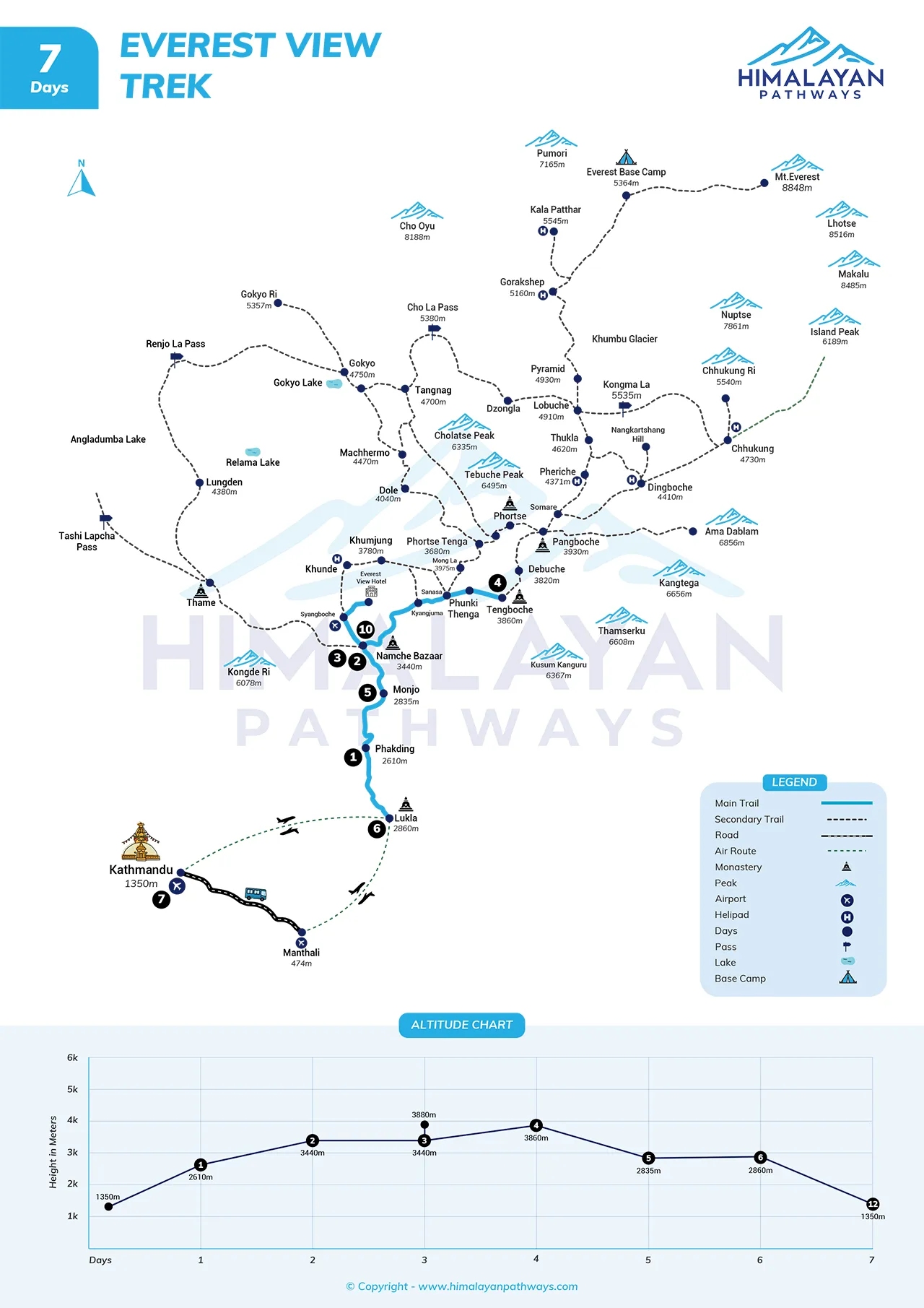
Everest View Trek is rated as easy to moderate and can be done by people who have basic fitness. It is far shorter and not as challenging as the longer Everest trails. The peak altitude is approximately 3,880 m / 12,730 ft at the Everest View Hotel, which maintains the threat of severe altitude sickness at a fairly low rate. The walking hours will be around 4-6 hours a day on well-kept trails where no technical climbing will be needed.
The primary physical difficulties include the uphill hike to Namche Bazaar at 3,440 m / 11,286 ft and the consistent uphill hike to approximately 3,860 m / 12,664 ft toward Tengboche. These passages might seem exhausting, yet a slow pace can enable them to be handled.
Numerous beginner trekkers, families and older tourists complete this trek successfully. Everest View Trek is doable, and most healthy travellers can walk in nature as long as they are properly acclimatised, hydrated and in the right state of mind.
Weather and Best Season
The Everest View Trek would be much easier with the selection of the right season. Spring (March to May) and autumn (September to November) are the best. The weather in the months is usually predictable, it is sunny, and the temperature is pleasant. The hills are covered with rhododendrons in spring, and the daytime weather in and around Namche Bazaar (3,440 m / 11,286 ft) is pleasant. Autumn is the season when the air is so crisp, and mountain is seen so well, particularly in October.
The monsoon season or summer (June to August) is not a very good time because of the rain, clouds, and the trails are slippery. Lukla flights are also subject to delays.
The winters (December- February) are not cold and provide good visibility; however, evenings in locations such as Tengboche (3,860 m / 12,664 ft) are freezing.
To the largest extent, spring and autumn offer the most comfortable, scenic, and trekking conditions to the majority of travellers.
Food & Drink on the Trek
Foods during the Everest View Trek are basic, satisfying, and nutritious. The trail has teahouses that provide both Nepali and simple international food. One of the popular dishes is dal bhat, which consists of rice, lentil soup, as well as vegetables and is a good source of energy. Noodles, fried rice, soups, potatoes, pasta, momos, and eggs are also widely eaten foods.
In bigger villages such as Namche Bazaar, with 3,440 m / 11,286 ft, menus are more diverse, with baked goods or even pizza.
Hot beverages like black tea, milk tea, ginger lemon honey tea and coffee are common. It is important to remain hydrated at high altitude. Drink treated or boiled water, which can be acquired in lodges. It is not difficult to find vegetarian food, and the majority of trekkers are delighted by the variety and the warmth of the food eaten in these mountain teahouses.
Altitude Sickness and Suggestions
The Everest View Trek does not go to extreme altitudes; however, altitude sickness can take place. It rises to a maximum of about 3,880 m 12,730 ft to the Everest View Hotel. Common mild effects are a headache, sleeplessness, and anorexia. Rest and hydration can normally deal with these.
The itinerary has an acclimatisation day to help your body adapt. The main prevention measures include walking slowly, taking a lot of water, eating properly and not drinking alcohol. Trekkers are also checked by guides on their condition and oxygen level.
In case the symptoms become more severe, the best solution is to go to a lower altitude. Acute altitude sickness is not common in this trek, particularly in cases where the trekkers adhere to instructions and pay attention to their bodies. Having a reasonable pace and awareness, the majority of people have managed to finish the trek in a comfortable and harmless manner.
Preparation and Fitness
The Everest View Trek is better when well prepared. No high-level trekking experience is required; however, it is in your favour to be in good physical condition. The types of physical exercises, such as walking, hiking, cycling, or climbing stairs,before the trip will result in improved stamina. You must be comfortable taking 5-6 hours of walks with a break.
It is also necessary to prepare mentally. Basic accommodation at higher villages, such as Tengboche at 3,860 m / 12,664 ft., makes the experience better and more accommodating but basic.
The right equipment is a must, like broken-in hiking shoes, thermal layers, a warm coat, a raincoat, and a small rucksack. You also need sunscreens and sunglasses because of the high UV rays of the sun at the altitude.
Visa and Permits
A Nepal tourist visa is required by most travellers, and it can be readily acquired upon arrival at Kathmandu airport. The Everest View Trek will take only 7 days, so you can get a 15-day visa, and one has to have a passport with at least six months’validity.
There are two permits needed to trek in the Everest region. To enter the protected area around Monjo, the Sagarmatha National Park Entry Permit is required to assist in conservational work. Khambu Pasang Lhamu Rural Municipality Permit is a local entry permit that is paid in Lukla or Monjo. Such permits are inspected at various spots on the trail.
All permit arrangements are done by Himalayan Pathways on your behalf so that you don’t have to stress about the documentation before the trek.
It is also advisable to carry a copy of your passport, visa and insurance in order to have a hassle-free trip.
Health & Safety
Everest View Trek is not very dangerous as long as you take some basic precautions. Walk slowly, drink a lot of water (either boiled or purified) and keep your hands clean. Always monitor the signs and symptoms and report them to your guide.
On rocky trails, be careful during the downward slopes and on wet roads. When encountering yaks and mules during the trek, always stand on the uphill side and give them room to pass by.
The robbery is not typical during the trek, though it is better to have your passport, cash, and phone in a safe place. Guides of Himalayan Pathways carry first aid and are knowledgeable about what to do in case of an emergency.
Transportation
During the Everest View Trek, the means of transportation will be domestic flights, and in the peak season, a drive to Manthali. A majority of the trekkers fly to Lukla, which is 2,840 m / 9,317 ft. During the peak seasons, flights may depart Manthali (Ramechhap), which is a 4–5-hour drive from Kathmandu. Direct flights can be made between Kathmandu during the off-season.
The flight is picturesque and may get delayed due to weather, and therefore, flexibility is essential. The total baggage is normally about 15 kg allowed by airlines; hence, light packing is beneficial. Once you get to Lukla, there are no roads, and it is on foot. The trek is followed by the same flight route, either direct to Kathmandu or to Manthali and a drive back to Kathmandu. The logistics of the Himalayan Pathways ensure that you do not have to worry about the transportation aspect of the Everest View Trek, so that you can enjoy the trek to the fullest.
Travel Insurance
Travel insurance is necessary in the Everest View Trek, as you are on a trek in a remote region of the mountains. Although this is a shorter route and may be as far as approximately 3,880 m / 12,730 ft, any unexpected issues still occur, like developing altitude sickness, injury, or delayed flights.
Your insurance policy should include trekking to at least 4,000 m/ 13,123 ft and emergency helicopter evacuation, which is very costly without insurance. It must also cover the medical care in Kathmandu andtrip interruptions or cancellations coverage.
Always have the details of the insurance with you on the journey, including the emergency telephone number and the policy number.
Getting the right insurance allows you to walk without the fear of being because you have the cover. This insurance policy renders the Everest View Trek much less problematic in terms of finances.
Alternative Routes
If you would like to have more adventure during your trek, there are some excellent options in the area. The most well-known one is the Everest Base Camp trek, which extends to Tengboche and further over to the Everest Base Camp at 5,364 m / 17,598 ft, and many trekkers also hike to Kala Patthar at 5,545 m / 18,192 ft to see the sunrise.
The other more popular destination is the Gokyo valley trek, where you visit the turquoise lakes and hike the Gokyo Ri at 5,357 m / 17,575 ft to get panoramic views of the Himalayas.
The Three Passes trek is more challenging as a loop trip over high passes such as Cho La at 5,420 m / 17,782 ft, and is more difficult than the Everest base camp trek.
If you have less time, you can also make a shorter journey to Namche Bazaar at 3,440 m / 11,286 ft and come back. Everest View Trek is the first trek that many of them undergo, and later return to do a longer route.
Your Extra Expenses
You will have a personal spending budget even with a package during the Everest View Trek. Some of the additional expenses are your Nepal visa fee, travel insurance and Kathmandu hotel and meals. Drink, snack, hot shower, Wi-Fi, and charging electronics can be charged along the trail. You may be enticed by cafes and bakeries in such villages as Namche Bazaar at 3,440 m / 11,268 ft, for which you will have to pay for it on your own.
The higher you go, the higher the price is, as everything is carried in by the mules or porters.
At the end of the trek, you can tip your guide and porter depending on how satisfied you are with their service. It is not mandatory but expected.
You may have an emergency buffer of flight delays at Lukla at 2,840 m / 9,317 ft, which may create additional nights and meals, which you will have to pay for on your own.
Budgeting these extras in advance will ensure that you relax and have an enjoyable time on the Everest View Trek.
Language & Communication
Communication at the Everest View Trek is most of the time not problematic due to the high usage of English in trekking regions. Most of the guides, teahouse staff and shopkeepers can speak basic English, particularly in such locations as Lukla at 2,840 m / 9,317 ft and Namche Bazaar at 3,440 m / 11,286 ft.
Nevertheless, it is pleasant to know some Nepali words so that the communication becomes friendlier. Namaste is a pleasant greeting, and Dhanyabad is thank you. In Sherpa villages, the people can talk Sherpa language, but most people are conversant in Nepali and some English because of tourism.
Mobile signal is available at certain locations; however, it may be weak or lost between villages. Wi-Fi is usually on teahouses at a charge, although it can be slow. It is better to inform the family that you may be offline sometimes. Respect towards local people and culture, patience and a smile will go a long way in the Everest View Trek.
Mobile Network, Internet and Charging Facilities
Connection in the Everest View Trek is feasible, although it isunreliableat places. The mobile signals are good at Namche Bazaar at 3,440 m / 11,286 ft, with Nepal Telecom andNcell.
In other places beyond Namche, the reception tends to be weak or completelynonexistent, so there will be extensive times of no coverage. Most of the teahouses have Wi-Fi, which is paid, slow, and occasionally weather-dependent.
You can charge your electronic devices in lodgesin the dining room for a minimal fee. Cold temperatures consume batteries more quickly, so warm up the phones and battery of cameras at night. A power bank comes in handy, in particular once you leave Namche.
Don’ts on This Trip
In order to get the full experience of the Everest View Trek respectfully and safely, it is important to keep a few things in mind that should be avoided. Never disregard altitude symptoms.If you don’t feel well, inform your guide and have a rest.
Littering is not allowed, so bring wrappers, batteries and plastic with you back to the correct disposal locations. Do not walk alone or short cut, particularly during fog or bad weather. Do not block trails or bridges as yaks and mules come, just step to the uphill side and allow them to pass then.
Do not disrespect local culture: take your shoes off in monasteries, go counterclockwise around Mani walls, and do not behave loudly during prayerful occasions.
Avoid giving candy and money to the children, because they would learn to demand them. Nor is it advisable to drink alcohol when trekking, as it enhances dehydration.
These are just a few rules that can be followed to ensure that the Everest View Trek remains safe, clean, and meaningful.
Trip Extension
Nepal has numerous extensions to the Everest View Trek that are very rewarding. One of them is a jungle safari in Chitwan National Park to view wildlife and experience the culture. Another popular one is the visit to Pokhara, a relaxing lakeside city where one can view the Annapurna range and get an opportunity to go on a short hike or participate in adventure sports.
And then, in case you are not tired of mountains, you may add additional trekking days in the Everest area. Other trekkers go as far as Everest Base Camp, 5,364 m / 17,598 ft, or follow the Gokyo route with Gokyo Ri, 5,357 m / 17,575 ft, to the panoramic views of the whole Himalaya.
Extensions can also be shorter, like an additional day at Namche Bazaar 3,440 m / 11,286 ft or visiting the nearby Sherpa villages as a cultural and sightseeing excursion.
Himalayan Pathways will provide such add-ons without inconvenience, which will be based on your time, budget, and comfort level upon the completion of the Everest View Trek.
Photography & Drone Rules
The Everest View Trek is very photogenic, yet one should not take photos irresponsibly. Never take photographs of local people unless they give their consent, particularly monks, elders and prayer participants.
There are photography rules for monasteries. There are many places where flash photography is forbidden, and some places do not permit photos at all.
In the case of landscape, early morning and late evening are normally the most favourable times to capture an image. Your phone and camera will run out of charge in the cold; therefore, carry an extra battery and keep it warm.
The use of drones in the Everest area is strictly regulated, and there is no permission to fly them within the confined zones in the area without special authorisation by various authorities. Any unauthorised drone flying may result in fines or seizures. The majority of the trekkers are encouraged to leave drones back at home and concentrate on ground photography.
Being polite and planning smartly, you will be able to make beautiful memories of the Everest View Trek without interfering with people and nature.
Cultural Festivals on the Trail
Provided you are lucky enough, the Everest View Trek can coincide with local Sherpa festivals that make villages alive. The best-known one is Mani Rimdu, which is celebrated at Tengboche Monastery at 3,860 m / 12,664 ft, typically in the fall. Monks dance in masks, sing ceremonies and perform blessings in this festival that are very attractive to many locals in the region.
One more significant festival is Dumji, which is usually celebrated in late spring or early summer in such villages as Namche Bazaar at 3,440 m / 11,286 ft and other neighbouring communities. You can witness the traditional dances, family meetings and communal feasts.
Losar (Tibetan New Year) takes place during winter when rituals are done at home, and prayers are made in monasteries, andthe trail is not as crowded at that time.
Attending any festival, you must dress in a modest way, be quiet during the ceremony and pay attention to your guide. Observing these scenes will make the Everest View Trek rich in cultural value and can make you get a glimpse of Sherpa customs, more than the mountain scenery.
Tips for First-Time Nepal Visitors
Nepal is friendly and easy to experience with some preparation for first-time visitors. The majority of tourists obtain a visa at Kathmandu; hence have the necessary money and make sure that their passport is not expired.
Change the money into Nepali rupees and bring small notes, particularly in the trekking regions where the cards are hardly accepted. Traffic in Kathmandu may seem hectic, and therefore, be careful in the crowded places.
Consume bottled or treated water only and use hand sanitiser regularly. Get yourself a local SIM, it will work best in towns and areas such as Namche Bazaar at 3,440 m / 11,286 ft.
Pack a universal adapter to charge.
Know some decent words, such as Namaste and dhanyabad, and never forget to take off your shoes in temples and monasteries.
In markets, it is usual to bargain to some extent, but with a smile on your face.
By following these easy tricks, you will be at home in a short period and have a better time on the Everest View Trek right after you set foot there.
 Unbeatable Holiday Offers - Save Up to 20% on Your Next Adventure!