Duration
11 Days


 Unbeatable Holiday Offers - Save Up to 20% on Your Next Adventure!

Duration
11 Days
Trip Difficulty
Easy
Max. Altitude
5106 Metres
Group Size
2-16 People
Best Season
Mar-May, Sep-Nov
Transportation
Jeep
Accommodation
Teahouse, Hotel, Lodge
Meals
Breakfast, Lunch & Dinner
The Langtang Ganja La Pass trek is an exciting and adventurous journey in the Langtang region of Nepal that offers a mix of scenic mountain ranges, traditional villages, serene monasteries, and a challenging high mountain passage. It suits best those trekkers who prefer not to follow a crowded path with beautiful Himalaya scenery, and enjoy the true wilderness.
The trek normally starts with a road trip from Kathmandu to Syabrubesi. From there, the path goes along the Langtang River into rhododendron and bamboo woods. You walk on through small Tamang villages and slowly increase in altitude. Kyanjin Gompa at 3,870 m / 12,697 ft. is one of the attractions before crossing the pass. The village has beautiful views of Langtang Lirung and other snow-capped mountains. Trekkers also use the place to acclimatize and then move higher.
The trek to Langtang Ganja La Pass is difficult yet rewarding, with the crossing of Ganja La Pass, which is at a height of 5,106 m / 16,752 ft. The climb to the top is steep and physically demanding, yet the mountain views are worth the challenge. After the pass, the trail leads to the beautiful Helambu region, forest, meadow, and cultural villages.
On the trail, trekkers enjoy the diversity of nature and culture. You pass by glaciers, over suspension bridges, and traditional stone houses covered with prayer flags. The calmness of the mountain nature will enable you to forget about the hectic life in the city and immerse yourself in the Himalayan beauty. Langtang National Park also has wildlife, including Himalayan tahr, colorful birds, etc that may be occasionally found within the park.
Langtang Ganja La Pass is ideal for trekkers who are physically fit and ready to walk through the high altitudes and take long walks. Through appropriate acclimatization and instructions, the trek turns into a healthy and satisfying one.
The Langtang Ganja La Pass is unique due to the combination of the distant routes, the dramatic views, and the cultural experience. Under the guidance of experienced guides, proper planning, and local support, Himalayan Pathways will provide a safe, well-organized, and rewarding experience for you.

On this day of the Langtang Ganja La Pass trek, we drive out of the Kathmandu Valley and reach the trailhead village of Syabrubasi. The ride is long and goes along curvy mountain roads for approximately 7-8 hours. You follow the ridges north of the Trishuli River, through the town of Dhunche (1,960m).
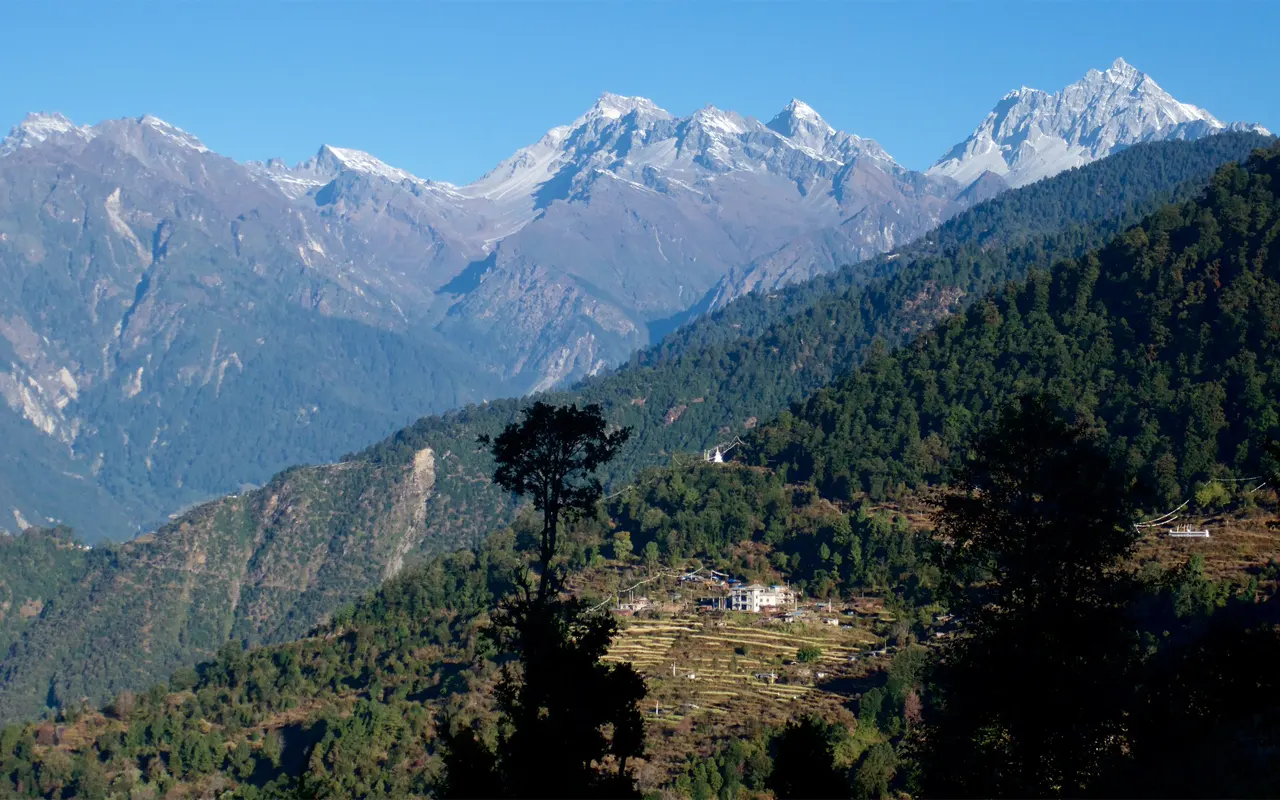
On a sunny day, you can see the faraway mountains of the Annapurna and Manaslu ranges to the west and Ganesh Himal and Langtang Himal by the side of the road. The road is up and down in terraced hills and mixed forests.
In the afternoon, you arrive at the village of Syabrubesi. You check into a local teahouse lodge. Tonight, the guide briefs you about the trek plan and examines your equipment.
Be sure to have rest. The hustle and bustle of Kathmandu becomes distant, and the mountain air puts you in trek mode.


The trek continues up the Langtang Khola from Syabrubesi on this trek. At the beginning, there is a suspension bridge that traverses a raging river, the Bhote Koshi. The road then ascends gradually into a mixed oak and rhododendron woods. You pass through little Tamang villages and bamboo groves.
During the spring, there are red rhododendron flowers that cover the hillside. Watch out also for the playful gray langur monkeys that skip about the trees, and the busy bee hives on top of the rock faces.
You arrive after some 6 hours in the village of Lama Hotel (2,470m), so called because of an ancient teahouse here once. It is a popular starting point for treks on Langtang region. It is here that you will find comfortable teahouse lodges where you can have warm meals and hot local teas.
The afternoon is free to rest. The easy walk up the hill today serves to acclimatize to a higher elevation. You will spend the night in the friendly Lama Hotel lodge, where you will get a good sleep to the wind in the mountains.
Breaking off the track near Lama Hotel, this day’s trek ascends steeper and steeper over ancient rhododendron and bamboo groves. During the trek, you cross Ghoda Tabela, an alpine pasture where pack horses are resting, and proceed to more dense woods.
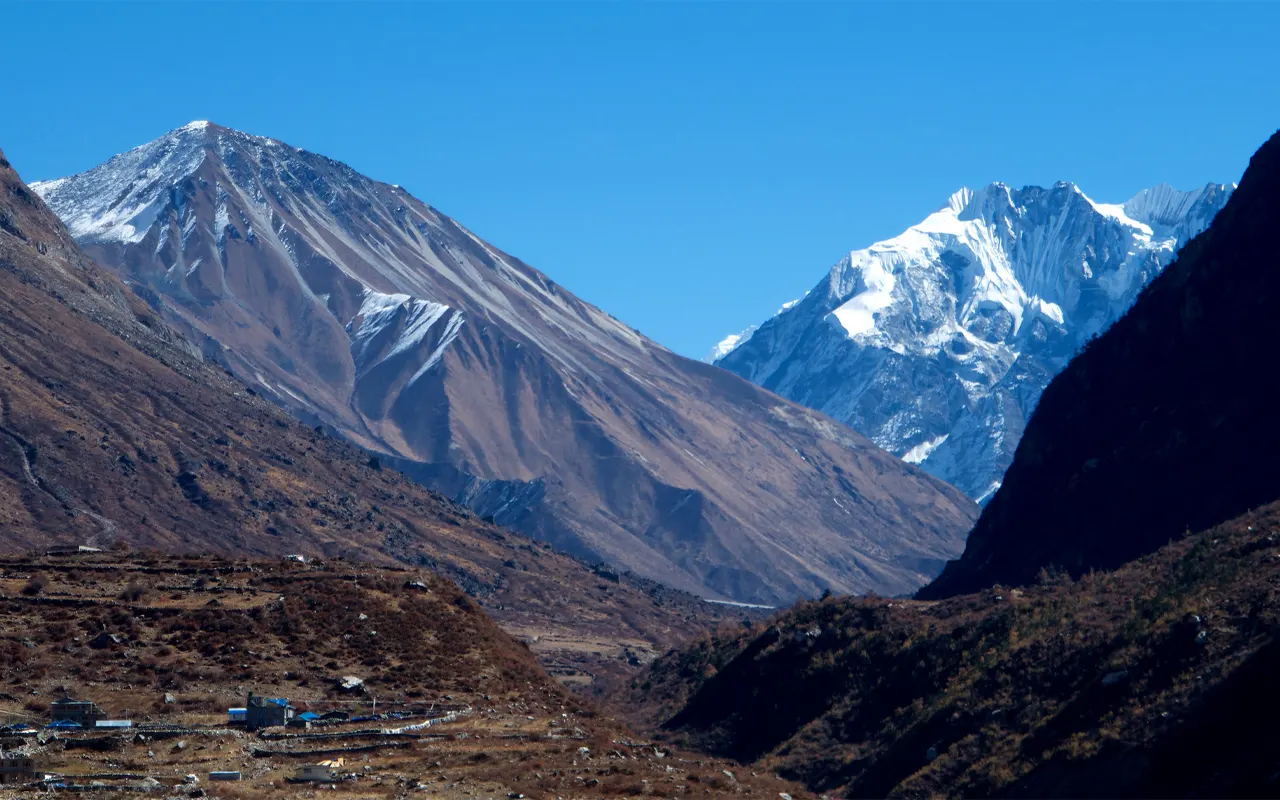
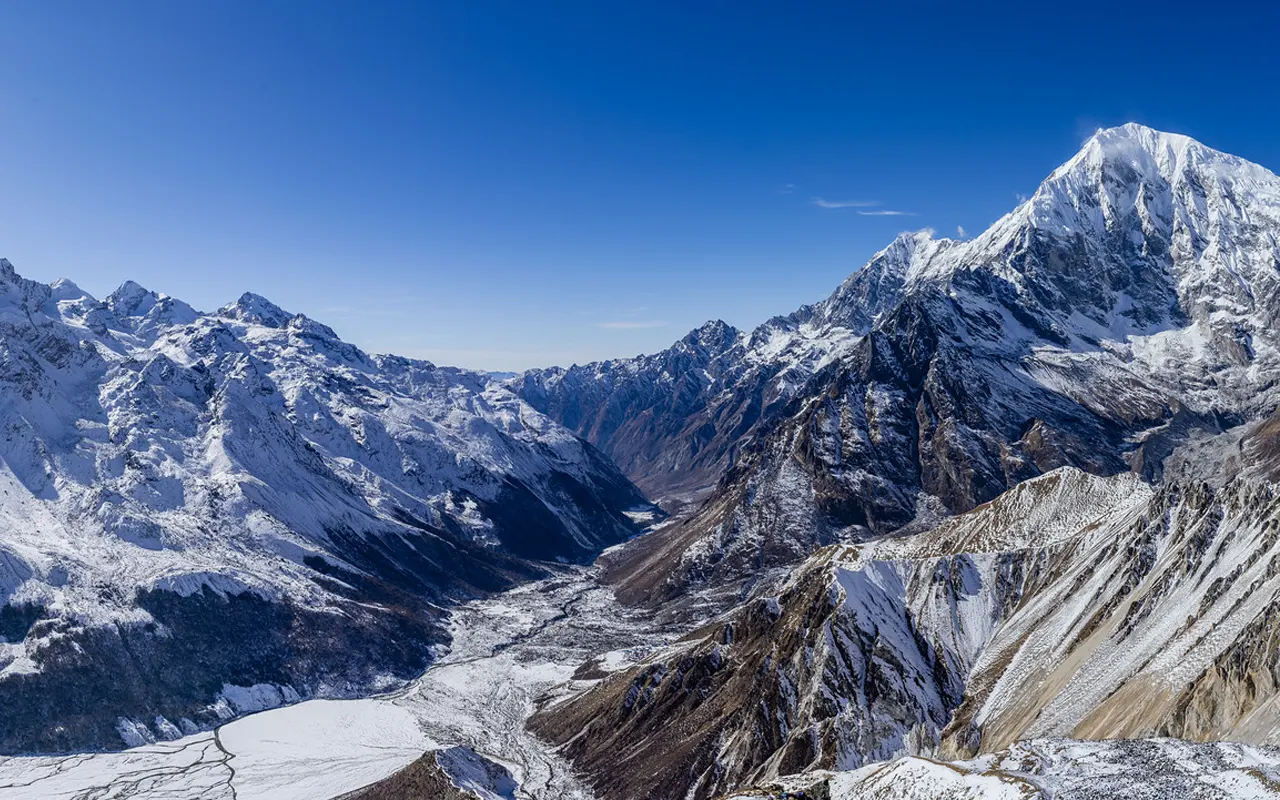
Through pines steadily goes the trek, the valley turning into alpine terrain. The striking walls of Langtang Lirung (7,227m) are now visible, and they dominate the skyline in front.
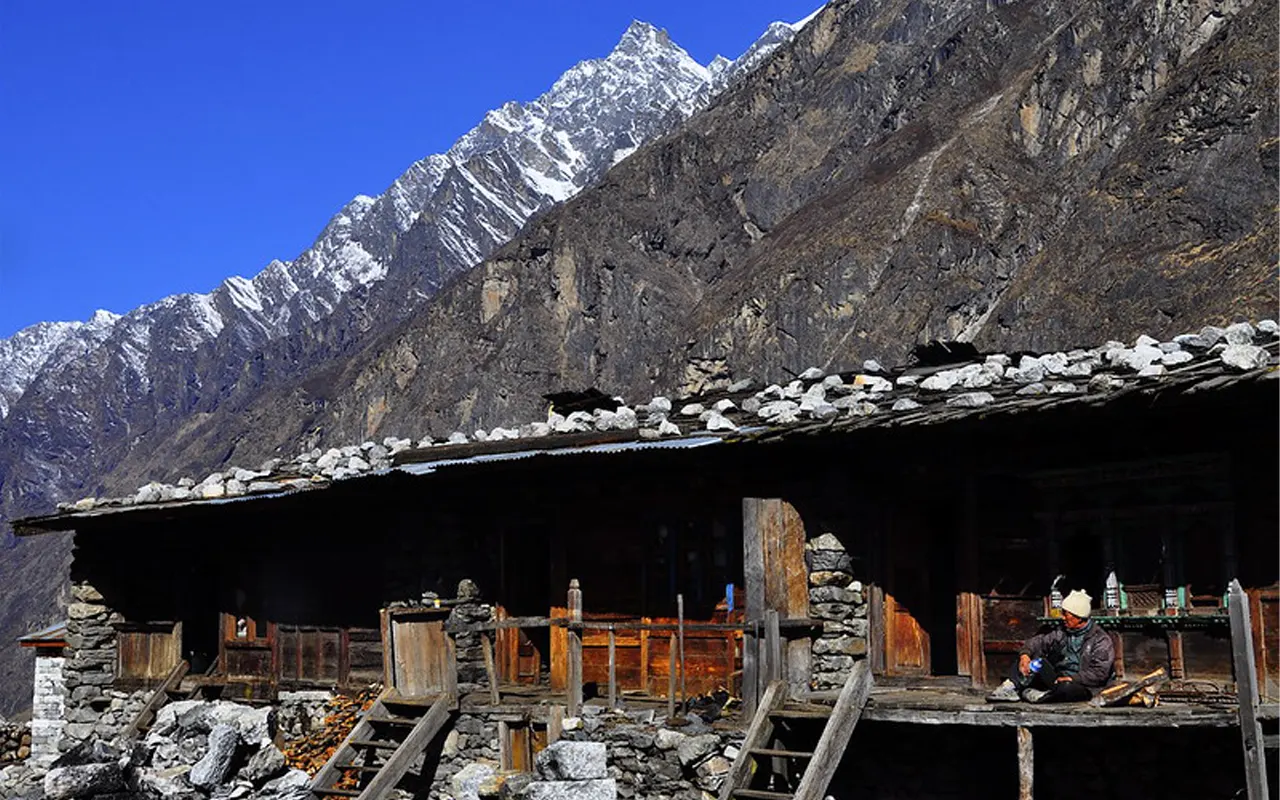
As you pass, you will observe colorful Tibetan prayer wheels, neatly placed mani stones, and chortens (stupas), which would remind you of Buddhism in the area. The villages have small streams serving rustic watermills. The road is clear, but it may get slippery after rain.
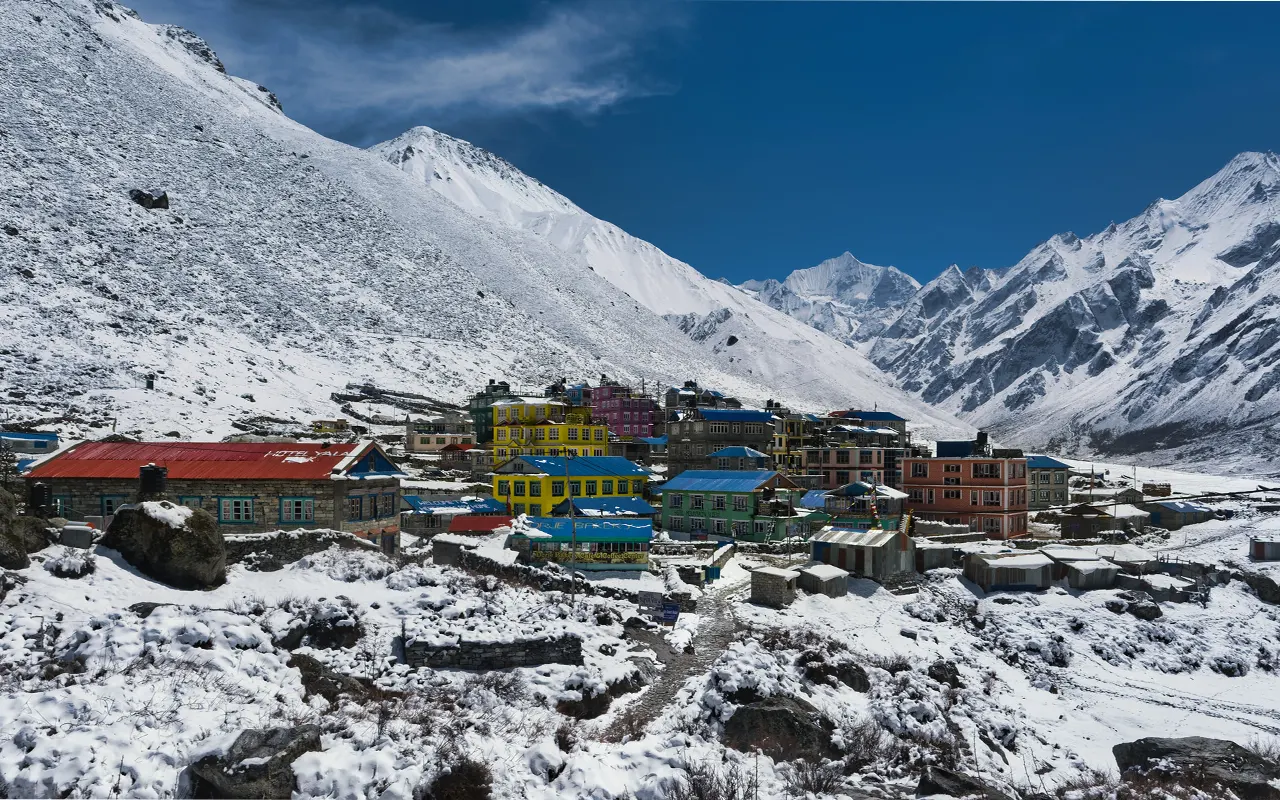
After approximately 5-6 hours, you arrive at Langtang Village (3,430m). This beautiful village is scattered with stone lodges and temples. The 2015 earthquake destroyed and rebuilt Langtang Village, but one can still experience the warm community spirit.
Marvel at the view of Langtang Lirung rising above. You will be staying in a local tea house. The afternoon may be spent in wanderings through the village, or in conversation with the villagers, or on the stone benches of the lodge. This beautiful mountain view is the payoff for the hard work of the day.
After two long days of trekking, today’s hike is shorter. At Langtang Village, proceed along the broad valley which climbs slowly upwards. Cross some wooden bridges across the Langtang Khola, and the trail ascends at a slow pace, climbing to Kyanjin Gompa (3,870m).
Passing through the yak pastures and the local factory of yak cheese, where families make fresh cheese and butter. We arrive in the late morning at Kyanjin Gompa, a small village of Buddhists with its monastery at the center.
The mountain views will be even greater from Kyanjin Gompa. The monastery is backed by a ridge that offers an excellent view of the mountains and the valleys, and the horizon is occupied by Langtang Lirung and the other 7000m mountain range around it.
The tea houses provide food and basic twin rooms for the night. Walk around the gompa and the stone walls that have prayer flags. The altitude is beginning to be felt, and hence, early rest and drinking enough water. Staying in a mountain lodge at Kyanjin Gompa is a way to prepare you for your next big hike.
It is a day of acclimatization. Kyanjin Gompa is a starting point where you hike up to Tserko Ri (4,984m), which is a steep and rewarding climb. Approximately 4-5 hours of climbing the trail gives it an addition of 1,100 meters. It is not an easy one, and it contains loose stones and switchbacks, but you will take a lot of breaks.
On rising in height, the air becomes thin, and scenes are opened. By midday, you are on the summit of Tserko Ri, and the views from here are unforgettable. We get to see the gigantic icefall of Langtang Lirung closely and get panoramic views of the whole Langtang and Ganesh Himal ranges.
Then, after having the packed lunch on the summit, we go down the same way we came back to Kyanjin. The effort of the day contributes immensely to the acclimatization of the body.
Go back to the lodge in the evening. Take as much water as you can and rest. It is an exhausting but worthwhile day hike that you will not forget in a lifetime.
You leave the lodge early, saying goodbye to Kyanjin Gompa. The path takes a wide valley and then ascends more steeply over alpine wood. It is a route that is narrow, so stay with your guide.
In another 4-5 hours, you arrive at Nyengang Kharka (4,200m). It is an open yak pasture surrounded by far-off mountain ranges. Spend the night here in tents. It is an open and windy camp, without the comforts of a village, but the view is magnificent.
In the summer, yaks can be seen roaming around. Spend the afternoon becoming even more acclimatized and getting ready for the big climb tomorrow. Under the stars, there is a warm campfire and dinner today.
This is the most challenging and exciting day during the Langtang Ganja La Pass trek as we finally cross Ganja La Pass today. We wake before dawn, strap our headlamps, and get out of Nyengang to the top of the moraine and rocky trail. The path becomes extremely steep.
You are going slowly, and the summit of Ganja La is near now. When the summit is reached at 5,106m, the views are unbelievable. You are on top of the high mountain pass with great peaks all around. On a clear morning, the glacier of Langtang Lirung to the northwest, the sharp peak of Dorje Lakpa to the west, and even far off Ganesh Himal and Mount Shishapangma in Tibet are likely to be seen. The wind may be chilling, so be warm and enjoy this achievement.
Then, after you have spent some time in the pass and taken pictures, you drop down on sharp rock and ice. The second part of the day is down through rocky slopes to Keldang (4,270m).
In Keldang, you spend the night in tents. It gets chilled within a short time, hence have a hot meal. Now you have connected Langtang with Helambu, a mountain success that can never be forgotten!
Today you will hike a shorter distance and find the hike easier than yesterday. This will be a good rest for your legs. The path passes up and down through the alpine ridges and meadows, through the windy camp at Keldang.
You go through a grassy land with colorful wildflowers and flying prayer flags. At midday, you come through the slope to a wooded valley. The shade is offered by the pine and oak groves upon coming down to the lower altitudes. About 6 hours later, you come to Dhukpa (4,040m), a small# Sherpa village in the midst of fir trees.
Dhukpa contains some plain tea houses and an attractive monastery. Afternoon walks through the village and sightseeing of the beautiful alpine scenery. You have already reached the highest point of the travel; the rest of the way is down. Overnight in the local lodge at Dhukpa, and get ready to make a last descent tomorrow.
From Dhukpa is the path plunges through woods and meadows to Tarkeghyang. At the beginning, you go through a mixed pine and Oak Forest. The trail evens after a period of 3-4 hours of downhill walking, and then it descends upwards to Tarkeghyang (2,600m).
This is a big Sherpa village, which is the gateway to Helambu. On the route, you come across small mani walls and stupas. The village is provided with some small lodges and a gompa in the centre of the village.
Spend the afternoon in the narrow lanes of Tarkeghyang and its stupas. There may be local children and yaks on the streets, portraying a pretty village picture. Spend the night in a lodge, have a local meal, and tell stories by the fire. You are now in the village again, miles away from the glaciers you beheld the day before that.
The last day of walking during the trek starts with the departure from Tarkeghyang and towards Sermathang. The road along this way is generally level or hilly. You pass through rhododendron, oak, and pine forests.
Mountain streams and little falls are visible on the road, and in the spring, the shrubs break into blossom. The downhill walk in the Helambu is warmer, and the air is lighter. It will take you 4-5 hours to reach Sermathang (2,590m). Sermathang is an expansive village with beautiful landscapes and renowned monasteries.
Sit on a sun-warmed bench or a wooden porch to admire the sweeping scenes of the Jugal Himal range. You can hear the monks chanting in the local temples. This small country village denotes the end of the mountain walk. You will have a pleasant teahouse stay at night.
This is the final day of our Langtang Ganja La Pass, and you come from Sermathang by an oak and pine grove to the Melamchi River. The 3–4-hour hike will take you to lower and warmer areas. The path twists and turns in farmlands and tiny villages. The trek ends at Melamchi Pul Bazaar (870m).
A bus or jeep drives you to Kathmandu from Melamchi Pul. Relax and see the mountains disappear into valleys. The trek will end when one arrives late in the afternoon in Kathmandu.
The itinerary of the Langtang Ganja La Pass trek is complete. In Kathmandu, you might explore Thamel’s shops, enjoy a farewell meal, and rest in a hotel at your own arrangement.


Langtang Ganja La Pass trekking route is described as a difficult one due to steep ascents, rocky paths, and elevated altitude. The distance that you will cover is approximately 5-7 hours per day, and you will be on rough and uneven tracks.
The highest point of the trek is Ganja La Pass, 5,106 m / 16,752 ft, and one should be very fit and determined for it. The route is known to contain extensive ascending parts, particularly before reaching the pass, and the path could contain loose rocks, snow, or scree.
This is not a technical climbing expedition, and it does not entail any special mountaineering skills, but the experience of trekking up the Langtang Ganja La Pass is physically challenging. Trekkers must be well-endowed with stamina and heart strength. It is highly advised that one work out before the trek by climbing stairs, hiking, and doing leg strength training.
The trek will be at high altitude, and you will start with low villages, and ascend slowly and steadily to an altitude of more than 5,000 m / 16,404 ft. Himalayan Pathways will make sure that there is adequate acclimatization to ensure that your body acquires the altitude.
With some preparation, you can accomplish this trek if you do not mind walking 6-8 hours per day over hilly terrain. The Langtang Ganja La Pass Trek is not easy, though the mountain scenery and the feeling of accomplishment make it worth the struggle.
The Langtang Ganja La Pass trek requires the selection of the appropriate season. The optimum seasons are the spring (March-May) and Autumn (September-November). The weather in these months is stable, and the mountain views are clear.
During spring, the flowers are in blossom in the hills, particularly the rhododendrons of all colors. In Langtang Valley, daytime temperatures vary between 10 °C and 20 °C. Nights, however, may drop below freezing close to Ganja La Pass at 5,106 m / 16,752 ft. Most trails are clear of heavy snow by the month of April.
It is in Autumn that the skies are clear following the monsoon rains. There is fresh air, and there is excellent visibility. The weather is dry and comfortable, ideal for the Langtang Ganja La Pass.
It is the heavy rainy season from June to August, and wet roads and landslides are possible. Winter (December-February) is very cold, particularly above 3,500 m / 11,483 ft, and the temperature towards the pass can drop to below -15 °C.
To be safe and comfortable, Himalayan Pathways primarily conducts the trek during the spring and autumn seasons.
In the Langtang Ganja La Pass trek, three meals a day, including breakfast, lunch, and dinner, will be provided to you. Places to eat are located on the route in local tea houses. It has basic, fresh, and nutritious food that gives it the stamina to use on long walking days.
The breakfast usually consists of porridge, eggs, toast, pancakes, or cereal. Lunch and dinner normally consist of a Nepali meal called dal bhat, which is composed of rice, lentil soup, and vegetables. This meal is healthy and can be refilled for free. The other alternatives are noodles, fried rice, pasta, potatoes, soups, and eggs. There are vegetarian dishes in large quantities, and it is possible to organize vegan orders.
Further up the mountain, like Kyanjin at 3,870 m / 12,697 ft or nearer to Ganja La Pass at 5,106 m / 16,752 ft, the food options are fewer, but no less gratifying.
It is quite important to drink safe water. Filtered or boiled water is served by Himalayan Pathways during the trek. Never drink water from streams, and always drink boiled, filtered, or treated water only. The lodges have tea, coffee, and hot lemon drinks.
Always have a personal snack and a reusable water bottle to have additional energy between meals.
The main issue of the Langtang Ganja La Pass trek is altitude sickness as the path goes to Ganja La Pass, which is 5,106 m / 16,752 ft above the ground. Less oxygen is available in the air at this height, and your body will take time to adapt.
The usual symptoms are a headache, nausea, dizziness, tiredness, and shortness of breath. All people respond in different ways to altitude. The schedule consists of an acclimatization day at Kyanjin Gompa at 3,870 m / 12,697 ft, hiking to approximately 4,984 m 16,352 ft. This assists in the gradual adaptation of your body.
In order to mitigate the risk, one should walk slowly, consume 3-4 liters of water per day, and have carbohydrate-based food. Do not take alcohol at high levels. Some trekkers use medication such as Diamox with a doctor’s consultation.
Himalayan Pathways guides are trained on high-altitude safety. They are equipped with a first-aid kit and oxygen. The best way out is to come down as soon as serious symptoms occur, even 500 m / 1,640 ft below, which may make the symptoms improve quickly.
It is safer to listen to your body and tell your guide early so as to have a safer trekking experience.
The Langtang Ganja La Pass trek can be made more pleasant and easier with proper preparation. The trail is 5,106 m / 16,752 ft high, so one should be physically fit.
Begin training 1-2 months before your trip. Start cardio routines like hiking, jogging, cycling, or swimming. Attempt to work out 1-2 hours all at once. Training in the hills comes in handy as the walk entails a lot of uphill and downhill portions.
Make your legs strong by doing squats, lunges, and step-ups. A good core enhances stability in rocky roads. Flexibility and stretching exercises will maintain muscle flexibility and decrease the risk of injury.
You will undertake the trek covering 5-7 hours of walking a day, with a daypack. A warm-up of 10-15 km before arrival helps in confidence and stamina building. Wear in your hiking boots beforehand to prevent blisters.
The itinerary of Himalayan Pathways is developed to experience a gradual increase in altitude and take a rest at Kyanjin Gompa at 3,870 m / 12,697 ft, and then proceed with the ascent. Nevertheless, it is better to have the opportunity to enjoy the landscape than complain about being tired.
In the case of the Langtang Ganja La Pass trek, every foreigner will require a Nepal tourist visa. You can get it upon arrival at Tribhuvan International Airport or any overland border. A visa of 15 days costs nearly USD 30, and a visa of 30 days costs nearly USD 50. Carry passport photographs and money.
Besides the visa, there are special trekking permits. One of them is the Langtang National Park Permit due to the fact that the trek will run through the protected zones. This is a path which covers such villages as Kyanjin 3,870 m / 12,697 ft and high mountain areas around Ganja La Pass 5,106 m / 16,752 ft.
Trekkers will also need a TIMS Card (Trekkers ‘ Information Management System), which keeps a record of each trekker and can be reached easily in case of need.
Before departing, Himalayan Pathways will take care of all the required permits and paperwork. All you have to do is submit your passport information and a copy.
There are permit checkpoints on the trail, and you should bring your documents when doing the trek. You should make sure that your visa can cover your entire stay in Nepal.
The administrative process becomes easy and free of any stress with Himalayan Pathways properly documenting the work.
During the Langtang Ganja La Pass trek, health and safety are very important. The route will run deep into the mountains and be 5,106 m / 16,752 ft high, where weather and elevation can take their toll on your body.
One should drink water that is purified or boiled to prevent stomach problems. Wash your hands with hand sanitizer before eating. In higher villages, such as Kyanjin, 3,870 m/12, 697 ft, the temperatures come down at night, and therefore, warm clothes and a good sleeping bag are essential.
The use of sun protection is vital since the UV rays are more intense at elevation. Wear a hat, sunscreen, and sunglasses. Trekking poles are used to keep balance during a rocky downhill walk.
Himalayan Pathways guides will carry a first-aid kit, oxygen, and communication equipment in case of emergency. Altitude sickness or injury may be severe and can thus be evacuated in the event of such.
High altitude trekking travel insurance is compulsory. Never forget to tell your guide that you are not doing well. Taking a slow walk, keeping hydrated, and having proper rest every evening are significant.
This adventure can be safe and rewarding with the right preparation and advice.
Himalayan Pathways organizes the transportation for the Langtang Ganja La Pass trek. The trip starts with a drive to Kathmandu to Syabrubesi, which is approximately 122 km. The journey is 7-8 hours by bus or jeep on picturesque mountain tracks.
The trek begins in Syabrubesi and slowly ascends across Langtang Valley to Kyanjin at 3,870 m / 12,697 ft. Beyond the Ganja La Pass (5,106 m / 16,752 ft), the trail runs down to Melamchi Pul Bazaar (870 m / 2,854 ft).
After the trek, a vehicle is used to drive back to Kathmandu at the end of the trek, and this is approximately 3-4 hours. Himalayan Pathways also has arranged pick-up and drop-off services at airports that make traveling easy and convenient.
All transportation in the trekking package is included, except for optional private vehicles. The road trip is also a beautiful journey to hills, rivers, and old villages, which contribute to the adventure experience.
The Langtang Ganja La Pass trek requires travel insurance due to the elevated altitudes and its remote position. The trek goes to Ganja La Pass, which is 5,106 m / 16,752 ft, and your insurance needs to include all trekking at least to this height.
Your policy must cover emergency medical care, hospitalization, and helicopter evacuation to a maximum of 5,500 m/18,045 ft or more. The rescue operations in the Himalayas may cost USD 5,000 to USD 10,000, and if there is no insurance, you will have to pay for it from your pocket.
Make sure that your insurance, it specifies that it covers high-altitude trekking. Not all standard policies cover mountain activities, and in such a case, you should read the policy thoroughly.
Before departing, Himalayan Pathways checks your insurance to make sure that you are covered. Assuming that there is an emergency, the team is able to establish an evacuation on short notice.
A good insurance will ensure that one is at ease even on the trek. It will safeguard your finances and will make sure that you get instant help in case of necessity.
In case you do not want to cross the high Ganja La Pass at 5,106 m / 16,752 ft, you can refer to different ways of trekking in the same region, which are excellent. Himalayan Pathways is capable of modifying your itinerary without any problem with weather, fitness, or preference.
The trail is shared by the Langtang Valley Trek (10 days) up to Kyanjin Gompa, 3,870 m / 12,697 ft. You do not cross the pass, but go back down to the trailhead. This alternative is more convenient since it does not require high altitude, yet gives a mountainous view and the Tamang culture.
The Langtang-Gosainkunda Trek (14-15 days) passes through Laurebinayak Pass (4,610 m / 15,125 ft) and the holy Gosainkunda lakes (4,360 m / 14,304 ft). It provides mountain adventure high without surpassing 5,000 m.
The Helambu Circuit (8-9 days) goes up to approximately 3,600 m / 11,811 ft and is more village and forest-oriented. An alternative is also the Tamang Heritage Trail.
All of the paths have breathtaking views, and Himalayan Pathways will assist you in making the right choice.
When Langtang Ganja La Pass is being undertaken, there are some personal costs that do not come with the package. These are some of the things that should be budgeted.
Alcohol, coffee, soft drinks, and bottled water cost more in the lodges of the mountain. The higher up you go, the higher the prices, particularly above Kyanjin Gompa at 3,870 m / 12,697 ft and above. Some of the teahouses in the villages offer hot showers, which typically cost USD 2-5 at a time.
The pricing of the charging phones or cameras is USD 1-2 per device. Wifi is slow and can cost USD 5-8 to get a brief connection in such locations as Kyanjin. Personal baggage Porter services are not included and will cost around USD 25-30 / day.
Guides and porters should also be paid tips that are typically 5-10% of the trek cost. The visa charges and travel insurance in Nepal are independent.
Himalayan Pathways suggests carrying USD 200-300 Nepali rupees as additional expenses. In Kathmandu and Syabrubesi, there are ATMs, but there are no ATM or card services available on the trekking path.
When trekking to Langtang Ganja La Pass, you will come across the ethnic people of Nepal. The national language is Nepali, although several locals within the region speak either Tamang or Sherpa as their native tongue.
Nepali and English are commonly used in Kathmandu. Himalayan Pathways has experienced guides who are fluent in English and Nepali and would facilitate effective communication during the trip. They assist in ordering food, finding a place to stay, and talking to villagers.
It is good if you learn a couple of simple Nepali words, such as Namaste (hello) and Dhanyabad (thank you). A smile and good courtesy will go a long way.
In larger villages such as Kyanjin Gompa at 3,870 m / 12,697 ft, communication is always easy yet cordial. Further on, as you come close to remote locations around Ganja La Pass at 5,106 m / 16,752 ft, the number of settlements diminishes.
Generally, the issue of language is not a problem in the Langtang Ganja La Pass trek since Himalayan Pathways guides have control over communication and would make them feel comfortable at every level.
There is limited connectivity on the Langtang Ganja La Pass trek, although there are villages that wifi and charging facilities. The Nepal Telecom (NTC) offers the best signal at such places as Syabrubesi, Langtang village, and Kyanjin Gompa at 3,870 m / 12,697 ft. Mobile service, however, goes dead once you go past Ganja La Pass at 5,106 m / 16,752 ft.
In some of the tea houses, Wi-Fi is provided, mostly in larger villages. It tends to be costly (USD 5-8), slow, and unreliable. It is recommended that trekkers notify their relatives before they go that they might be out of communication for a couple of days.
Most lodges have charging facilities that cost USD 1-2 per device. Solar panels are a common source of electricity, and thus, power is usually scarce. It would be advisable to have a power bank or solar charger with you.
Carry a universal plug; Nepal has type C, D, and M plugs. Switching off devices when not in operation is also a way of saving battery.
During the Langtang Ganja La Pass trek, one should observe the local laws, as well as admire nature. Do not litter. Take back everything that you have thrown away to preserve the environment.
Respect religious sites. Take a walk clockwise around stupas and prayer wheels. Take off your shoes when going to monasteries and houses. Always ask for permission before taking pictures of people and shrines.
Do not drink untreated water. Boil all drinking water to prevent disease, particularly at high altitudes.
Keep to the marked paths and stay behind your guide. The trail around Ganja La Pass, 5,106 m / 16,752 ft, may be hazardous at times when one goes off-track.
Do not feed animals or disturb wildlife. The use of drones in Langtang National Park is not allowed without approval.
It is advisable not to play loud noise at night in the tea houses, as well as to respect fellow trekkers. All these basic rules will guarantee a positive and healthy trekking experience that will be safe and respectful to all.
Travelers who have gone through the Langtang Ganja La Pass trek often want to continue their trip to Nepal. Himalayan Pathways can make some thrilling selections of destinations and plans for you.
You can visit the UNESCO heritage sites of Kathmandu, such as the ancient temples and historic squares. At Nagarkot 2,175 m / 7,136 ft, there is a spectacular view of sunrise in the Himalayas.
Another extension is Pokhara, which is popular. It is characterized by peaceful lakes and a mountainous landscape. Another place to visit is the Chitwan National Park, where the jungles can be seen, and wildlife can also be observed.
In case you feel like doing more trekking, may add the Gosainkunda Lakes at 4,360 m / 14,304 ft or some other Himalayan trail. Other popular trails that the trekkers proceed with are the Annapurna Base Camp.
Once you have the Ganja LaPass at 5,106 m / 16,752 ft, you can continue your journey to see more of the Nepalese culture and landscapes. Himalayan Pathways will be able to tailor your extension to your needs and schedule.
The Langtang Ganja La pass trek has excellent photography possibilities. There are snow-white mountains, yak herds, and mountain villages that form great images. Early morning and late afternoon are the most suitable times of the day to take photos.
You will cross picturesque spots such as Kyanjin Gompa 3,870 m / 12,697 ft and high altitudes at Ganja La Pass 5,106 m / 16,752 ft. You will always need to have additional batteries since cold weather requires lots of power.
Ask before taking pictures of individuals or even in temples. Be respectful of the local customs, and flash photography is not to be used in religious places.
The use of drones is highly forbidden within Langtang National Park without government authorization. Drones that fly unlawfully can be seized. The Himalayan Pathways highly recommends not bringing the drone.
Use a strap or padded bag to keep your camera safe. When walking, pay attention to your footing and do not be distracted on hilly paths. You are able to take memorable experiences on your trekking tour with respect and care.
In the Langtang Ganja La Pass trek, you can get to enjoy special cultural festivals of the Tamang and Buddhist people along the trekking route. These celebrations are an indication of strong religious beliefs, folk music, vibrant culture, and good community connections. Exploring the Langtang Valley and Helambu villages means that you can observe the real Himalayan culture.
Lhosar is one of the main region-wide festivals, which is the Tamang New Year. It is normally celebrated in January or February. The people in the village come together in traditional attire, dance cultural dances, sing their local songs, and cook special meals. It is during this period that monasteries like Kyanjin Gompa at 3,870 m / 12,697 ft live with prayer ceremonies and blessings.
In monasteries along the trekking path, there are Buddhist festivals such as Buddha Jayanti, also known as the birth of Lord Buddha. Monks recite prayers, light a butter lamp, and perform peace and compassion rituals. The trail has prayer flags and mani walls, which have a year-long spiritual connotation.
In case your Langtang Ganja La Pass trekking program will intersect a local festival, Himalayan Pathways guides will be able to explain the traditions and customs. These celebrations are an important part of your Himalayan experience that gives it a rich cultural dimension.
If this is the first time you are taking this trekking of Langtang Ganja La Pass, proper preparation goes a long way. Travel light and carry a few things. Himalayan Pathways offers a duffel bag as the main luggage, and you carry a small daypack.
Wear layers of clothing since the climate may vary at any time. Lower places are warm; however, at night, almost at Kyanjin Gompa, 3,870 m / 12,697 ft and above, it is cold. Carry thermal, down jacket, gloves, and a hat.
Bring hiking shoes, which are powerful, waterproof, and get them broken in beforehand. Keep hydrated and treat all the drinking water. Walk slowly and steadily, particularly when you come close to Ganja La Pass 5,106 m / 16,752 ft.
Bring additional cash in Nepali rupees. Wear sunglasses and sunscreen to protect yourself against bright sunlight.
And, above all, maintain a positive attitude. The Langtang Ganja La Pass trek is an adventure both physically and mentally. First-time trekkers are able to complete the course with preparation and guidance by Himalayan Pathways and have all the moments.

High-altitude trekking experience is not compulsory, but preferable. If you are in good physical condition and well prepared, you can do it.
The accommodation on the trek in Langtang Ganja La Pass is simply in basic tea houses, twin-sharing rooms, and plain bedding.
There might be single rooms available in the lower villages, but they are scarce and not assured at the higher elevation.
Depending on the weather and route conditions, camping can be necessary near the Ganja La Pass of 5,106 m / 16,752 ft.
The trekking activities of Himalayan Pathways in Langtang Ganja La Pass are mostly small groups, as it is the safest and well-supported way to guide the trek.
This trek is not suitable for small children because of the high altitude and rocky nature.
Some species of birds, the Himalayan tahr, and monkeys can be seen by trekkers in Langtang National Park.
The villages have only basic health posts, and no sophisticated medical facilities are available along the trekking trail.
If Ganja La Pass at 5,106 m / 16,752 ft is not safe or blocked, the guides will alter the itinerary or go back through Langtang Valley.
Tipping is not compulsory, yet it is the tradition to thank the guide and support staff.
Tea houses and villages along the way only accept Nepali Rupees.
No formal training is necessary, yet excellent physical training is highly recommended.
Yes, it is possible to visit Buddhist monasteries in Langtang village and Kyanjin Gompa at 3,870 m / 12,697 ft.
The trekking of Langtang Ganja La Pass must be reserved a month to two months before the peak seasons.
Under the trekking policies in Nepal at the moment, solo trekking without a licensed guide is not allowed.

