Trek Difficulty
The Helambu trek is considered one of the easier trekking routes in Nepal and is well suited for beginners, families, and travelers who prefer a relaxed walking experience. This short Helambu trek itinerary is designed with gradual ascents and descents, avoiding extreme altitude and technically challenging terrain. We will walk at a moderate speed and have time to appreciate the views and have frequent rests during the trip.
The walk will take a daily average of eight to ten kilometers. This normally translates to five or six hours of walking with some rest and lunch breaks. The routes are well cut and largely traversing through woody tracks, village tracks and open hill sides. No prior trekking, climbing skills and special training are required. Although the journey does involve walking up and down a certain amount of days, the ascents are not very steep and can be handled by the majority of individuals.
With a relaxed mindset and steady walking rhythm, the Helambu trek is enjoyable and rewarding rather than physically demanding.
Weather and Best Season
The Helambu trek can be done in most months of the year, but certain seasons offer more comfortable weather and clearer views. The best times for this short Helambu trek itinerary are spring and autumn, when weather conditions are stable and the landscapes are at their best.
The most popular season of the trek is autumn when it is the season of September to November. This will be a dry season with blue skies and good visibility of the mountains. The temperatures are friendly during the daytime when walking is possible and during the evenings, temperatures are not too high. It is a season that is good to do photography and have a clear view of the surrounding Himalayan ranges without getting any interruption.
Spring, from March to May, is another excellent time for the 6 days Helambu trek. It is warm and the trees are beautiful and covered with rhododendrons and green leaves. Light rain can be experienced in occasional showers and usually in late spring, although all in all, the trekking conditions are favorable.
During winter (December-February) winter trekking can also be done but it is colder and especially at the higher villages such as Thadepati. In warm clothes, the hike may be pleasant, and the trails are quite silent. The rainy season is between June and August and it is less popular because of the rain, clouds, and wet trails. Although trekking can still be done, sightseeing can be minimal and additional attention is required.
Food and Drink on the Trek.
As part of the short Helambu trek itinerary, meals are available throughout the journey and are prepared fresh each day using local ingredients.
We will have breakfast in the mornings at the lodge and the usual items include porridge, eggs and Tibetan bread, toast or pancakes with tea or coffee. Lunch is typically consumed in a tea house on the trail and consists of substantial meals of dal bhat served with rice, lentils and vegetables, or noodles, soups or dumplings. Once we arrive at the lodge in the evening, we will have a warm dinner to restore the body after a day of walking.
The food provided on the 6 days Helambu trek is simple but nourishing and rich in carbohydrates, which are ideal for trekking energy. Vegetarian food has become very common and is sometimes suggested in favor of increased digestion at high altitude. We will prepare boiled water at lodges or purification tabs to make sure that we are hydrated safely.
Altitude Sickness and Recommendations
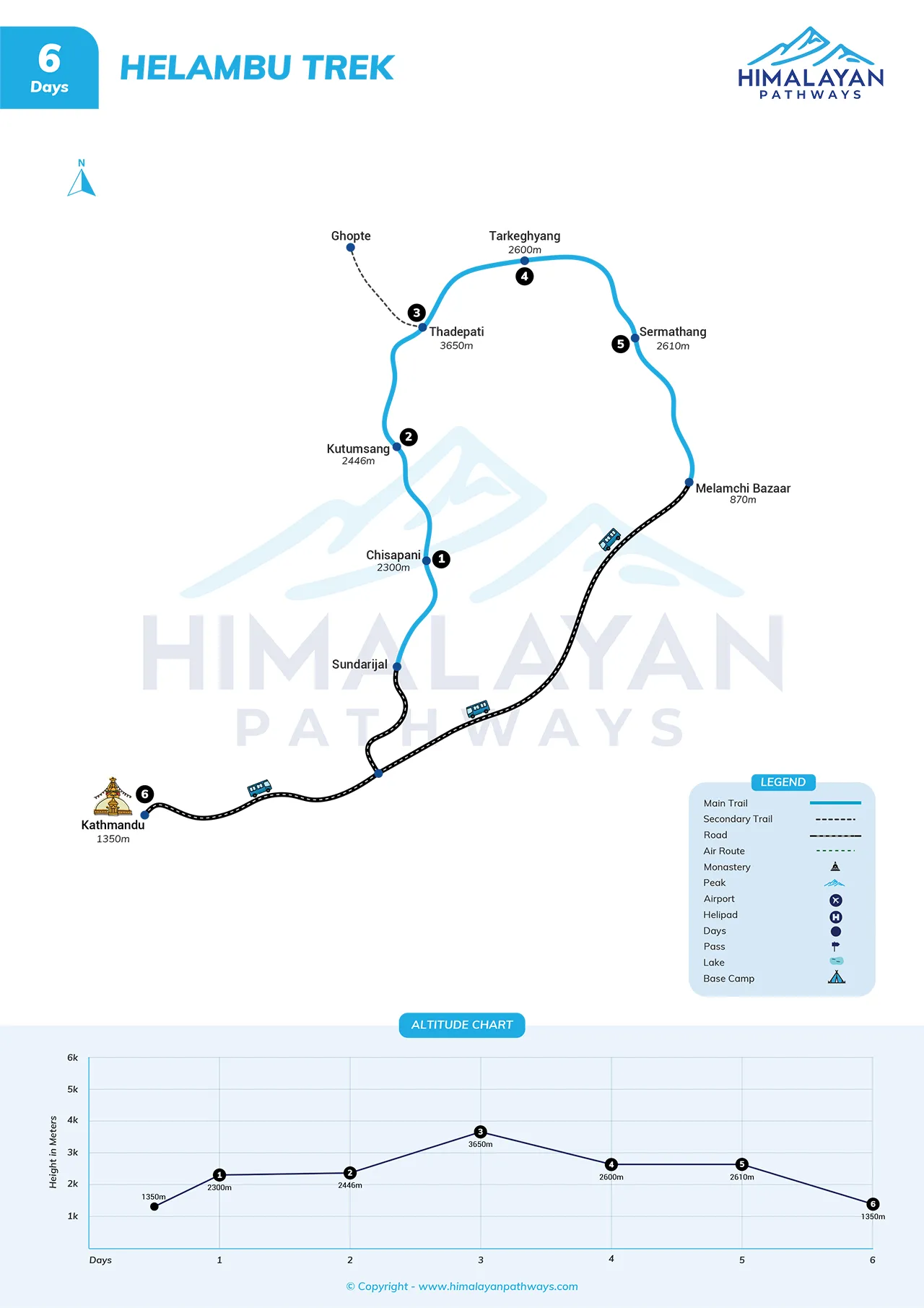
The Helambu trek is a low to mid altitude trek, so the risk of serious altitude sickness is relatively low compared to higher Himalayan routes. The highest overnight point on this short Helambu trek itinerary is Thadepati, which sits at around 3,690 meters. Although this level can be handled by most trekkers, we will still engage in necessary precautions to make everyone comfortable and safe.
There are mild symptoms that include headache, exhaustion or mild dizziness which can be experienced above 2,500 meters. In case you are not feeling well, then you should tell the guide as soon as possible. Our guide will bring a first aid kit and will be able to help with rest and hydration as well as some basic medication. When more severe symptoms occur, a decrease in elevation is the best remedy in rare situations.
Most trekkers complete the 6 days Helambu trek without any altitude related problems by following simple guidelines and listening to their bodies.
Preparation and Fitness
A moderate level of fitness is enough to enjoy the Helambu trek comfortably. The experience of this trek is not technical and does not demand any prior experience at high altitude, but some preparation will help make the experience pleasant. To prepare before the trek, we recommend a little physical training in the weeks prior like walking, hiking, cycling or jogging.
It is necessary to pack the correct gear. We will suggest that you carry comfortable trekking shoes, layered clothing depending on the changing temperatures, a warm jacket during the evenings, and waterproofs. During the 6 days Helambu trek, you will carry only a daypack, while the rest of your luggage can be managed by porters if arranged. This trek is very manageable and rewarding to most trekkers so long as one has a positive attitude and has been well prepared to handle it.
Visa and Permits
For the Helambu trek, travelers must have a valid Nepal tourist visa and the required trekking permits. A visitor is able to get a tourist visa upon arriving at Kathmandu airport, a majority of international visitors. We will suggest that you make sure your passport has at least six months to go before traveling.
By booking the trek with us, all the permit arrangements will be done by us on your behalf. All the required paperwork will be gathered in Kathmandu and it will be ready before the actual start of the trek. The guide will be carrying the permits and showing them at the checkpoints where necessary during the trek.
Recent trekking regulations in Nepal require trekkers on many protected routes to be accompanied by a licensed guide and to carry a valid TIMS card., particularly; by way of safety and proper papers. By joining the 6 days Helambu trek with an organized team, you can focus on enjoying the journey while we take care of the formalities. This makes the trekking process easy, legal, and stress free throughout the process.
Your Extra Expenses
Our Helambu trek package is mostly inclusive during the trekking days, but there are a few personal expenses that are not covered. We will have a briefing session with you before the trek, so that you can have time to budget comfortably and enjoy the trip without the burden of worrying.
- Visa Fee: We will help with this but the Nepal tourist visa is bought by you at Kathmandu airport. A 15 day visa is USD 30, a 30 day is USD 50.
- Travel Insurance: This should be done prior to the arrival to Nepal. We will remind you so that it includes trekking activities and emergency evacuation.
- Kathmandu meals: Before and after the trek, meals are not included. It is possible to spend between USD 20 to 30 per day on budgeting on where to eat.
- Kathmandu Accommodation: Hotels in Kathmandu will be your own cost unless included in your package. The choice is between low-end guesthouses or comfortable tourist hotels.
- Drinks and Snacks on Trek: During the short Helambu trek itinerary, three meals per day are included, but extra drinks, bottled water, and snacks are paid separately.
- Charging Hot Showers and Wi-Fi: Tea houses can charge a little to charge devices, hot shower, or internet.
- Souvenirs and Personal Shopping: You will visit the local villages and you may desire to buy and purchase handicrafts or small gifts.
- Tips: Tipping is not enforced, rather, welcome. For the 6 days Helambu trek, we recommend budgeting a modest tip for your guide and porter.
- unexpected Costs: We suggest putting aside a small additional amount of money in case of unforeseen expenses or elective activities.
We will recommend that one carries Nepali rupees as there are no ATM in the trail.
Health and Safety
Your safety and well being are our top priorities throughout the Helambu trek. We will ensure that the trek is undertaken with a good pace and in a good way such that you can have the comfort during the trek. We have a professional guide who is first aid trained and will carry a medical kit in case of minor complications such as blisters, headaches, or minor injuries.
During this short Helambu trek itinerary, we will encourage good hygiene practices, such as washing hands before meals and using hand sanitizer regularly. Freshly prepared food and only boiled or purified water are also useful in avoiding stomach trouble. We will remind you to be well hydrated and to notify the guide whenever you feel unwell at any given time.
The Helambu is mostly a safe area, and the locals are smiling and the atmosphere is calm. During the 6 days Helambu trek, we recommend staying with the group and following the guide’s instructions at all times. We will move swiftly and be responsible enough to make sure that in case of an emergency, there is adequate response to render help.
Transportation
Transportation for the Helambu trek is easy and very convenient as no domestic flights are needed to undertake this route. We will take care of all the necessary ground transportation regarding the trek so that you can travel with comfort and without stress. This makes the Helambu route very suitable for travellers who are looking for easy logistics and a good start and finish.
At the start of this short Helambu trek itinerary we will pick you up from your hotel in Kathmandu and drive to Sundarijal, the initiation point of this trek. The drive takes about one hour and passes through the outskirts of the city to reach the entrance of the Shivapuri Nagarjun National Park. We will use a private vehicle in which flexibility and comfort are possible on the first day.
At the end of the trek, after finishing the walking part near the Melamchi Bazaar, we will arrange transportation back to Kathmandu. Normally, this return journey is made by local bus, which takes about three to four hours and gives one an introduction to ordinary local life. Your guide will help with tickets and seats to make it easier for you.
Travel Insurance
Travel insurance is highly suggested for people who are joining the Helambu trek, although this is regarded as a moderate and accessible trek route. While we take every precaution to ensure a safe and enjoyable journey, there is always a certain level of risk involved in trekking in the mountains. We will ask you to arrange travel insurance before you arrive in Nepal so that you can trek with peace of mind.
Your insurance policy should cover trekking activity up till at least 4000 meters as the highest point in this short trek itinerary in Helambu is close to that altitude. It is also important that your insurance covers the emergency medical treatment and evacuation by helicopter. In case of serious illness or injury evacuation to Kathmandu may be necessary, without insurance this can be very expensive.
Alternative Routes
The Helambu trek is flexible and can be modified and extended as per your time, interest and trekking experience. We will be happy to customize the route if you want to explore more of the surrounding regions or change the journey according to your schedule. This flexibility makes Helambu a great option for a trip of a short duration as well as longer Himalayan adventures.
For travelers with more time, one popular option is to trek Helambu with the Langtang Valley and Gosaikunda Lake routes. This makes for a longer trek that unites three scenic regions featuring higher landscape of the Alps and sacred lakes. This option takes more days and more fitness and is a very rewarding experience for those looking for a longer trek with more than the short Helambu trek itinerary.
If you have limited time we can also reduce the itinerary. While the 6 days Helambu trek has the most comfortable pace, it is possible to shorten the trek to five days by varying the distances walked or arranging for transport from some points. We normally suggest you avoid rushed schedules, but there are shorter ones if you need them.
Another appealing option in and from Helambu is a side hike to Ama Yangri, a sacred viewpoint near Tarkeghyang. This can be made as an extra day and there are great panoramic views of the mountains. We can also set up cultural stays, alternative entry or exit points or combine trek with other activities. We will be working closely with you to plan the best route for your Nepal adventure.
Language and Communication
The international travelers usually find it easy to communicate during the Helambu trek. We will also have a skilled guide who speaks fluent English and can assist with translation in case the need arises. Most of the tea house owners in the villages along the trail speak basic English because of the frequent visitors of the region.
Your local communities are primarily Hyolmo Sherpa and Tamang. They use their languages along with Nepali which is the national language. It is possible to learn some simple Nepali words and make interactions more pleasant. It is always welcome to say Namaste as a greeting or Dhanyabad as a form of saying thank you. Our guide will be happy to tell you about the local customs and assist you to communicate with villagers.
Language barriers are not a big problem during this short Helambu trek itinerary. The tea house menus are written in most cases in English and therefore it is easy to order food. In case you have any special needs like diet requests or health issues, we will make sure that these are well communicated. During the 6 days Helambu trek, you will be able to interact freely and with confidence with locals.
Mobile Network, Internet and Charging Facilities
Mobile coverage on the Helambu trek is feasible, but this may be poor in certain locations. We will assist you in knowing what to expect before the trek. This mobile network has been developed in various villages e.g. Chisapani, Tarkeghyang, and Sermathang, though the signal is poor in forested areas.
It is advisable to use the local SIM card of Nepal Telecom, because in most areas with hills, the telecom would be covering the area well. Mobile data can be used on making calls and sending messages during this short itinerary Helambu trek itinerary, although the speed of the internet can be low. Wi-Fi is available in certain tea houses, but it is charged at a low price in most cases, primarily in larger villages.
The tea houses offer charging facilities which are typically located in the dining areas and a small fee might be charged on a per-device basis. We recommend the use of a power bank and travel adapter. On the 6 days Helambu trek, it is normal that there is very little connection and most trekkers take the opportunity to be off-line and appreciate nature.
Photography and Drone Rules
The Helambu trek provides numerous sites to capture beautiful photographs, such as forest trails, mountain viewpoints, and traditional villages. During the journey, we will promote respectful photography. Always seek permission to take pictures of people in the area, monasteries and in the houses.
The most suitable times to capture the best light in photography are early mornings and late afternoons, particularly in villages and open points of view. Bring extra batteries because cold weather might make the battery run out. In this Helambu trek itinerary, a camera or smartphone is normally adequate in taking up memorable moments.
In Nepal, the usage of drones is controlled, and one should not fly a drone without receiving permission, particularly in the territories of the national parks. Flying drones without authorization should not be encouraged because some of the 6 days of Helambu trek are located in areas that are under protection. We recommend that regulations should be examined and drones should be used in a responsible manner. In many cases, sightseeing itself is a great way to have some memories that are just as valuable as pictures.
Tips on first-time visitors
To first-time visitors of Nepal, some preparation will help a long way. We will advise to get a visa at Kathmandu airport and bring passport photos and sufficient cash to pay visa fee as the immigration process is likely to be slow. In order to remain healthy, we will recommend drinking of boiled and purified water, and consumption of well cooked food. It is also a good practice to use hand sanitizer prior to eating.
We will recommend that we use Nepali rupees as our daily cost and take out cash in Kathmandu as we will not have any ATMs on the trekking route. It is normal in markets and with taxis to bargain and we advise that it is done in a good manner and with a smile. It is also good to respect the local culture, therefore it is good to dress decently, take off shoes in shrines and greetings are always welcomed with Namaste.
Generally, Nepal is a safe country, although we will recommend caution of valuables in crowded city locations. Traffic and schedules may be uncertain, and patience and adaptability will make your journey more enjoyable.
The Cultural Trails Festival
- Rich Local Culture: Hyolmo Sherpa and Tamang communities predominantly found in the Helambu region. Their cultural life is a fusion of Tibetan Buddhist and Hindu culture and festivals are also significant in the life of the village. When the trek dates coincide with a festival, it can also turn out to be a very special experience.
- Hyolmo Tshechu Festival: Tshechu is among the very significant festivals among the Hyolmo Sherpa people. It normally falls on the tenth day of a lunar month. In monastery courtyards, monks dance colorful masked dances in honor of Guru Rinpoche. The people wear traditional attires and visitors are always encouraged to learn about the celebrations, particularly in such villages as Tarkeghyang and Sermathang.
- Losar Tibetan New Year: Losar takes place usually in January or February and it is the New Year of Sherpa and Tamangs. The houses are cleaned and painted, special food is cooked and families visit one another to wish each other blessings. Prayer ceremonies in monasteries and festival snacks or local drinks are there to provide to the trekker.
- Buddha Jayanti: This festival takes place in April or May on a full moon day and this dates back to the birth, enlightenment, and death of Buddha. In monasteries, there are prayer sessions, burning of butter lamps and the establishment of a calm spiritual environment.
- Dashain and Tihar: These are the biggest Hindu festivals that are celebrated towards the months of October and November. Villages have tika blessings, oil-lamps, lights at festivals, and traditional singing and dancing.
Don’ts on This Trip
- Respect local culture or religion: never take photos without permission of any people, monks, or monasteries. Circle mani walls and chortens clockwise and take off shoes and hats when entering places of worship or houses.
- Never wear revealing clothes: Trekking attire is okay, but cover shoulders and knees in village and sacred places to honor indigenous traditions.
- Do not hand out money to children: Do not hand out money, sweets, or pens to children as this may encourage begging. You can donate, either through schools or local organization in case you want to contribute.
- Do not litter or pollute: Hold all non biodegradable waste with you and dispose of it correctly. Maintain paths, communities and water bodies.
- Do not disturb wildlife: Do not feed or raise a noise in the woods. Wildlife can be seen silently at a distance.
- Do not push yourself: Walk at a slow pace and tell your guide when you feel tired or when you feel ill.
Trip Extension
- Kathmandu Valley Sightseeing: After the Helambu trek, you can explore the cultural highlights of Kathmandu Valley. See the UNESCO World Heritage Sites, Boudhanath Stupa, Pashupatinath Temple, Swayambhunath and old Durbar Squares in Kathmandu, Patan and Bhaktapur. The locations provide an understanding of the history of Nepal, architecture, and religion.
- Pokhara and Annapurna Region: Pokhara is a lakeside city that has magnificent view of the mountains. you may rest by Phewa Lake or make the visit to the World Peace Pagoda or include short walks such as Poon hill or Mardi Himal to watch the sunrise panoramas.
- Chitwan Jungle Safari: Chitwan National park offers the wildlife adventure involving the use of jeep, canoe and the sighting of rhinos, deer and birds.
- Adventure Activities: Include white water rafting, paragliding in Pokhara, or a mountain flight to Everest, which is to be added to ensure your adventure.
- Tailor Made extensions: Extra tours or treks could be organized, according to your interests and possible time.
 Unbeatable Holiday Offers - Save Up to 20% on Your Next Adventure!