How difficult is the Langtang Tamang Heritage Trek?
“How difficult is the Langtang Tamang Heritage Trek?” This is a question a number of trekkers ask once they compare trekking routes in Nepal.
The answer is that the Langtang Tamang Heritage Trek is a moderate level in terms of difficulty. The per day walk is an average of 3-7 hours, and the trails of the mountains consist of stone steps, forest trails, and ridges.
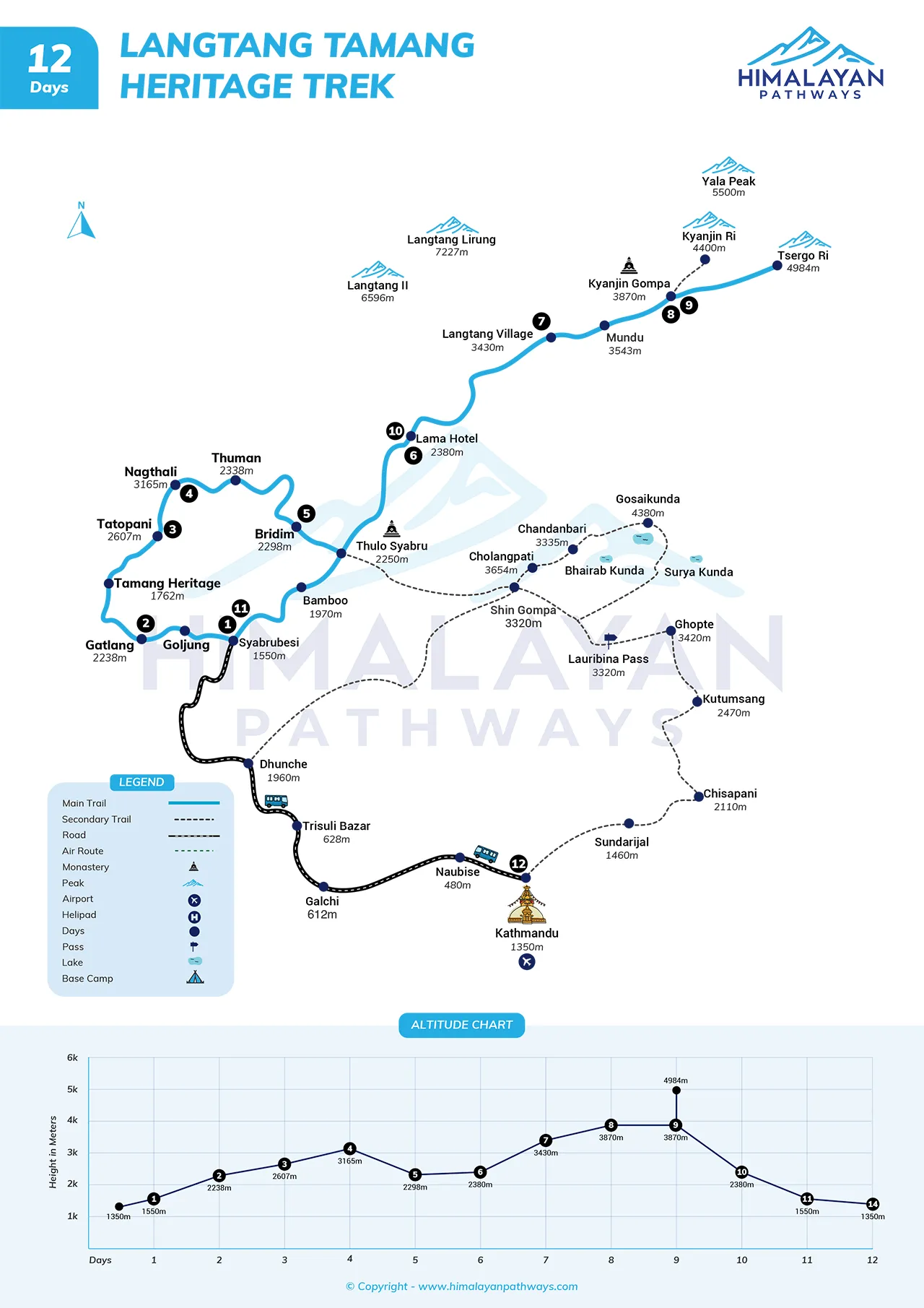
The primary challenge is added by the altitude. You sleep as high as 3,870 m / 12,697 ft at Kyanjin Gompa and hike up to 4,984 m / 16,352 ft on the viewpoint day. You can go through the climb without pressure and not stress yourself as long as you walk slowly, hydrate, and accept the slow pace.
You do not require the technical climbing skills. You just need regular walking endurance. You will also enjoy the Langtang Tamang Heritage Trek much better and will recover better each night if you train walking on the hills and stairs even before the trip.
Weather and the best season for the Langtang Tamang Heritage Trek
The spring (March-May) and Autumn (September-November) are the best seasons for the Langtang Tamang Heritage Trek. The weather is stable, with clear visibility and warmer temperatures in these seasons. Rhododendron blooms are covering the hills in colorful flowers, making the trek even more beautiful during the spring.
During winter (December-February), the air is cold at higher elevations such as Kyanjin Gompa, which is at 3,870 m / 12,697 ft. Trails and viewpoints may be covered with snow. During monsoon (June-September), there is more danger of landslides on the road, and the trails are slippery, but the valleys appear green.
Himalayan Pathways suggests the best seasons of spring and autumn because they are the most comfortable, with a mountain landscape and a cultural village lifestyle. When you are going during off-season months, carry warmer clothes and buffer days in the event of a road delay.
Foods and Drinks
During the Langtang Tamang Heritage Trek, you get full meal trekking meals at teahouses and lodges. Dal Bhat is the kind of food that is taken on long walking days since it is served with rice, lentils, and vegetables, and usually with free refills. It is also possible to order noodles, potatoes, soups, eggs, pancakes, and Tibetan-type bread based on the village.
Drink lots of water, since dry air and physical activity leave you dehydrated in no time. Boiled water can be more affordable than bottled water and will cause less plastic waste.
Himalayan Pathways recommends a filter bottle or water purification tablets and reuseable water bottle for safe drinking water. It is also possible to have local hot beverages, such as ginger-lemon-honey tea. Do not take a lot of alcohol during the trek as it may slow the process of acclimatization.
Altitude Sickness
The problem of altitude sickness may happen to any person, even experienced trekkers. Being over 3,000 m / 9,843 ft is dangerous, particularly in situations when you climb too quickly. This trek attains a sleep elevation of 3,870 m / 12,697 ft and hiking summit of 4,984 m / 16,352 ft, thus smart habits are needed.
Gradual ascent, pace, and days of rest are the best prevention. Health experts advise that when you travel above 3,000 m (9,843 ft), you should increase your sleeping altitude slowly and take regular rest days to help your body adjust properly.
You need to be alert to headache, nausea, dizziness, and atypical fatigue. When the symptoms deteriorate, you need to stop ascending. The most effective response to severe symptoms is descent to the lower elevation.
Himalayan Pathways guides not only follow you day by day, but they are also more concerned about your safety rather than reaching the summit.
Preparation and Fitness
Train for the Langtang Tamang Heritage Trek with simple and regular exercise. Begin 6-8 weeks before the trek. Walks, climbing steps, bicycling, or light running 3-5 times per week. Include leg strength exercises such as squats and step-ups. This pre-training can help you spend your day covering long distances during the trek.
Practice walking with your backpack on. Concentrate on a consistent pace, but not on speed. In Nepal trekking, slow and steady walking brings the best results.
Pack warm layers of clothes as the temperature fluctuates rapidly as you ascend to higher altitudes, such as Kyanjin Gompa at 3,870 m / 12,697 ft. Carry a warm jacket, rain gear, and comfortable hiking boots.
Finally, prepare mentally. Teahouse trekking is easy and gratifying, but remote travel requires patience. The Langtang Tamang Heritage Trek becomes more enjoyable when you accept and follow the natural rhythm of the mountains.
Visa and Permits
The majority of international visitors visiting Nepal require a Nepal Tourist Visa, which you can get from Tribhuvan International Airport or overland borders of Nepal. Nepal’s official tourism authorities list the tourist visa fees as USD 30 for 15 days, USD 50 for 30 days, and USD 125 for 90 days.
In case of trekking to the Langtang area, you require permits. You will need the entrance permit to Langtang National Park and the Trekkers ‘ Information Management System (TIMS) Card.
The Langtang National Park Entry Permit allows you to enter the national park and the permit fee helps support conservation and park management. The TIMS card keeps your trekking information on record, which can be used for safety and tracking purposes if needed.
The Himalayan Pathways manages these logistics, and you do not have to worry about the documentation.
Health and Safety
On the Langtang Tamang Heritage Trek, Himalayan Pathways prioritizes your safety. Health, hydration and pace are checked by your guide daily. Basic habits like washing hands frequently, using sanitizer, and consuming treated water should also keep you safe.
Carry your personal medication and a little first aid kit. On trekking days, there may be lengthy walks over down and uphill slopes, and hence, foot care is important.
There may be delays in road transport to Syabrubesi. During our weather and landslides may alter the road conditions in the hills, particularly during the monsoon season. Have buffer days in your schedule where you can.
The quality of sleep can be reduced at higher elevations. You can make it better by staying warm, eating enough, and not taking alcohol. Medical experts recommend slow acclimatization as the most important way to prevent altitude sickness.
Transportation
Your transport follows the standard route between Kathmandu and Syabrubesi, and then returns to Kathmandu after the trek. The driving distance is approximately 122 km (75.8 miles) and normally takes 6-7 hours based on the condition of the roads and stops. [34].
Himalayan Pathways gives you the option of hiring a local bus or even a private jeep, depending on the comfort and number of people. A personal jeep would have more flexibility in making stops and a smoother time. A local bus is cost-effective but may be overcrowded.
During the trek, you walk between villages. The hiking time is usually approximately 3-7 hours/day, and the highest point of the trek is approximately 4,984 m / 16,352 ft on the viewpoint hike.
All the vehicles used during your journey will be well-maintained and comfortable according to your group size and budget. You will have an experienced driver who knows the roads well. You will not have to worry about transportation and focus on enjoying the trek.
Travel Insurance
Travel insurance is essential for any high-altitude trek. Since this trek reaches up to 4,984 m (16,352 ft), an emergency evacuation in case of altitude-related problems or injuries is required.
Select a travel insurance that includes trekking (at least above 4,000 m / 13,123 ft) and emergency helicopter evacuation and medical attention if necessary.
In Nepal, many trekking packages require emergency coverage, but insurance is not included in the trip cost. This allows travelers to choose an insurance provider that best fits their needs.
Review the exceptions, as some policies do not cover trekking. Some would be considered trekking, yet the high altitude still requires explicit altitude coverage.
Keep your insurance information with you during the trek. In remote valleys, having quick access to your policy number helps with fast coordination if an emergency happens.
Alternative Routes
When you like the Langtang Tamang Heritage Trek, you may continue or change it with adjacent trails. Nepal provides several routes in the Langtang region, such as the Langtang Trek, Langtang Gosaikunda Trek, Ganja La Pass Trek, and Tamang Heritage choices.
One of the more popular options includes Gosainkunda Lake that is located within the attractions of Langtang National Park. This path takes you to the holy Gosaikunda Lake and over the high pass of Lauribina La.
The other alternative leads to Helambu region, which is rich with cultural and natural heritages, away from the busy trekking trails.
In case you do not want to spend time on the way to a long destination, you can simply concentrate on the Tamang Heritage villages from Syabrubesi to Gatlang, Tatopani and Briddim loop. Himalayan Pathways can include more high passes and days of acclimatization in case you are more adventurous.
Your Extra Expenses
Even though your trek includes full board meals and accommodation, you will still need some extra cash for small personal expenses along the way. The tea houses might charge separately for hot showers, Wi-Fi, device charging, snacks, and bottled beverages.
Take enough Nepalese rupees with you out of Kathmandu as there are no ATM in the trail, and in remote locations, card payment doesn’t work.
Examples of the additional charges may be personal snacks, bakery items where possible, additional tea/coffee, chocolate, and guides and porters’ tips. Budget additional money in case you desire some upgrades on the driving days on the jeeps privately.
In case you are interested in purchasing some souvenirs, you will find small shops in villages and more places in Kathmandu. Create a small buffer expense in case weather delays may create an unexpected additional stay at the lodge.
Language and Communication
Nepali is the official language; however, the Langtang Tamang Heritage Trek is located in areas where the Tamang language and Tibetan-influenced culture make up the daily life. Local greetings and traditional music will be heard regularly, particularly in the heritage villages.
The guide of your Himalayan Pathways speaks English, assists with translating, ordering meals, and explaining the culture. A few basic words of Nepali make communication closer. “Namaste” works everywhere.
The menu can be a combination of English spelling and local names in the teahouses. When words are not enough, smiling and pointing can help you communicate. A friendly attitude matters more than perfect pronunciation.
When going to monasteries and village prayer rooms, always ask your guides about the things you don’t understand. Patience, simple attire, and respectful manners can help you associate with the community positively.
Mobile Network, Internet & Charging Facilities
The connection is getting better with each passing year, and remote trekking continues to enhance the signal strength. Higher villages during the Langtang Tamang Heritage Trek often give less coverage than the trailhead area around Syabrubesi. You can use Wi-Fi and local SIM cards as the main ways to stay connected during the trek.
Numerous teahouses have Wi-Fi, which costs money, but speed can be slow at higher altitudes, such as at Kyanjin Gompa, 3,870 m / 12,697 ft.
You can charge your electronic devices at the tea houses at a small cost, but the electricity supply is not reliable all the time. Also, carry a power bank, and keep your devices and extra batteries in warm pockets, as cold drains batteries fast.
Connectivity will always be a luxury when you are in the Langtang Tamang Heritage Trek, and is most appropriate when you remain in the company of the mountains and the village life.
Don’ts on this trip
Don’t rush the altitude. You must give your body time when above 3,000 m / 9,843 ft. You have to maintain a constant speed and not run up the mountain.
There are many reasons why alcohol should be avoided heavily on the trail, the main one being that it worsens dehydration and sleeping patterns.
Don’t leave trash behind. Keep the plastic waste with you and wait till you can find a good bin. Minor steps save the biodiversity of Langtang National Park.
Respect the holy places. Always keep off religious things, and do not be noisy in monasteries. Ask people before taking their picture.
Do not overlook the initial altitude sickness symptoms. In case the headache and nausea remain constant, inform your guide. It is safer to descend than to take any point of view.
Trip Extension
Most of the visitors complete the Langtang Tamang Heritage Trek and desire some more adventure and time in Nepal. You can add a Kathmandu cultural day, a relaxing Pokhara lakeside stay, or a private mountain flight with Himalayan Pathways, based on your budget, fitness level, and interests.
In case you like to do additional trekking to the Langtang region, then you can continue to the Gosainkunda Lake or Helambu.
To have the Langtang Tamang Heritage trek extension, you may include an additional night at the Kyanjin Gompa, at 3,870 m / 12,697 ft, to do relaxed photography and a second day hike. You may climb Kyanjin Ri on 4,773 m / 15,659 ft or go back to the village for views in improved conditions.
Share your interests, and we will build the extension in accordance with your time and comfort.
Photography & Drone Rules
Photography is welcome in this journey, although you are expected to consult before taking photographs of the locals, particularly the elderly, and in monasteries. Respect wins trust.
There is a need to be more careful with the drone rules. You will need a special permit from the Civil Aviation Authority of Nepal to operate drones in and around the Langtang National Park. Do not fly the drone recklessly in the villages and forests as it may disturb the daily lives and wildlife.
Since this is the route that traverses within the sheltered regions and along the regions of sensitive borders, it is advisable that you consult with Himalayan Pathways for the arrangement of the drone permissions ahead of time.
Cultural festivals on the trail
If you visit at the right time during the Langtang Tamang Heritage Trek, you can experience local festivals that bring the villages to life. Sonam Lhosar is the Tamang New Year, and people celebrate by having a family reunion, wearing traditional attire, music, and dancing.
You may also see people celebrating Dashain and Tihar with giant swings in the villages, people putting tika, and lighting the house with diyo. The period of autumn is usually accompanied by the festival energies, and it provides your trip with a cultural background.
There are local festivals in all the villages, which you can witness during the trek. Himalayan Pathways guides will show you how to be respectful with some easy etiquette, such as bowing before elders, taking snacks graciously, and maintaining silence in temples.
Tips for First-Time Visitors
If this is your first trek in Nepal, choose comfort over ego and walk at a pace that feels right for you. Wear proper clothes according to the weather, walk slowly, drink frequently, and eat enough food.
Pack light but pack smart. Carry a warm jacket, a warm hat, and sleep well at night. Carry cash in small notes. Villages far away are not able to break big bills.
Listen to your guide. The Nepal Tourism Board lists Langtang routes under the guide and TIMS requirements, and licensed guides help with navigation, cultural understanding, and safety throughout the trek.
Above all, be patient. The Langtang Tamang Heritage Trek is not something that can be forgotten because when you feel the connection with people, not only the peaks, its their hospitality and love for you.
 Unbeatable Holiday Offers - Save Up to 20% on Your Next Adventure!