How Difficult Is the Everest Base Camp Trek
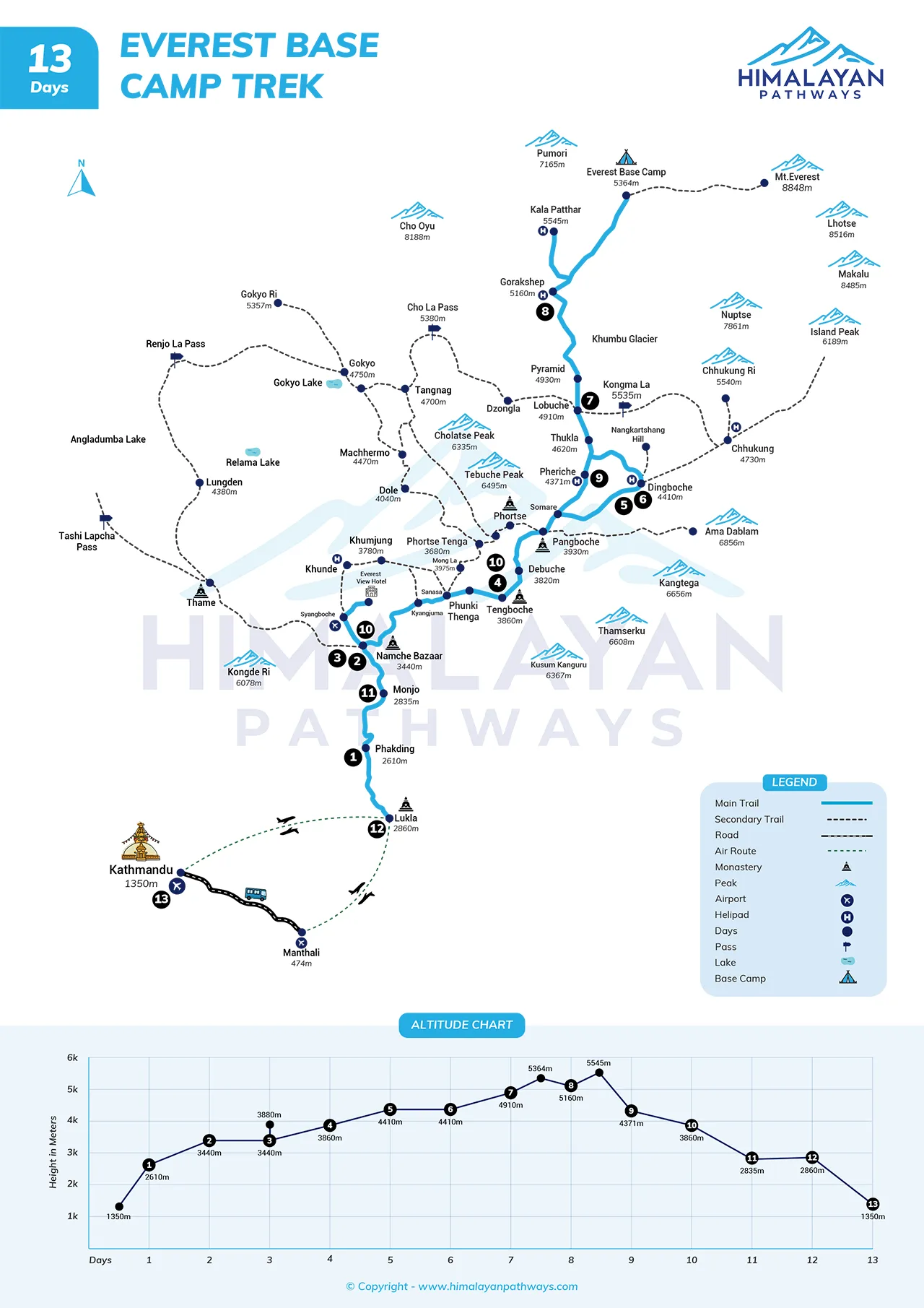
Everest Base Camp trek is not a very difficult trek, but rather it is considered difficult due to the high altitude. The routes are clearly marked and do not demand technical climbing and mountaineering. Nevertheless, each day, trekkers walk around 4-7 hours on uneven and rocky roads. The trek begins at Lukla (2,840 m / 9,318 ft) and ascends to Kala Patthar (5,550 m / 18,209 ft), and may be physically challenging.
Fitness and endurance are necessary, particularly during long uphill days like Namche to Tengboche and Dingboche to Lobuche. Namche (3,440 m / 11,286 ft) and Dingboche (4,410 m / 14,468 ft) help acclimate the body to the high elevation.
The Everest Base Camp trek can be successfully done by people who train properly. It is a challenge that is highly rewarding to many trekkers who feel quite accomplished once they get to the base camp.
Weather and Best Season
The weather is a major factor in the Everest Base Camp trek, and the timing of the season used is very critical. The best seasons are spring (March to May) and autumn (end of September to November). The weather in such seasons is generally clear, so the mountain sceneries are at its finest. During the day, the temperatures may be 5-15 °C, and at night, they may fall below zero degrees, particularly above Namche (3,440 m / 11,286 ft).
Trekking is a challenging task as the monsoon season (July-August) has heavy rainfall, slippery routes and low visibility. During winter (December-February), it gets extremely cold, especially in places that are higher, such as Gorakshep (5,164 m / 16,942 ft), and some lodges might even be closed. There is a possibility of trekking in the cold seasons, but it might result in snow and colder nights.
To enjoy the trek, the majority of the trekkers prefer spring or autumn when doing the Everest Base Camp Trek.
Food & Drink During the Trek
Everest Base Camp trek food is basic, nutritious and geared to provide energy to walk long distances. The trail has tea houses that offer three meals a day, breakfast, lunch and dinner. Typical foods are dal bhat (rice and lentils), vegetable curries, noodles, soups, potatoes, pasta, and momo (dumplings). Breakfast usually consists of porridge, eggs, toast or pancakes.
There are vegetarian and non-vegetarian dishes, but vegetarian dishes are considered to be more helpful at high altitudes.
The lodges have safe drinking water in the form of boiled and filtered water. Trekkers are advised to consume a lot of water to keep hydrated. Avoid alcohol, particularly at altitudes above 3,000 m / 9,843 ft, since it may cause altitude sickness. In general, the food in the Everest Base Camp trek is simple, though healthy.
Altitude Sickness and Suggestions
The general attitude sickness or AMS is a frequent issue on the Everest Base Camp trek since the route exceeds 3,000 m / 9,843 ft. The symptoms of the condition are headache, nausea, dizziness, and fatigue.
The way of being safe is proper acclimatisation. Your body can take its time to acclimatise to elevated altitudes by spending days in Namche (3,440 m / 11,286 ft) and Dingboche (4,410 m / 14,468 ft).
Trekking is recommended in slow walking with frequent pauses and consumption of water at least 3-4 litres per day.
Guides regulate health and oxygen, and emergency oxygen is on board in case of necessity. Diamox is also brought by many trekkers with the advice of a doctor. In case of increased symptoms, it is necessary to descend as fast as possible. The important thing to do is to listen to your body to ensure that your Everest base camp trek is safe and enjoyable.
Preparation and Fitness
Everest Base Camp Trek is a safer and more fun activity with good preparation. The trek will take a number of hours daily at high altitude; hence, endurance is essential. A 3-6 months training plan is advised and is centred around cardio exercises such as hiking, climbing up the staircase, cycling or walking on a treadmill. Leg strength training exercises, including squats and lunges, also come in handy.
Backpack walking with a weight of approximately 10-12 kg will enhance stamina and confidence. Psychological conditioning is also significant. Knowing the difficulties of being at altitude and having a positive attitude will be of assistance on bad days. Broken-in hiking boots are necessary. Trekkers are advised to pack light and consult with a doctor on any medical problems before the trip. When well prepared and fit, the majority of individuals can complete the Everest Base Camp trek and enjoy the experience.
Visa and Permits
In the case of an Everest Base Camp trek, every foreigner must have a Nepal tourist visa. This is easily available at Kathmandu airport. There are visa fees of USD 30, USD 50 and USD 125, which have to be paid in cash depending on 15 days, 30 days and 90 days. The passport should have a minimum of six months’ validity on the day of arrival.
Besides the visa, there are two trekking permits needed to do the Everest Base Camp trek. These are the Sagarmatha National Park Entry Permit and Khumbu Pasang Lhamu Rural Municipality Permit. Such permits are inspected at different spots on the trail, particularly near Monjo (2,835 m / 9,301 ft). Himalayan Pathways takes care of all the permits necessary for this trek.
You should also always carry your permits along with you on the trek because you will be required to present them at the official points along the way.
Health & Safety
The Everest Base Camp trek is very important for health and safety. A general health check and purchasing travel health insurance should be done before travelling. Regular vaccination is recommended. Carry any personal medication you might have.
To prevent stomach issues on the trek, consume completely cooked food and boiled or purified water. The most significant problem is altitude, especially in places above Namche (3,440 m / 11,286 ft).
Do as you are advised by the guide in walking pace, rest, and hydration. Guides are equipped with a first-aid kit and emergency oxygen. In case of such symptoms as headache, nausea or dizziness, notify your guide as soon as possible.
In extreme situations, evacuation via helicopters can be undertaken depending on the weather conditions. The Everest Base Camp trek is normally safe when taken well and with care.
Transportation
Everest Base Camp trek transportation involves road and air transport. The first day is spent on a private vehicle journey (approximately 4 hours) between Kathmandu (1,400 m / 4,593 ft) and Ramechhap. From Ramechhap, a 25-minute mountain-flight to Lukla (2,840 m / 9,318 ft), where the trek begins.
The entire trek is on foot from Lukla to Everest Base Camp and back to Lukla. On the completion of the trek, you fly back from Lukla to Ramechhap or Kathmandu, depending on the flight schedule of flight.
Mountains may change their weather rapidly, and it is a normal occurrence that flights will be delayed. In case of flight cancellation, you have to stay at Ramechhap or Lukla overnight. The Everest Base Camp trek is about flexibility when planning, and all the major transport arrangements are done by Himalayan Pathways, and it is included in your package.
Travel Insurance
Travel insurance is compulsory for the Everest Base Camp trek. Your insurance has to provide medical care and helicopter evacuation in times of emergency. It is also essential that your policy is inclusive of trekking over and above 5,000 m / 16,404 ft, since the normal insurance cover does not cover high altitude activities.
The peak of the trek is Kala Patthar (5,550 m / 18,209 ft), and therefore ensure that your insurance policy specifically states cover up to at least 6000 m / 19685 ft.
Always carry a copy of your insurance policy and emergency contact numbers on the trek. Your guide can assist in evacuation, in the event of a serious illness or injury; however, all the expenses will have to be approved and paid by your insurance provider.
Proper insurance provides a sense of security and an assurance that you can go about enjoying the Everest Base Camp trek without worrying about the insurance.
Alternative Routes
The Classic Everest Base Camp Trek is the Lukla-Namche-EBC trail, though several alternative routes exist and allow the trekker to have a different experience. The first is that one would begin at Jiri or Phaplu, which will also add 7-8 additional days of walking and enable slow accumulation of altitude before Lukla (2,840 m / 9,318 ft).
The Gokyo Lakes route is another route that is in demand and is characterised by impressive turquoise lakes and Gokyo Ri (5,357 m / 17,575 ft) views. Others who do this in conjunction with Everest Base Camp cross high passes, such as Cho La (5,420 m / 17,782 ft).
An Island Peak climb (6,189 m / 20,305 ft) is another mountain that adventure seekers can include, and they need additional permits and training.
To go back quicker, a helicopter can be taken off either close to Everest Base Camp or Kala Patthar (5,550 m / 18,209 ft). These choices are expensive and time-consuming, with customisation depending on preference.
Your Extra Expenses
The package does not cover some of the personal expenditures and must be budgeted ahead of time during the Everest Base Camp trek. The higher it is, the higher such costs are because of transportation challenges.
Typical additional costs are snacks, soft drinks, tea or coffee, Wi-Fi, charging devices and hot showers. The price of Tea house Wi-Fi is typically USD 5-10 per hour, whereas charging phones or cameras is USD 2-3 per device. Hot showers can range between USD 3 and 5, particularly past Namche Bazaar (3,440 m / 11,286 ft).
Other souvenirs one can purchase are prayer flags or handicrafts, which are mostly found in Namche. It is normal to tip the guides and porters.
Most trekkers will spend approximately USD 150-200 altogether. Extra food or lodging is also billed out by you in case the flights are delayed in Lukla (2,840 m / 9,318 ft). Carry cash in small changes, because there are no ATM past Namche.
Language & Communication
On the trek to the Everest Base Camp, language is not a significant issue. The national language is Nepali, and in Everest, a large number of Sherpa speak both Nepali and English. Trekking guides also speak fluent English and handle the communication with the lodge owners and locals. In tourist settlements such as Namche Bazaar (3,440 m / 11,286 ft) and Lukla (2,840 m / 9,318 ft), menus and signs are typically in English.
It is better to know some basic Nepali words, like Namaste (hello) or Dhanyabad (thank you), and form friendly contacts. The exchange of information among the trekkers, the guides, and the lodge employees is usually not difficult during the Everest Base Camp trek.
Basic English is widely spoken even in the higher villages, and therefore, it has very little to do with language barriers and the trekking experience.
Mobile Network, Internet & Charging
The Everest Base Camp trek has relatively low mobile network service coverage. Nepal Telecom (NTC) and Ncell SIM cards are operational in such villages as Lukla (2,840 m / 9,318 ft), Namche Bazaar (3,440 m / 11,286 ft) and Tengboche (3,860 m / 12,664 ft). The higher-level coverage generally is better with Ncell, and NTC may be inconsistent.
Lodge has Wifi access at an additional charge, but it is slow and intermittent. The possibility to charge electronic devices can be found at tea houses, and it typically costs USD 2-3 per device because electricity is obtained through solar power or generators.
It is strongly advisable to carry a power bank. There is a possibility of remaining in touch even when ascending to the Everest Base Camp trek, except that it would be bare and limited at the elevated areas.
Don’ts on the Trip
The Everest Base Camp trek has a couple of crucial things that should be avoided so that one can be safe and at the same time respect local culture. Take the increase gradually- walking slowly can help to avoid altitude sickness, particularly above Namche Bazaar (3,440 m / 11,286 ft). Do not use untreated water; use boiled or purified water. Do not walk as a single person and always stay together with your group.
Do not litter and remember to bring your trash to the right dumping sites since Sagarmatha National Park is a reserve. Never take pictures without permission from locals or monasteries, and dress modestly in places of worship.
Never walk at night or disregard weather forecasts, especially around high-altitude places. Show respect to the local culture by taking off your shoes prior to entering tea houses. These rules will help to make the Everest Base Camp trek a safer and more meaningful experience.
Trip Extension
Following the Everest Base Camp trek, a lot of the trekkers will decide to continue with the journey. One of the most used ones is the Gokyo Lakes Valley, which has beautiful lakes of turquoise and other views, such as the Gokyo Ri (5,357 m / 17,575 ft). The Everest Three Passes Trek is another adventure that provides a difficult circuit that has mountain passes.
And in the case of seasoned trekkers, it can be supplemented with an Island Peak climb (6,189 m / 20,305 ft) that will require additional permits, days, and technical equipment.
In case you choose to relax, then cultural tours of Kathmandu, jungle safari in Chitwan, or Lumbini are good alternatives. There are also helicopter tours back and forth, around the Kala Patthar (5,550 m / 18,209 ft). Trip extensions are optional with regard to costs and time, yet Himalayan Pathways can customise the tour to suit your interests following the Everest Base Camp trek.
Photography & Drone Rules
The Everest Base Camp trek is a high place of encouragement for photography since the landscape and the culture are quite spectacular. Phone cameras and smartphones are permitted all over the trail. Nevertheless, it is good practice to request permission to take photographs of people, monasteries or religious ceremonies.
There are very strict regulations on the use of drones. In the Sagarmatha National Park, which comprises a majority of the Everest Base Camp trek, flying drones is a criminal offence without special permission from various authorities. Drone permits are hard to secure, and hence, trekkers are highly discouraged from carrying drones.
By following these regulations, the natural environment and the privacy of the locals are preserved. The most basic photography can be used to record the memorable events of the trek.
Tips for First-Time Visitors
If this is the first time that you are doing the Everest Base Camp trek, preparation and attitude are both important. Begin training by walking, hiking or climbing steps to have stamina. Wear many layers and pack light since temperatures vary depending on the altitude. Keep hydrated, eat healthily and have power snacks.
Carry sufficient money, ATM is scarce past Namche Bazaar (3,440 m / 11,286 ft). Be flexible with the weather, and flights are changeable. Acclimatisation days should not be disregarded, and symptoms of elevation should not be overlooked. Warm up at night with an excellent sleeping bag.
And above all, listen to your guide and have fun on the trip. Everest base camp is hard, but a trip to remember when properly done.
 Unbeatable Holiday Offers - Save Up to 20% on Your Next Adventure!