Trek Difficulty
The Langtang Valley Trek is regarded as amoderate-level trek that beginners with minimal fitness can do. The walks will last between 5 and 7 hours a day on well-marked tracks with gentle rises and falls, and a few steps on stones. The trek is not very technical and can be taken by first-time Himalayan trekkers.
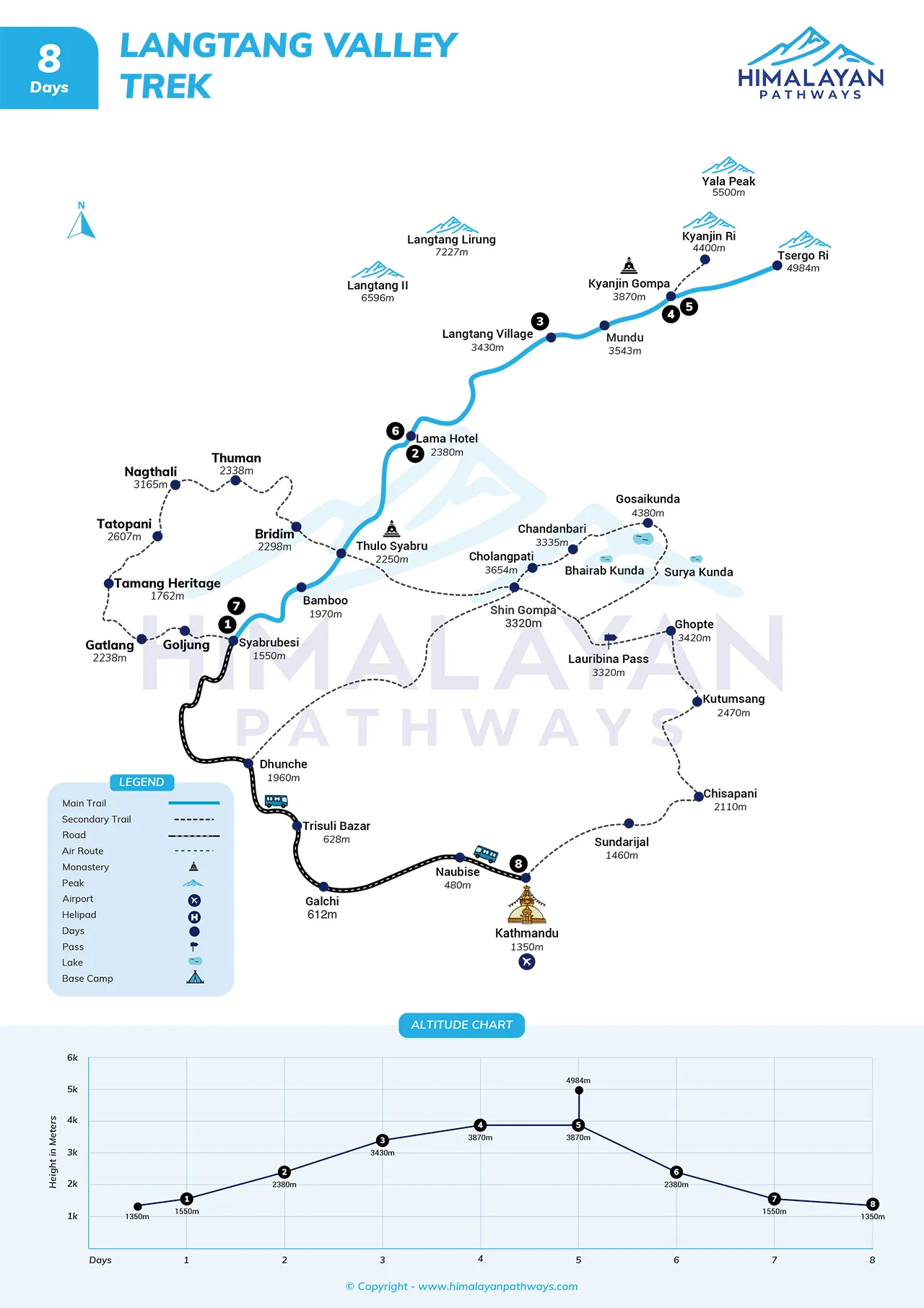
The highest point of the night stay is in Kyanjin Gompa (3,870m), and it can be handled given the right acclimatisation. The slow pace of walking, consumption of enough water, and frequent rests are among the conditions that make most trekkers complete the route comfortably and enjoy the scenery.
Weather and Best Season
The Langtang Valley Trek is best done during spring (March to May) and autumn (September to November). In spring, it is not hot, and the forests are covered with some colourful rhododendrons, making a beautiful landscape. Autumn is dry, daytime is the same, and evenings are clear with a magnificent view of the mountains. The seasons are the most comfortable to walk in,but nights can be chilly in elevated places.
During monsoon season (June to August),rain is heavy, trails are usually muddy, leeches are common, and the weather is often cloudy, so views are usually restricted. The cold season (December-February) is fairly quiet, and there are fewer trekkers, and snowy mountain landscapes, although snowfall may cover the tracks at higher levels.
Whatever the time of the year, the weather in the mountains is unpredictable, and therefore, the right clothing, rain gear, and a flexible schedule are necessary.
Food & Drink During the Trek
The Langtang Valley Trek boasts of food that is prepared in local teahouses, and it is easy, nutritious, and trekking-friendly. Dal bhat is the most typical meal made up of rice, lentil soup, and vegetables, which are an excellent source of energy, and can be replenished. One can also have noodles, fried rice, momos, soups, pancakes, porridge, and egg dishes. Breakfast and lunch are warm and simple, whereas dinner is a substantial meal to restore your strength after days of strenuous walking.
Vegetarian meals are suggested in the higher elevations as they are fresher and easier to digest at the altitude. Always drink boiled, bottled or treated water only to prevent water-borne diseases. Teahouses sell the boiled water at a minimal price, or you can take purification pills.
At elevated altitudes, alcohol is not recommended since it heightens the occurrence of altitude-related problems.
Altitude Sickness and Acclimatisation
The Langtang Valley Trek has acclimatisation to minimise the chances of altitude sickness. The itinerary is gradual with overnights at Langtang Village and Kyanjin Gompa so that your body can get used to it.
Walk at a gradual pace, keeping hydrated, and avoiding alcohol. Mild symptoms like headaches or shortness of breath may also appear, and they must be reported to the guide instantly.
When the symptoms become severe, the best option would be to cease ascending or going to a lower altitude. Our guide at Himalayan Pathways will have a first aid kit and will checkthe oxygen level whenever needed.
There is very little possibility of altitude issues during this trek, but emergency helicopter evacuation may be organised when needed. Diamox is used by some trekkers based on a doctor’s consultation.
Therefore, appropriate acclimatisation would make the trekking experience safe and pleasant.
Preparation & Fitness
The Langtang Valley Trek does not require any special fitness, but simple training will make the experience much more pleasant. The frequent cardiovascular exercises like walking, jogging, cycling, or running up the stairs prior to the trek help in endurance building.
Simple exercises help you to strengthen your legs and make the experience more comfortable on long ascents and descents. Trekking boots are required to be well broken in before the trek to prevent blisters.
Mental training is also significant because the weather and length of the trail may change. In case you have some medical conditions, you must consult your doctor and notify us beforehand to slow down the speed.
Most trekkers walk through the trek with relative ease, stability during walking, and with sufficient assistance given by guides and porters.
Visa and Permits
You will need a visa to enter Nepal. The Nepal tourist visa is usually granted to most travellers at the Kathmandu airport. The Langtang Valley Trek only requires a 15-day visa. Your passport must have at least 6 months of validity to get the visa, along with a few passport-sized photos.
In the case of trekking, two permits are needed, namely the Langtang National Park Entry Permit and the TIMS card. These permits assist in controlling the tourism and the safety of the trekkers.
We, Himalayan Pathways,organise all the necessary permits on your behalf, and you do not have to think about paperwork. All you have to do is submit a copy of a passport and a passport-size photo when you arrive.
Checks of permits are performed at Dhunche before entering the park, so you must carry your permits and passports with you during the trek.
Health & Safety
The Langtang Valley Trek prioritises health and safety, with trained guides carrying first-aid kits to handle common issues such as blisters, headaches and minor injuries.
It is important to adhere to good hygiene, regularly apply hand sanitiser, consume only treated water, and consume freshly cooked foods.
The tracks are normally easy to follow, but a lot of attention should be taken on the rocky or slippery areas, particularly after it rains. Walk and stay with your guide and do not wander alone.
The Langtang region is safe, andit has minimal chances of theft, but still, one should keep their valuables safe.
High altitude trekking and emergency evacuation travel insurance is compulsory. This gives fast access to medical attention when it is required. The trek is safe, well-organised, and fun for all the trekkers regardless of their experience levels.
Transportation
The Langtang Valley Trek package involves road transport from Kathmandu to Syabrubesi round-trip. Travel is organised in the form of a shared tourist bus or a private jeep, depending on your preference and group size. The journey lasts approximately 7 to 8 hours and provides beautiful attractions of various rivers, hills, and villages.
Beyond Dhunche, the road turns rough and winding and is bumpy. Trekkers with motion sickness can take pills before travelling, and they should sit at the front of the vehicle to prevent it.
We leave Kathmandu early in the morning to avoid traffic and make short stops on the way to have meals and restrooms.
Once the trek is completed, you get back along the same route and reach Kathmandu by the end of the afternoon.
Travel Insurance
The Langtang Valley Trek requires travel insurance, which is necessary in order to keep you safe. The insurance should include high altitude trekking up to approximately 5,000 meters and emergency evacuation by helicopter.
Medical treatment and evacuation may be expensive for you in the absence of insurance in case of severe illness or injury, in rare situations. Being well covered would guarantee a stress-free trek.
Before the departure, you will be requested to give your insurance policy number and emergency contacts to Himalayan Pathways so that we can easily contact them in case of emergency or need. Always ensure that Nepal and activities that involve trekking are covered by your insurance.
Bring a copy of your insurance documents, either digital or on paper, during the trek and leave one with members at home. In the majority of cases, trekkers do utilise the insurance; however, being covered means that you can be sure about your safety even in cases of unfortunate circumstances.
Alternative Routes
Langtang has several route options that are suitable for trekkers who have more time or have certain interests. The Tamang Heritage Trail is one of the choices that can be made, and it is oriented towards cultural immersion, taking the form of traditional villages, homestays, and other local customs.
The other extension is the Gosaikunda Lake route, an alpine lake journey that is holy, but with the addition of height and difficulty. This variant involves crossing a mountain and will pay rewards to those trekkers with breathtaking scenery and spirituality.
You can also have custom itineraries, like additional days of acclimatisation or side trips. Flexibility enables the trek to be designed to your interests, schedule, and fitness, and at the same time, experience the beauty of Langtang.
Himalayan Pathways will customise the trek according to your interest, budget and fitness so that you can enjoy Nepal to the fullest.
Your Extra Expenses
Although the trek package includes most of the necessities, you are likely to incur personal costs during the trek. Soft drinks, alcohol, or bottled water are sold separately, and the prices are higher up the mountain.
Teahouses charge small fees for using hot showers, Wi-Fi, and charging electronic devices. They are optional services to make your journey easier in the mountains. The higher you go, the higher the cost of things and services will go.
It is the norm to tip the guides and porters, provided that you are pleased with their performance. Though it is not obligatory, it is a significant gesture of appreciation.
The accommodation and meals are not included in Kathmandu, and you must make arrangements for them on your own. Bring sufficient Nepali rupees in small change since there are no ATM in the trail.
Language & Communication
Most trekking areas of Nepal, including Langtang, have a large number of English speakers. Your guide speaks fluent English, and the majority of the lodge owners know some simple phrases to use in everyday communication.
It is welcomed and usually can leave a smile when learning a couple of words in Nepali, like “Namaste” as hello or Dhanyabad as thank you. Nepali is also used by the local Tamang and Sherpa communities, as well as their native languages.
Along the Langtang Valley Trek, the mobile network will have very limited coverage past Syabrubesi, and access to the internet is unreliable. Constant internet interactions cannot be expected during the trek.
Your guide can help in emergency communication by using local contacts or park offices. Altogether, the trek provides the opportunity to go offline and become closer to nature and the local culture.
Mobile Network & Internet
The mobile connectivity in the Langtang area is extremely minimal, and you would be dealing with long durations with no signal. The coverage of Nepal Telecom and Ncell becomes weak or completely non-existent across the trail, after Syabrubesi.
Even in such locations as Langtang Village or Kyanjin Gompa, you might sometimes pick up a faint signal, but it is unreliable. A small number of lodges have satellite Wi-Fi that is charged, but the speed is very low, and it depends on the weather.
In teahouses, electricity can be provided by using solar panels or generators. Charging your electronic gadgets is generally provided at a low price in the tea houses and lodges. Power banks are greatly suggested to reduce the cost of gadget charging and as a backup.
The majority of the trekkers prefer to be completely unreachable and to take the silence of the mountain. You can get back in touch so easily when you come back to Kathmandu.
Don’ts on This Trip
The culture and nature are highly regarded during the trekking in Langtang. You must never step on mani walls nor sit on chortens, but always go round them in a clockwise direction. Shoes and hats should be removed inside the houses and monasteries, and taking photos should be requested before entering monasteries.
Avoid littering at all times. Throw your rubbish in trash bin in the villages and never litter the trails. Cigarette butts must be fully extinguished and disposed of safely.
Children should not be given sweets or money because this promotes begging. Instead, you can support local schools or health posts, which would be a better idea to help.
Always remain with your guide and group, even in the case of short breaks. Go slow and take your time because you must not overdo it to be on the safe side and to enjoy the experience.
Trip Extension
Nepal has numerous rewarding extensions in case you have additional days afterthe Langtang trek. The most popular option is a Chitwan Jungle Safari, during which you can visit the Chitwan National Park and see such animals as rhinos, deer, and crocodiles.
Another excellent relaxation place is Pokhara. You will be able to walk around lakesides, go on small hikes, view the sunrise, or participate in adventure sports activities such as paragliding over a mountain.
White-water rafting on the Trisuli River is the best if you are an adventure lover. It best complements your trip back to Kathmandu and also makes your trip exciting.
Cultural tours or an overnight stay in Nagarkot or Dhulikhel within the Kathmandu valley give the view of the sunrise of the Himalayas. All these extensions would contribute to the diversity and richness of your trip to Nepal.
Photography & Drone
Langtang presents an astounding photography experience in terms of the mountain landscape and village life. The ideal time to take clear and dramatic shots is during early mornings and late afternoons when there is sufficient natural light to achieve the shots.
Never take a picture of the locals without their consent, particularly of monks and older people. The majority of them are glad to be photographed decently.
The use of drones is limited in national parks, and permission must be granted. The drones should not be flown without permission, as this may disturb other trekkers, wildlife, and the yaks. On this account, it is better to avoid carrying a drone.
Rather, avoid getting distracted by your camera or phone. The mountain air is very clean, offering excellent visibility, especially during autumn and winter. At other times as well, it can be just as rewarding to put the camera away and simply take in the moment.
Cultural Festivals on the Trail
Festivals can have special cultural experiences through trekking during the festival seasons. Losar is the Tibetan New Year that is marked by Tamang communities through songs, dancing, and traditional food.
You can also observe decorations or celebratory sounds during the Dashain and Tihar seasons, particularly in Kathmandu. These celebrations are an indication of the rich Nepalese culture.
Prayer ceremonies can also be conducted in local monasteries during the full moons or special days. At Kyanjin Gompa, it is possible to observe the traditional rituals and chanting.
Your guide will tell you whether there is any festival or ceremony during your trek or not. Being respectful enables you to have a better understanding of local life and traditions.
Tips for First-Time Nepal Visitors
To have fun in Nepal, it is important to stick to hydration and proper eating. Elevation and daily walks may exhaust energy fast, and thus, consuming water on a regular basis and having a balanced diet may enable your body to adjust and remain very strong during the trip.
Weather and conditions at the mountain change with the slightest notice, and hence layered clothes are highly helpful. Make sure your feet are well protected by sturdy trekking shoes and warm, comfortable socks, as they greatly reduce discomfort and make long walks much easier.
It is also important to have a sufficient amount of Nepali rupees outside the city. Carrying cash, especially small bills, is particularly handy, since change is sometimes scarce in the villages. This makes it easy to deal with small bills and tips.
It is a privilege to consider local traditions and make your experience even more meaningful. Cultural awareness is demonstrated by such things as simple gestures, such as greeting people by saying Namaste, dressing modestly, and taking off shoes when necessary.
Being patient and open-minded is the only thing that can help you enjoy the beauty of Nepal, its people, and the relaxed lifestyle in Nepal.
 Unbeatable Holiday Offers - Save Up to 20% on Your Next Adventure!