Trek Difficulty of the Kanchenjunga Trek
Kanchenjunga Trek is among the most difficult trekking trails in Nepal. Kanchenjunga Base Camp Trek goes as high as 5,140m (16,864ft), where the air is extremely thin. You take a walk of 5-7 hours per day, and it may extend to longer durations during the pass crossings in the Kanchenjunga Trekking Itinerary.
The tracks feature sharp ascents, rocky routes, glaciers and isolated valleys. Infrastructure is primitive, and climatic conditions can be severe.
This Kanchenjunga Trek requires good physical fitness, endurance and a strong mind. Prior High-altitude trekking experience is highly desirable.
The acclimatisation days are beneficial, yet the trekkers have to walk gradually and listen to their bodies. Kanchenjunga Base Camp Trek is very rewarding and not a beginner trek because of the altitude, remoteness and very long trekking days.
Weather and Best Season for Kanchenjunga Trekking
The most appropriate season in the Kanchenjunga Trek is spring (March-May) and autumn (September-November). The seasons provide a clear sky with stable weather during the Kanchenjunga Base Camp Trek. In spring, the woods are in blossom, and in the fall, one can see the most mountainous landscapes.
There is a fluctuation in temperatures in the Kanchenjunga Trekking Itinerary. At lower altitude (below 5,140m, 16,864ft), the nighttime temperature in base camps drops to under -10 °C (14degF).
Winter is heavily snowed;the pass is closed and very cold. Rain, landslides and low visibility are some of the effects of the monsoon. In the mornings, it is generally clear; afternoons may be cloudy. Trekkers have to have warm clothing and rainwear.
The weather is very volatile in the mountains, and to have a safe experience with the Kanchenjunga Trek, one must prepare to face the weather.
Food & Drink During the Kanchenjunga Trek
Food in the Kanchenjunga Trek is basic yet fulfilling. The Kanchenjunga Base Camp Trek has tea houses that provide nourishment to spend long days in the Kanchenjunga Trekking Itinerary. The main dish is called dal bhat (rice, lentils, vegetables), and it can be filled up. Noodles, fried rice, potatoes, soups, porridge, eggs and momos are other foods at the low altitude.
Not all meat is fresh, and there is a limitation on the amount of meat one should consume. A big number of trekkers consume vegetarian food.
Safe drinking water is highly essential. Boiled or purified water should be used as opposed to stream water. Take lots of water, tea and soup.
One should not consume alcohol at altitudes higher than 3,000m (9,843ft) since it dehydrates and slows down the acclimatisation process during the Kanchenjunga Trek.
Altitude Sickness on Kanchenjunga Base Camp Trek
A major issue in the Kanchenjunga Trek is altitude. Kanchenjunga Base Camp Trek reaches the altitudes of over 5000m (16404 ft), where there is a low amount of oxygen. This Kanchenjunga Trekking Itinerary contains acclimatisation days to minimise the danger. Altitude sickness has symptoms such as dizziness, nausea, fatigue and headache.
The guides should be informed as soon as the symptoms appear. Rest or descent to get out of high altitude is the most appropriate treatment.
Problems are avoided by walking slowly, drinking water, and not taking alcohol. Guides control health and have first aid equipment.
All individuals respond differently to altitude, and therefore, their first point of concern during the Kanchenjunga Trek is safety. Acclimatisation is necessary to make the journey safe and enjoyable.
Preparation and Fitness for Kanchenjunga Trek
The Kanchenjunga Trek requires good preparation. Kanchenjunga Base Camp Trek needs good legs, stamina, and psychological stability. Practice for at least two months before the Kanchenjunga Trekking Itinerary. Hiking and stair climbing, cycling and jogging are the activities that are beneficial in building stamina.
Train walking with a backpack. High-altitude trekking experience above 3,500m (11,483ft) is highly beneficial in the past. Exercises that help in lengthening and bending the body minimise the risk of injury.
It is also necessary to prepare mentally since the Kanchenjunga Trek is a long and distant one. Carry good equipment and broken-in shoes. Being well-fit and well prepared, the Kanchenjunga Base Camp Trek will be a difficult yet memorable Himalayan adventure.
Visa and Permits
In the case of the Kanchenjunga Trek, every traveller will require a Nepal tourist visa, which is usually obtained once the individual reaches Kathmandu. Kanchenjunga Base Camp Trek is in a restricted zone and is therefore in need of a special permit. These are the Kanchenjunga Restricted Area Permit and the Kanchenjunga Conservation Area Permit.
It is not recommended that a person take a solo walk in this area; therefore, the Kanchenjunga Trekking Itinerary should go through a licensed guide and a minimum of two trekkers.
There are permit checkposts on the trail, particularly around Taplejung (1,820 m / 5,971 ft) and Ghunsa (3,475 m / 11,401 ft). All the paperwork is handled by our team from Himalayan Pathways, and your Kanchenjunga Trek will be a hassle-free and unproblematic adventure.
Health & Safety
The Kanchenjunga Trek is a very unsafe place due to the isolation and elevated altitude. The Kanchenjunga Base Camp Trek extends as far as 5,000 m (16,404 ft), which is one of the altitudes where altitude sickness is experienced.
Our guide keeps watch over your health and has first aid. Slow walking, consuming safe water, and adhering to the Kanchenjunga Trekking Itinerary correctly will allow one to be sufficiently acclimatised.
The trails may be rocky, steep, and narrow, and in such a case, trekking poles can help. Foods in tea houses are safe, provided they are fresh and simple meals. Keep valuables secure. The area is also quiet, and people are hospitable, so the Kanchenjunga Trek is not a dangerous experience as long as you are on your guard and take the advice.
Transportation
Coming to the beginning of the Kanchenjunga Trek is an adventure. The first thing is that you fly from Kathmandu to Bhadrapur. Then you pass by hills to Taplejung (1,820 m / 5,971 ft), the entrance to the Kanchenjunga Base Camp Trek. The roads may be rough, yet have beautiful views.
Once the Kanchenjunga Trekking Itinerary is complete, you can be driven back from Yamphudin (2,080 m / 6,824 ft) by jeep and then take a flight back to Kathmandu. Flights can be influenced by the weather, and additional time is scheduled.
Days of travelling are very long and thrilling, and they assist you in viewing rural Nepal prior to joining the remote mountain paths of the Kanchenjunga Trek.
Travel Insurance
Kanchenjunga Trek needs travel insurance since it involves high-altitude locations where you go to remote locations. The Kanchenjunga Base Camp Trek is at an altitude of more than 5,143 m (16,873 ft); therefore, insurance has to cover trekking above 5,000 m (16,404 ft) and helicopter rescue.
Without insurance, medical treatment and evacuation are costly. The Kanchenjunga Trekking Itinerary has some remote locations that can take quick rescue because of sickness or injury.
Flight delays and cancellations of the trips are also assisted by insurance. Carry along your policy information on your Kanchenjunga Trek to have emergency assistance that may be provided as soon as necessary.
Alternative Routes
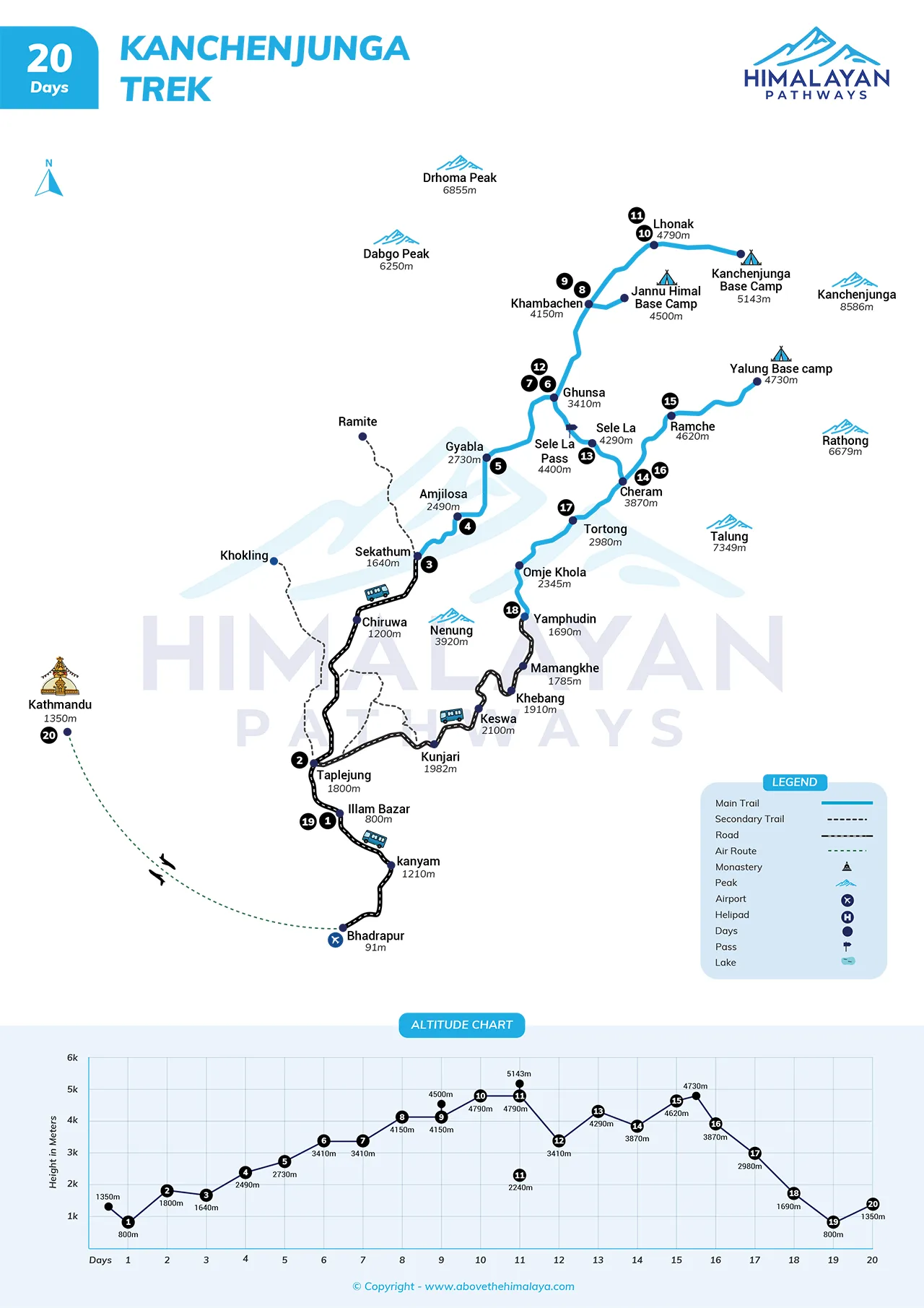
In the standard Kanchenjunga Trekking Itinerary, the complete circuit of the Kanchenjunga Trek is 20 days, although there are options of shorter routes. One is to hike to Kanchenjunga North Base Camp only (to Pangpema) at 5,143 m / 16,873 ft and back the same way. This variation of the Kanchenjunga Base Camp Trek lasts approximately 14-16 days and nonetheless offers close-ups of the third-highest mountain in the world.
Alternatively, one can only visit South Base Camp, Oktang (4,840 m / 15,879 ft), by Yamphudin.
Other trekkers continue the Kanchenjunga Trek to the even more remote Lumba Sumba Pass (5,160 m / 16,929 ft), where they have to camp. Each of the options in the Kanchenjunga Trekking Itinerary has been designed keeping in mind adequate acclimatisation and safety.
Your Extra Expenses
In the Kanchenjunga Trek, a good portion of the trek expenses would be paid, exceptfor a few personal costs. Nepal visa, Kathmandu hotels and meals are not part of it. Additional beverages such as bottled water, soda or even snacks are an extra charge on the Kanchenjunga Base Camp Trek.
There is also the charging of devices, hot showers, and limited internet at tea houses on the Kanchenjunga Trekking Itinerary, which demand little payment. The practice of tipping the guides and porters is the norm when the Kanchenjunga Trek has been completed.
You can also use the money on souvenirs or gear. Because of the absence of ATMs outside of Taplejung (1,820 m / 5,971 ft), you will need sufficient Nepali cash to go through with the entire Kanchenjunga Base Camp Trek trip.
Language & Communication
The Kanchenjunga Trek goes through various communities. Most of the locals in lower villages such as Yamphudin (2,080 m / 6,824 ft) are Limbu and Rai. There are communities of Tibetan origin in higher villages like Ghunsa (3,475 m / 11,401 ft).
Nepali is a common language, and your guide will translate it. In the Kanchenjunga Trekking Itinerary, communication is not difficult due to the use of English by the staff on the treks.
Namaste, a simple word that is learnt, is useful to the Kanchenjunga Trek as it makes communicating with the locals easier.
The internet and phone network are poor, and cultural interaction is better than online communication. A smile and gestures would go far throughout the Kanchenjunga Base Camp Trek.
Mobile Network, Internet & Charging
The connection is likely to be minimal during the Kanchenjunga Trek. Network connectivity may be possible up to the Taplejung (1,820 m / 5,971 ft) or Yamphudin (2,080 m / 6,824 ft), but above the Kanchenjunga Base Camp Trek, e.g. Ghunsa (3,475 m / 11,401 ft), networks are rarely active.
The Kanchenjunga Trekking Itinerary has practically no Internet along its route. Some of the tea houses charge a fee to charge devices with solar energy. Carry a power bank on the Kanchenjunga Trek.
Low temperatures decrease the battery life and, therefore, keep electronics warm. This is a digital detox allowing trekkers to have the natural beauty of the Kanchenjunga Base Camp Trek in its whole.
Don’ts on This Trip
When the trek is going on Kanchenjunga, always keep your guide with you and never walk alone since the area is isolated. Observe your Kanchenjunga Trekking Itinerary and pay attention to your body in elevated heights. The Kanchenjunga Base Camp Trek exceeds 5000 m (16404 ft), so do not disregard the indications of sickness.
Clean up your litter during the Kanchenjunga Trek. Be considerate of mountain village culture and traditions. Do not disturb wild animals in this conservation zone.
Alcohol should be limited during the Kanchenjunga Base Camp Trek since it interferes with acclimatisation. The responsible behaviour will guarantee that the Kanchenjunga Trekking Itinerary will be a safe and memorable experience.
Trip Extension
Most trekkers who have successfully undergone the trek to Kanchenjunga take time to relax or see more of Nepal. Following the Kanchenjunga Base Camp Trek, which is a tiring journey, a Chitwan safari will provide hot climatic conditions, jungle lodges and the rhinos and crocodiles.
Another extension that has to be added to the Kanchenjunga Trekking Itinerary is Pokhara, which offers views of the lakeside and Annapurna.
Another place to visit before or after high-altitude trekking above 5,143 m (16,873 ft) on the Kanchenjunga Trek is the Kathmandu Valley heritage sites.
These additions provide your body with time to rest and, at the same time, experience the diversity of Nepal. The inclusion of rest days following the Kanchenjunga Base Camp Trek would enable you to get used to the altitude of the mountain in the lower areas.
Photography & Drone Rules
The Kanchenjunga Trek presents some of the best photography opportunities, be it in the form of glaciers or villages along the Kanchenjunga Trek Itinerary.
Never snap pictures of individuals without first seeking their consent when in the Kanchenjunga Base Camp Trek.
Photography can be limited in monasteries. When taking shots of a view of high places, take care when on high places such as Pangpema (5,143 m / 16,873 ft).
The use of drones in the Kanchenjunga Trek is usually restricted to the use of government permits, as per border and conservation regulations. The Kanchenjunga Base Camp Trek should not have drones, according to most of the trekkers.
Bring extra batteries since low temperatures at elevated altitudes and low temperature drain the power very fast during the Kanchenjunga Trekking Itinerary.
The Cultural Festivals on the Trail
The Kanchenjunga Trek is conducted in culturally enriched villages. You can see Hindu festivals, such as Dashain and Tihar, which can be observed in the lower regions, such as Yamphudin (2,080 m / 6,824 ft), during the Kanchenjunga Base Camp Trek.
In the more elevated villages, such as Ghunsa (3,475 m / 11,401 ft), Buddhist ceremonies are widespread, and Losar is a holiday. These are cultural beauties in the Kanchenjunga Trekking Itinerary.
Limbu people also sing songs and dance during harvest time. The Kanchenjunga Trek is culturally significant even in the absence of major events, everyday life, prayer flags, and visiting monasteries. Adhere to traditions and request permission before taking photos at the Kanchenjunga Base Camp Trek.
Tips for First-Time Nepal Visitors
When visiting Nepal for the first time, you should know the basic manners in the Kanchenjunga Trek. Bow down saying Namaste, wear decently, and observe local culture at the Kanchenjunga Trekking Itinerary.
To be safe on the Kanchenjunga Base Camp Trek, drink only purified water and consume freshly cooked food. Bring a sufficient amount of Nepali cash, as there are no ATMs after Taplejung (1,820 m / 5,971 ft).
It is good to reward trekking staff with tips after the Kanchenjunga Trek. In urban areas, bargaining is acceptable, but not in the mountain huts.
Weather and flights also fluctuate, and therefore one should be flexible when making plans before or after high altitude trekking above 5, 000 m (16, 404 ft) on the Kanchenjunga Base Camp Trek.
 Unbeatable Holiday Offers - Save Up to 20% on Your Next Adventure!