notification-icon Unbeatable Holiday Offers - Save Up to 20% on Your Next Adventure!

Manaslu Larke Pass Trek

duration-1

Duration

14 Days
difficulty-icon1

Trip Difficulty

Moderate
max-altitude

Max. Altitude

5106 Metres
group-size-icon

Group Size

2-20 People
best-season

Best Season

Mar-May & Sep-Nov
transportation

Transportation

Bus
accommodation

Accommodation

Hotel, Teahouse
meals

Meals

Breakfast, Lunch, and Dinner
  • Your safety, our no 1 priority
  • Best price guarantee
  • Experienced & dedicated team
  • Easy booking, no hidden charge
  • You can customize this trip
profile-expert

Live Chat 24/7

overview

Trip Overview

The Manaslu Larke Pass Trek is one of Nepal’s most rewarding high-altitude trekking adventures, offering a remarkable mix of mountain scenery, remote villages, cultural richness, and a challenging Himalayan pass crossing. This is a trip across the relatively untouched Manaslu area, where traditional lifestyles, Buddhist heritage, and the dramatic natural scenery make this a trek that you will never forget. This adventure is more serene and more true to the original Himalayan experience than other busier trekking paths, and it is perfect for those travelers who want to connect more with the Himalayas.

It starts with a picturesque drive through Kathmandu to the isolated hills of the Gorkha region, where the trekking trail meanders slowly through terraced farmland, river valleys, suspension bridges, and quaint mountain villages. As the Manaslu Larke Pass Trek advances, the terrain turns out to be of green subtropical forest with the alpine meadow, rocky highlands, and glacier environment. Villages like Samagaon at (3,520 m / 11,549 ft) and Samdo at (3,875 m / 12,713 ft) give an idea about the powerful Tibetan Buddhist culture that influences life in this remote mountainous area.

One of the most notable features of the Larke Pass Trek is the Larke La Pass (5,106 m / 16,752 ft), which is the summit of the trek. The pass needs perseverance, gradual steps, and adequate acclimatization, yet the prize is a truly spectacular panorama of other Himalayan peaks such as Manaslu, Himlung, Kanguru, and Annapurna that can be seen. Trekkers can also have other side trips like the Birendra Lake or Manaslu Base Camp at (4,800 m / 15,748 ft) on their way, which provide added adventure and scenic interest.

The Manaslu Larke Pass Trek is a challenging yet attainable trek by well-prepared trekkers who have moderate to good fitness. The path is a mix of hiking, teahouse-level lodging, unpredictable weather, and the remoteness of mountain conditions, so it is essential to prepare. Nevertheless, the feeling of achievement and the depth of the journey are well worth it in spite of all the challenges.

This is a fantastic route to take for travelers who want to have an adventurous Himalayan crossing experience that has a cultural touch and is not as full of people. Himalayan Pathway is a company that plans trek trips with skilled and knowledgeable local teams that assist trekkers in having a safe, comfortable, and unforgettable mountain adventure throughout their stay on the mountain.

Highlights of Manaslu Larke Pass Trek

  • Traverse the spectacular Larke La Pass (5,106 m / 16,752 ft) with a breathtaking panoramic view of the Himalayas.
  • Experience the untouched beauty of Nepal’s remote and less crowded Manaslu region.
  • Visit the real mountain villages with Tibetan Buddhist culture and traditions.
  • Experience breathtaking sights of Manaslu, Himalchuli, Ganesh Himal, Himlung, and Annapurna mountain ranges along the trip.
  • Visit the cultural landmarks of Samagaon (3,520 m / 11,549 ft), one of the cultural sites of the trek.
  • See the beautiful Birendra Lake (3,460 m / 11,352 ft) and its glacial-clear reflections.
  • Challenge yourself on one of Nepal’s most rewarding high-altitude trekking adventures.
  • Explore the dramatic scenery of forests and river canyons, glaciers, and alpine deserts.
  • Experience breathtaking mountain mornings in some isolated Himalayan villages such as Samdo (3,875 m / 12,713 ft) and Dharamsala.
  • Experience the ideal combination of adventure, culture, wilderness, and an off-the-beaten-path trekking experience.
itinerary-icon

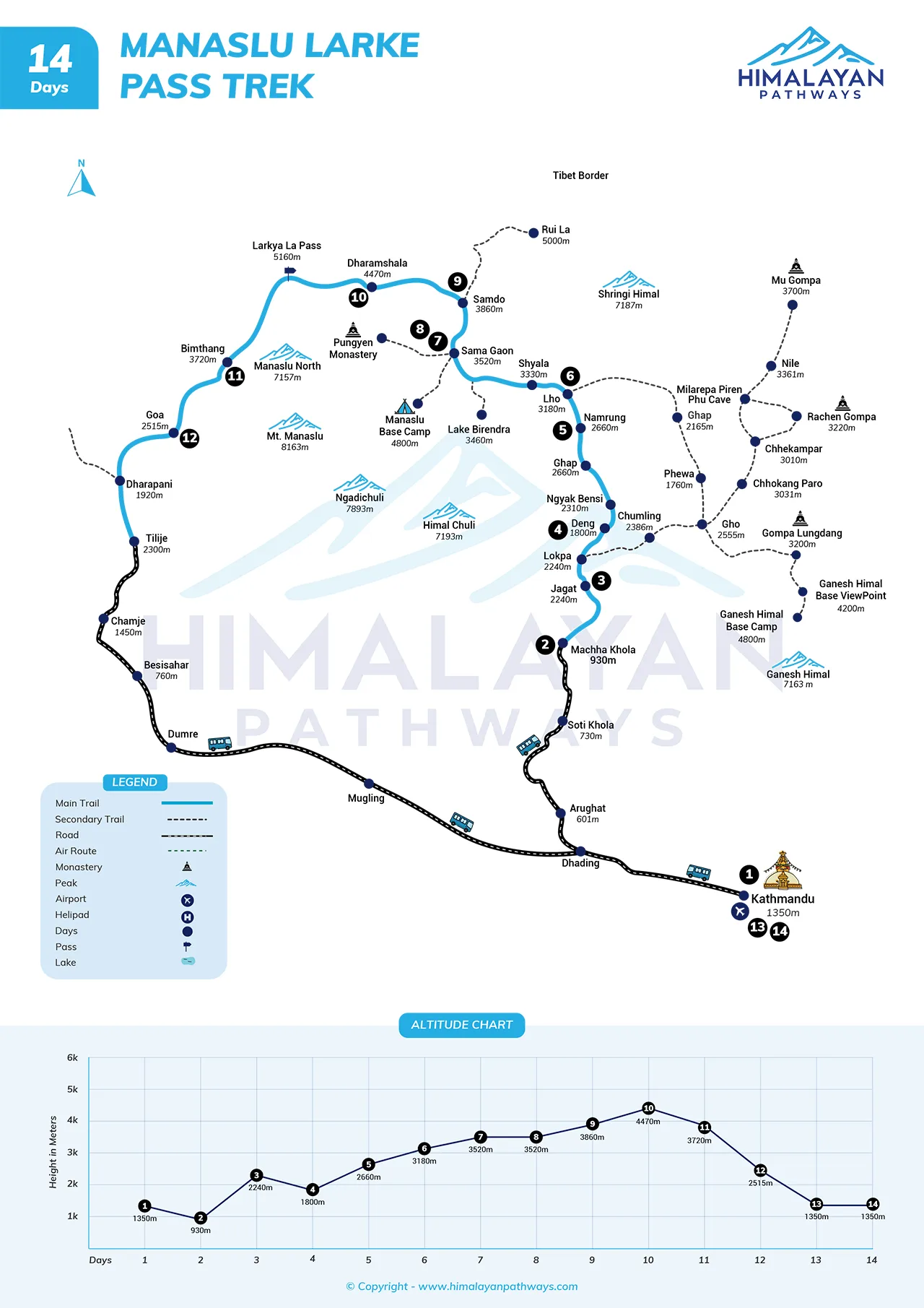
Manaslu Larke Pass Trek Itinerary

The Manaslu adventure begins with a Kathmandu welcome. When we arrive at Tribhuvan International Airport, one of our team members will receive you and help with the luggage, then take you to your hotel in the city. It is a short drive, and your initial view of a bustling Nepal capital.

Once you check into your hotel, you can relax or venture out to experience the Kathmandu ambience. The city is rich in its culture, local shops, and busy streets, which make it an interesting place to start your trip.

Afterwards, when all the trek members have arrived, a briefing by your trekking guide regarding the impending trek of Manaslu Larke Pass will be given. It is also time to do final preparations on gear and to shop in case there is still something to acquire. It is suggested that an early night should be taken tomorrow as it will be a long drive.

activity-icon

Activity & Duration

Airport Transfer and Preparation, 30 Minutes
altitude-icon

Highest Altitude

1,350m / 4,429ft (Kathmandu)
meals-icon

Meals

Breakfast
accommodation-icon

Accommodation

Hotel

The morning after breakfast, you start your trip to the Manaslu region. The road leaves Kathmandu when it goes through Kalanki and Thankot and then into the Trishuli Valley. The initial section of the drive is on the highway leading to Pokhara.

The path then shifts northwards to Dhading after a few hours. The tarmac slowly turns to a bad road track as the road leads to the Upper Gorkha area. En route, you can view mountain scenery in the far distance, such as Manaslu, Ganesh Himal, Langtang, and Annapurna.

The road passes through Arughat, a bustling market-town, and then over green terraced hills and hamlets: Maltar, Arkhet, and Soti Khola. The movement is continued past the former trekking halt of Soti Khola to Machha Khola, where the night is spent.

activity-icon

Activity & Duration

Drive, 9 Hours
altitude-icon

Highest Altitude

1,350m / 4,429ft (Machha Khola)
meals-icon

Meals

Breakfast, Lunch, Dinner
accommodation-icon

Accommodation

Teahouse

This is your first day of the trekking adventure. The path starts with the easy path, which traces the Budhi Gandaki region, going up and down the path, but through varying conditions. The stroll will acquaint you with the natural beauty of the lower Manaslu area.

On the way, you will come to the popular natural hot spring region of Tatopani at (1,040 m / 3,412 ft) and pass by such villages as Tharo Khola and Khorlabesi. A refreshing landmark on the road. Shringi Peak in the distance provides a picturesque mountain background.

The path runs through a broader valley to Dobhan Khola and then up to Yaru Khola, where a long steel bridge spans. Another steep climb up Thulo Dhunga will lead to Jagat, a village that is located above the river valley.

activity-icon

Activity & Duration

Trekking, 7–8 Hours
altitude-icon

Highest Altitude

1,340m / 4,396ft (Jagat)
meals-icon

Meals

Breakfast, Lunch, Dinner
accommodation-icon

Accommodation

Teahouse

It begins with a gradual ascent on a rocky ridge towards Salleri at (1,440 m / 4,724 ft). This section has the spectacular Chamar Peak towering in the Shringi range, giving spectacular mountain scenery.

The trail turns off Salleri, dropping a little to Sridibas at (1,430 m / 4,692 ft). Moving forward, you will go through the village of Philim, which is a traditional Gurung village that is characterized by stone-built houses and a mountainous location.

The path continues through smaller towns such as Lokwa and Ekle Bhatti at (1,600 m / 5,249 ft). Forest tracks proceed to Nyak Phedi and Peva before the scenery starts to reflect more of the presence of Tibetan Buddhism. Gates of villages and mani walls greet you in Deng, where the day ends.

activity-icon

Activity & Duration

Trekking, 8–9 Hours
altitude-icon

Highest Altitude

1,860m / 6,102ft (Deng)
meals-icon

Meals

Breakfast, Lunch, Dinner

The trek that is followed today starts with a short walk by Deng prior to the crossing of the Budhi Gandaki River. The trail, upon crossing, ascends gradually above the river, with variegated panoramas of steep hills and wooded land.

You will go on to Bihi Phedi and cross the Serang Khola on a suspension bridge. At this point, the trail gets steeper as it leads to Ghap at (2,100 m / 6,890 ft), a quiet mountain village with greenery.

The path then ascends through bamboo and rhododendron woods, and the Prok area, where one can enjoy the sight of the Lidana Glacier. The higher you go, the more alpine the environment. Late in the afternoon, you come to Namrung, a Buddhist village, where you can see the mountains and a small monastery.

activity-icon

Activity & Duration

Trekking, 7–8 Hours
altitude-icon

Highest Altitude

2,630m / 8,629ft (Namrung)
meals-icon

Meals

Breakfast, Lunch, Dinner
accommodation-icon

Accommodation

Teahouse

Today, you have a journey from Namrung to Lho Gaun. The route ascends through woods comprising oak, fir, and rhododendron trees, and this provides a serene mountain experience. The landscape starts to be more distant and dramatic.

With a slow climb, you arrive at Lihi at (2,910 m / 9,547 ft), an ancient village of the mountains. And the trail here parts. One of the routes will be to the Himalchuli base area, whereas your route is to the Larke Pass route.

Moving further on, you go through Sho at (2,880 m / 9,449 ft), where the beautiful sight of Manaslu, Saula Himal, and Himalchuli is even more evident. The last one is a more leisurely route along the forest before arriving at Lho Gaun, a picturesque village with gorgeous mountain views and the adjacent Ribang Gompa.

activity-icon

Activity & Duration

Trekking,
altitude-icon

Highest Altitude

2,910m / 9,547ft (Lihi)
meals-icon

Meals

Breakfast, Lunch, Dinner
accommodation-icon

Accommodation

Teahouse

The path leading off Lho proceeds to Samagoan. After a narrow gorge of the Thusan Khola, the path ascends steadily to open mountain pasturelands. The landscape is opened out, and there are better Himalayan panoramas on the walk.

Before long, you arrive at the Buddhist colony of Shyala, with its mountainous scenery and local culture. It is one of the most picturesque parts of the walk, and the alpine atmosphere in it is quieter than in the lower villages.

The trail then goes on through the narrower forest and over several suspension bridges, at Shyala. After approximately an hour and a half, you reach the bigger and more culturally diverse settlement of Samagaon, which is heavily impacted by Tibetan Buddhism. This important mountain village is a key acclimatization point on the Manaslu trek.

activity-icon

Activity & Duration

Trekking, 4–5 Hours
altitude-icon

Highest Altitude

3,520m / 11,549ft (Samagaon)
meals-icon

Meals

Breakfast, Lunch, Dinner
accommodation-icon

Accommodation

Teahouse

Today is a great day of acclimatization at Samagaon, where your body is warmed up to the rising altitude, before proceeding onward. The morning begins with breakfast while enjoying magnificent mountain views, including Manaslu (8,163 m / 26,781 ft), Ngadi Chuli (7,879 m / 25,850 ft), Shringi Himal (7,155 m / 23,474 ft), Ganesh Himal (7,422 m / 24,350 ft), Himalchuli, Saula Himal, Naike Peak (6,211 m / 20,377 ft), and Simnang Himal.

The hiking will be directed after breakfast to the lovely Birendra Lake (3,460 m / 11,352 ft). It is a glacial lake that has still water that is mirror-like, reflecting the snowy mountains around it. This is a good short hike due to the serene environment.

At their own desire, the walk can be extended to the Manaslu Base Camp at (4,800 m / 15,748 ft). It gets steeper, rougher, and icier towards the end. Having spent time in the amazing environment, you will go back to Samagaon to spend the night.

activity-icon

Activity & Duration

Acclimatization Hike, 5 Hours
altitude-icon

Highest Altitude

4,800m / 15,748ft (Manaslu Base Camp)
meals-icon

Meals

Breakfast, Lunch, Dinner
accommodation-icon

Accommodation

Teahouse

And abandoning Samagaon, the trail of today leads out to Samdo. As the high mountains are entered, the environment starts to grow further away, more valley-like, with fewer trees.

The track begins with a gradual ascent in the wide grass valley of Kermo Kharka. The path is slow initially, which gives one the opportunity to savor the evolving landscapes and the dramatic mountainous landscape. As one walks along the giant tongue of the glacier, it creates a special high altitude ambience to the day.

The last part is a steep ascent of approximately 150 meters through alpine bushes and finally reaches Samdo. This is a conventional mountain village situated beneath Samdo Ri, and it houses the descendants of Tibetan refugees. Samdo is an unforgettable place to spend the night, due to its tranquility and cultural ambiance.

activity-icon

Activity & Duration

Trekking, 4–5 Hours
altitude-icon

Highest Altitude

3,875m / 12,713ft (Samagaon)
meals-icon

Meals

Breakfast, Lunch, Dinner
accommodation-icon

Accommodation

Teahouse

The current walk is not as lengthy as it used to be, but the altitude is high, which contributes to making the journey more challenging. On reaching the Larke Pass area, it slows down and becomes more cautious to aid in proper acclimatization and energy conservation.

The track follows open grassy highlands up the base of the Larke Glacier. The scenery is rugged and naked, and the mountain scenery is more so the higher you are. Beyond the riverbed, the trail, crossing the Salke Khola, rises slowly above the riverbed.

It is about an afternoon before you arrive at Dharmasala, or to the locals, Duwang. This tiny stone town used to host Tibetan refugees and has become the central point of stay before the Larke Pass. It is a spectacular mountain scene with views of Syacha Glacier, Larke Peak (6,249 m / 20,502 ft), Samdo Peak (6,335 m / 20,784 ft), Manaslu, and surrounding mountains.

activity-icon

Activity & Duration

Trekking, 4–5 Hours
altitude-icon

Highest Altitude

4,460m / 14,633ft (Dharmasala)
meals-icon

Meals

Breakfast, Lunch, Dinner
accommodation-icon

Accommodation

Teahouse

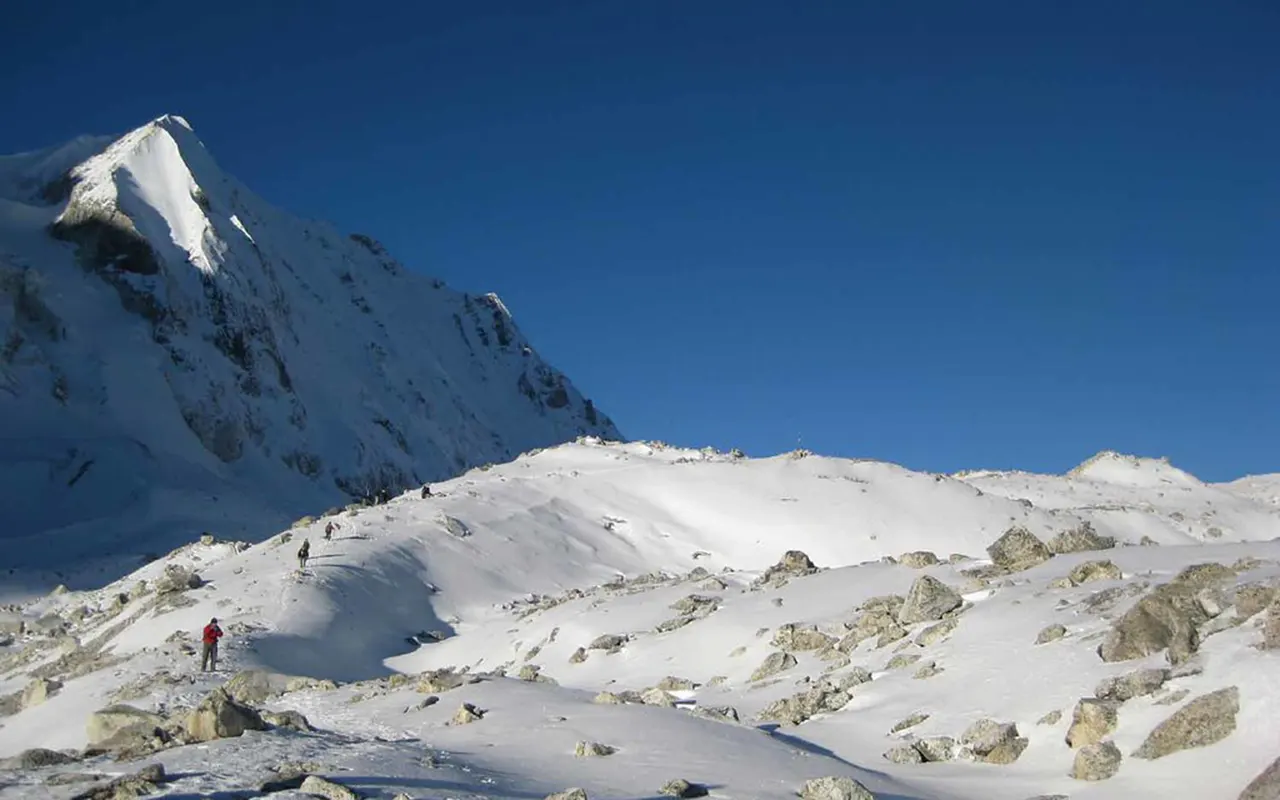
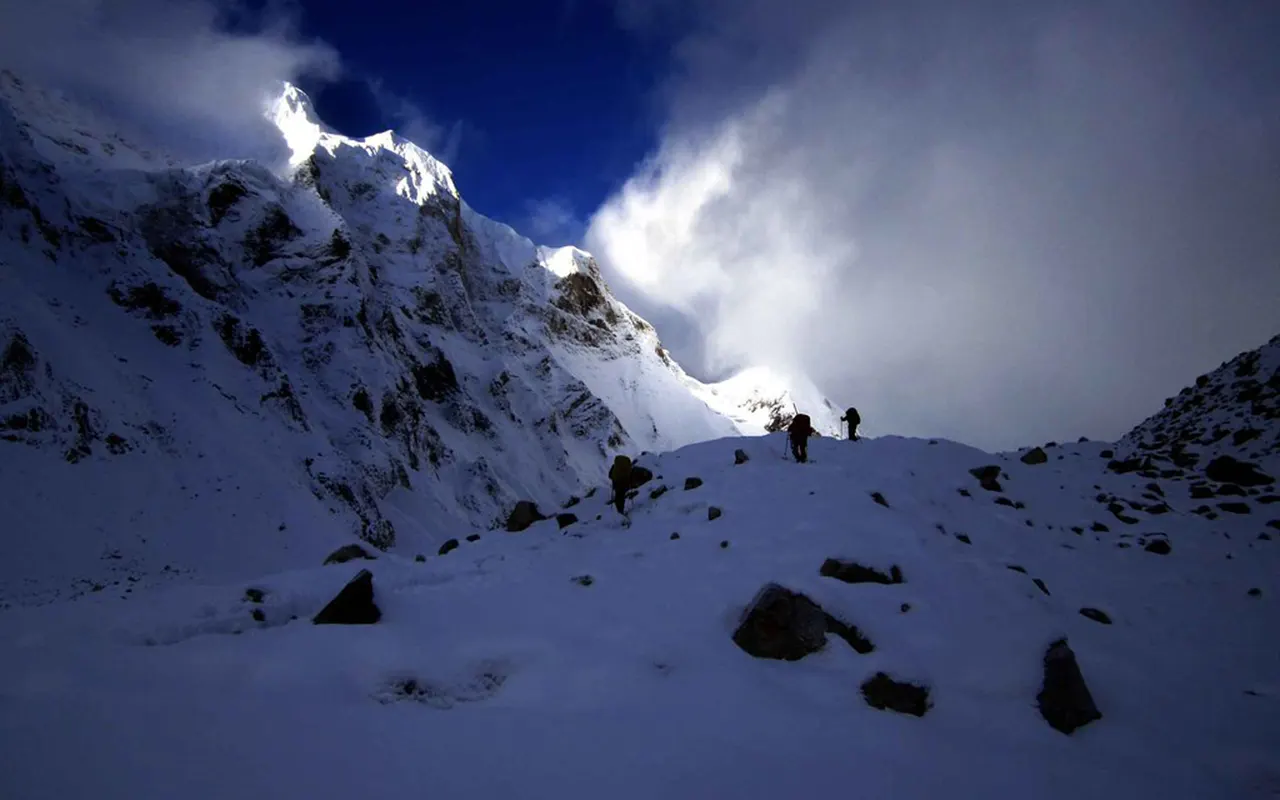
The hardest and most gratifying day of the trek is today, when you pass through the renowned Larke La Pass. The day starts earlier than the sunrise because a long and tough journey is in store. It is cold in the early morning and the ascent needs endurance and patience.

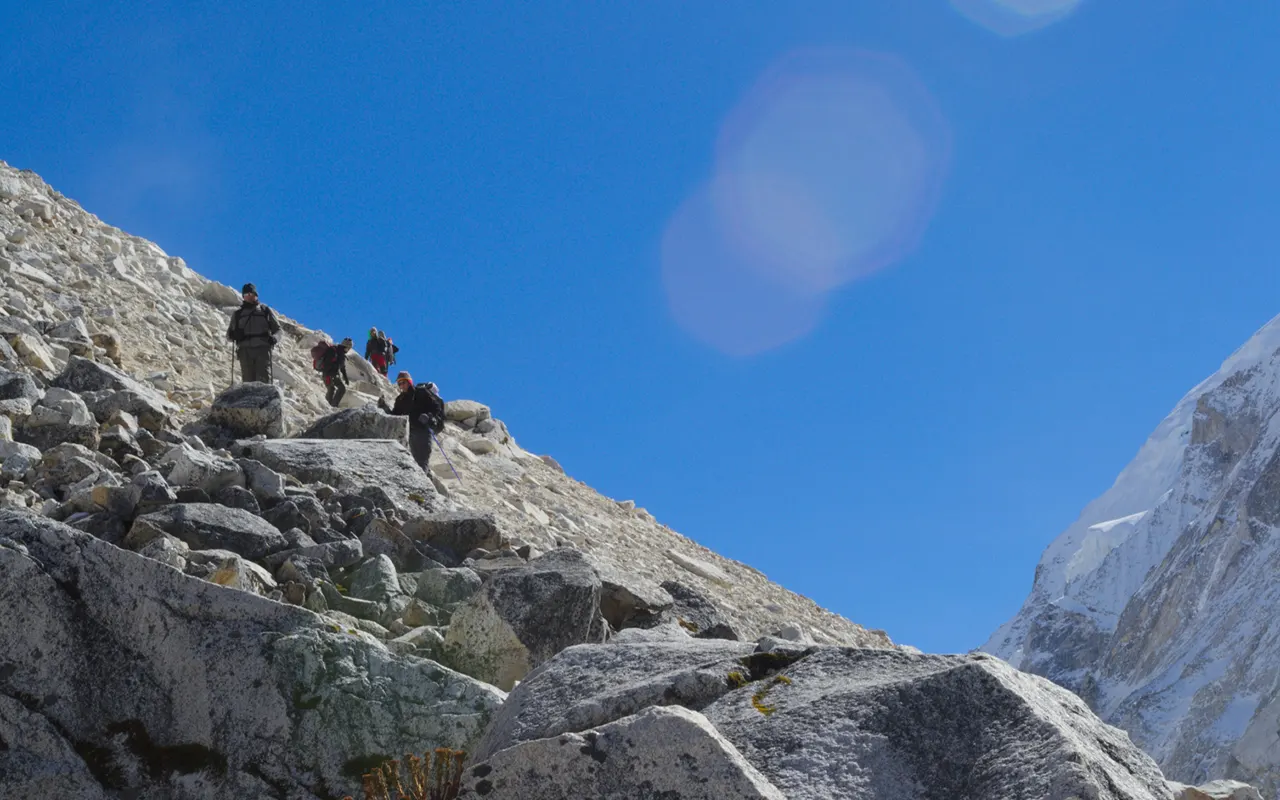
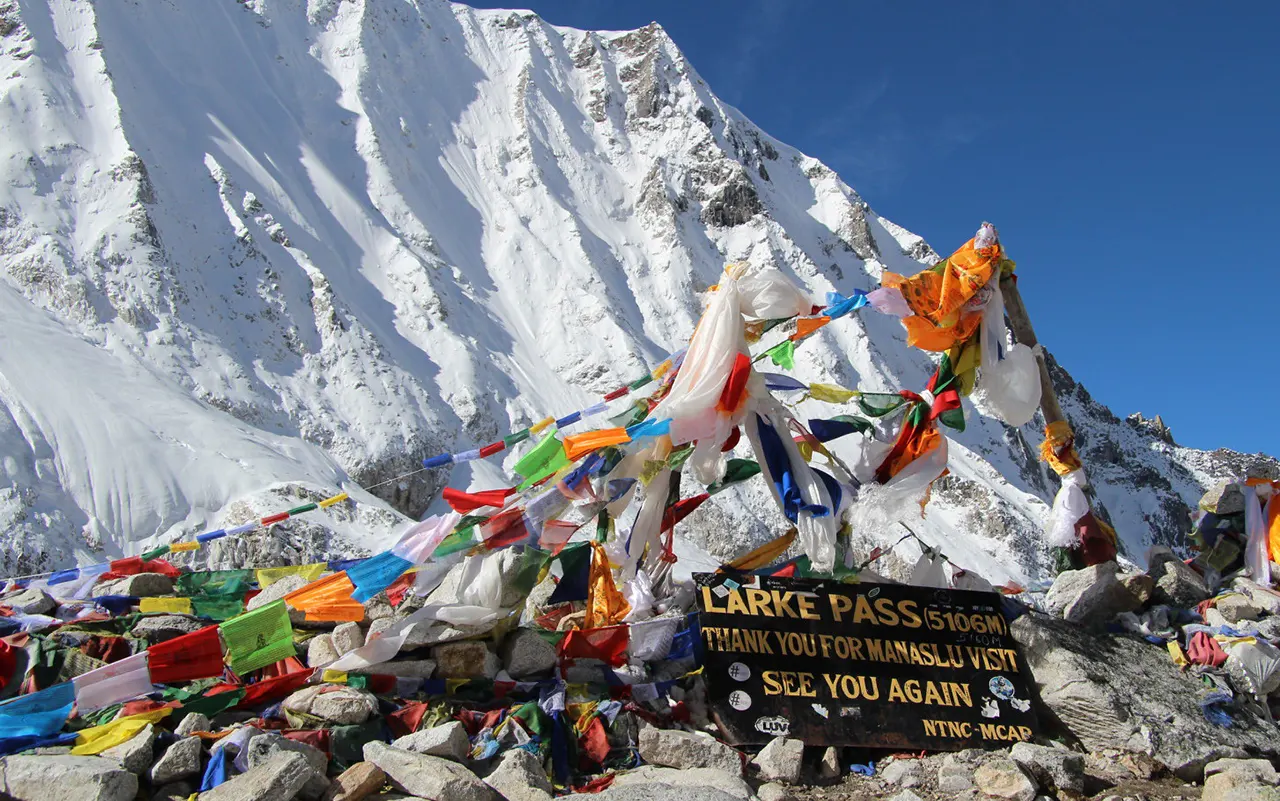
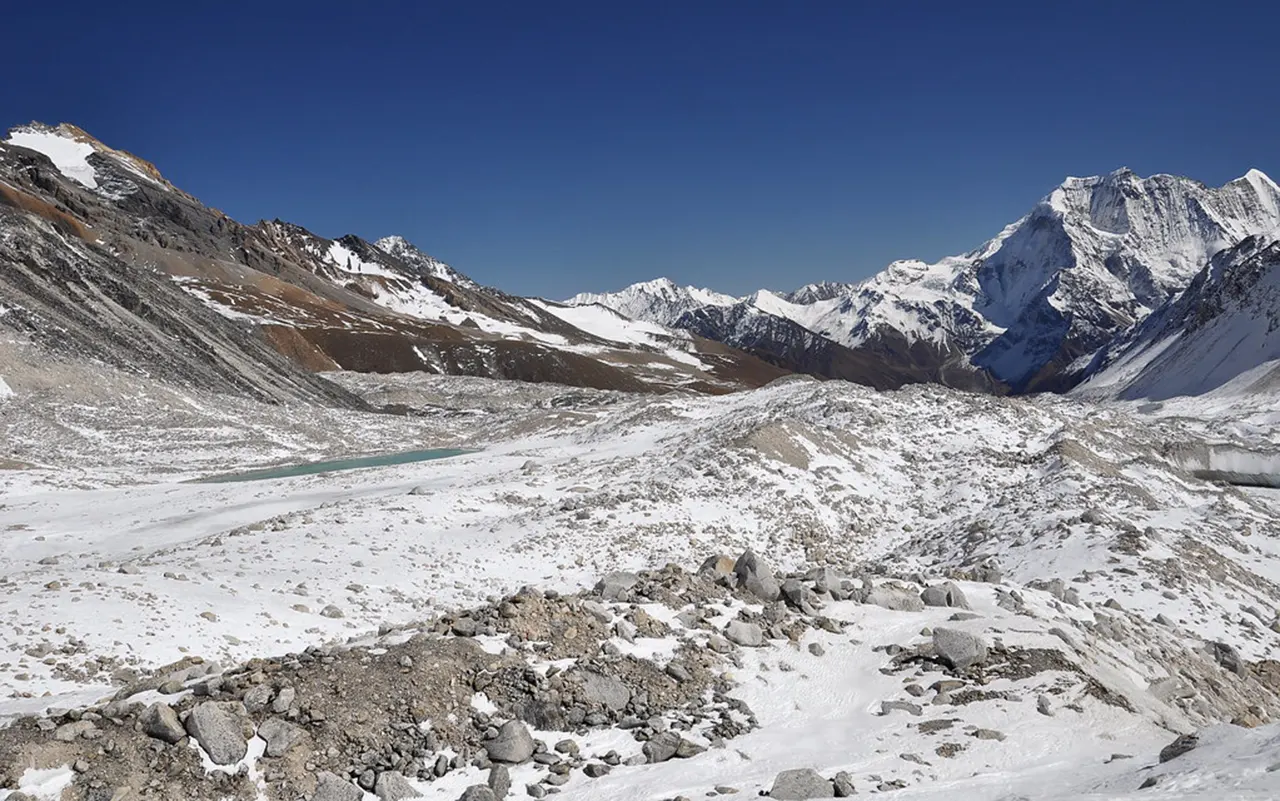
The initial section of the trail is less rocky to the east of the Larke Glacier. The trail is getting steeper, rockier, and even snowier as it continues to rise. It makes the last ascent to Larke La Pass (5,106 m / 16,752 ft) challenging yet very rewarding.

At the summit, there are amazing views that open to Gyaji Kang, Himlung Himal, Kanguru, Annapurna I, Annapurna II, Cheo Himal, and Nimjung Peak. Beyond the pass is a long descent, through Larke Kharka and Tanbuche, to Bhimtang, a picturesque mountain village on the glacial lake of Ponkar.

activity-icon

Activity & Duration

Trekking, 8–9 Hours
altitude-icon

Highest Altitude

5,106m / 16,752ft (Larke La Pass )
meals-icon

Meals

Breakfast, Lunch, Dinner
accommodation-icon

Accommodation

Teahouse

Today, the route leads slowly down the mountain range after the strenuous passage across the pass. Beyond Bhimtang, the trail passes over a bridge and runs onward toward Hampuk Village. On the path, there is a tiny cave, which can be briefly visited.

The path goes through expansive grazing lands such as the Jangli Kharka, Sangure Kharka, and Puktu Kharka. These expansive pasture lands provide a relaxing stroll experience with the mountainous landscape that changes as the altitude becomes lower and lower.

Later, the trail reaches Karche Village at (2,700 m / 8,858 ft), followed by Karche Pass at (2,715 m / 8,907 ft). Here, the road leads towards Goa Village. Today, in comparison with the last day, is much simpler and smoother, with time to relax and appreciate the beauty of nature, and to rest after the Larke La crossing.

activity-icon

Activity & Duration

Trekking, 6–7 Hours
altitude-icon

Highest Altitude

3,590m / 11,778ft (Goa Village)
meals-icon

Meals

Breakfast, Lunch, Dinner
accommodation-icon

Accommodation

Teahouse

The day will be the last day of your trekking and the long ride home to Kathmandu. The day starts with walking down the Dudh Khola River. The path is less demanding than the mountainous days and gives one a less hectic last trekking experience.

Onward, you will arrive at Tilije, where you will find your personal car awaiting. A short way along the road, you cross Dharapani, where the Dudh Khola empties into the Marshyangdi River. This is your entry into the Annapurna trekking area.

Here, the drive proceeds through Besisahar and up to Kathmandu. The trip is prolonged yet allows time to ponder the amazing experience of the Manaslu region. In the early evening, you return to the capital, and, after a pleasant stay at your hotel, you retire to sleep.

activity-icon

Activity & Duration

Trekking and Drive, 9–10 Hours
altitude-icon

Highest Altitude

2,515m / 8,251ft (Tilije)
meals-icon

Meals

Breakfast and Lunch
accommodation-icon

Accommodation

Hotel

Today is the last day of your Manaslu Larke Pass. You should have breakfast at your hotel, and then you will be ready to leave Nepal. You can either use some of your free time to finalize the packing or take a few minutes’ rest before taking off, depending on your time.

We will transfer you to Tribhuvan International Airport, where you will continue your trip. The brief tour around Kathmandu can give the last glimpse of the crowded streets and everyday life of the Nepalese capital.

By the time your adventure concludes, you will be left with memorable experiences of mountain scenery, isolated villages, high passes, and cultural experiences. It is a Himalayan adventure of a lifetime and one that is best experienced in the quiet snatches of the beautiful valleys to the theatrical crossing of the Larke La Pass, a trek that will remain with you long after the trek is completed.

activity-icon

Activity & Duration

Airport Transfer, 30 Minutes
altitude-icon

Highest Altitude

1,301m / 4,268ft (Kathmandu)
meals-icon

Meals

Breakfast
inclusion-icon

Price Includes and Excludes

What is included?

  • Pick-up and drop-off by a private car at the airport.
  • 2 nights hotel stay at Kathmandu in twin sharing, including breakfast.
  • Accommodation in teahouses/lodges during the trek in twin sharing
  • Complete meals on the trek (Breakfast, Lunch, and Dinner)
  • Certified and English-speaking trekking guide, salary, meals, accommodation, and insurance.
  • Porter service including insurance (1 porter 2 trekkers)
  • Kathmandu to Machha Khola transport (private).
  • Personal/communal transport back/to Kathmandu Tilije.
  • Any trekking permits and conservation and restricted area permits needed.
  • Basic health monitoring and a first aid kit on the trek.
  • Sleeping bag, duffle bag, trekking poles at request (to be given back after the trek)
  • Any taxation and service fees by any local government.

What is not included?

  • Nepal visa
  • Emergency evacuation insurance, as well as personal travel insurance.
  • Personal costs such as soft drinks, alcohol, hot showers, Wi-Fi, charging, snacks, laundry, and boiled water.
  • Additional food in Kathmandu.
  • Individual trekking gear and clothing.
  • Extra accommodation because of early arrival, late departure, or itinerary changes.
  • Other costs incurred as a result of weather, road conditions, flight delays, or health adjustments in the itinerary.
  • Porter upgrade, which is optional.
  • Optional transportation upgrades
  • Guides and porters’ tips
  • Any service that is not covered in the included section.
trip-info-icon

Trip Information

Weather and Best Season

The weather contributes significantly to the general experience of the Manaslu Larke Pass Trek because altitudes and the weather vary dramatically. Lower areas tend to be warmer and greener, whereas higher elevations towards Larke La are colder, windier, and less predictable. Mornings and evenings may already be quite cold around Samagaon at (3,520 m / 11,549 ft).

One of the best seasons for the Manaslu Larke Pass Trek would be spring (March to May). The weather is usually sunny, the temperatures are normal, and the trail is colored with rhododendron forests. The mountain scenery is typically spectacular, and this is a good season to shoot and hike.

Other perfect times of the Larke Pass Trek are autumn (between September and November). Cleared weather, dry roads, and clear visibility make it easier to cross Larke La. Snow and extreme cold in winter, muddy trails, landslides, and poor mountain views can be the result of the monsoon.

Foods and Drinks

The Manaslu Larke Pass Trek Food is basic, hot, and designed to sustain extended trekking days. Along the trail, teahouses are common, serving trekking meals like dal bhat, noodles, fried rice, soups, potatoes, pasta, eggs, and pancakes. The more you rise, the fewer food choices you have.

In the altitude such as Dharmasala at (4,460 m / 14,633 ft), the variety of meal options is smaller since it is difficult to transport and is rather remote. Fresh food is more difficult to deliver, and simple yet nutritious food is the rule. Hot food particularly comes in handy in the chilly mountain environment.

Drinks typically contain black tea, milk tea, ginger tea, coffee, hot lemon, and bottled or purified water. It is also very important to remain hydrated throughout the Larke Pass Trek, particularly at elevation. It is advisable to avoid alcohol on the trek because it may have an effect on acclimatization and predispose one to dehydration in higher altitudes.

Altitude Sickness

The issue of altitude sickness is a serious problem when the Manaslu Larke Pass Trek is underway since the pathway ascends very high (3,000 m / 9,843 ft). The symptoms can start with a headache, nausea, fatigue, insomnia, dizziness, or loss of appetite. All these are signs to be taken seriously.

This is dangerous post-Samagaon at (3,520 m / 11,549 ft) and on the way to Samdo, Dharmasala, and Larke La Pass at (5,106 m / 16,752 ft). Elements like proper acclimatization, gradual ascent, hydration, and rest will reduce the risk of getting an illness related to altitude during the Larke Pass Trek.

When symptoms get worse, it is always safe to descend. Hiking under the guidance of experienced people enhances the safety of the process, since they are able to watch out for the signs and make appropriate decisions when necessary. Himalayan Pathway is able to assist trekkers to pace properly with proper logistical planning to enable them to take care of the altitude challenge in a responsible way during the trip.

Preparation and Fitness

The Manaslu Larke Pass Trek is more enjoyable and safer with good preparation. It is a physically challenging path that includes a long day of walking, as well as variable conditions, ascents and descents. Trekkers are advised to expect a certain amount of hiking every day, with the duration of hiking probably being several hours on consecutive days.

The Larke Pass Trek requires cardiovascular fitness, endurance, stamina of the legs, and stamina. Hiking, stair climbing, jogging, cycling, or frequent gym training may help to enhance preparedness. The training period is preferably to start some weeks before departure.

Mental preparation is also important. The experience includes remote routes, modest lodging, weather variability, and physical exhaustion. The correct equipment, multiple layers of clothing, hiking shoes, and a realistic view of the path go a long way. One of the most challenging parts is the ascent to Larke La (5,106 m / 16,752 ft) and it demands constant energy and faith.

Visa and Permits

Travelers who come to participate in the Manaslu Larke Pass Trek require entry documents and trekking permits. The majority of foreigners need a Nepal tourist visa that may be obtained either before traveling or on arrival basing on nationality and prevailing rules.

Special permits are also needed during the trek since this is a trekking route that passes through restricted trekking areas. Permits such as the Manaslu Restricted Area Permit, the Manaslu Conservation Area Permit, and the Annapurna Conservation Area Permit are widely used, as the path eventually links to the Annapurna area.

In the case of the Larke Pass Trek, independent trekking regulations can be different in accordance with regulations; therefore, it is essential to enquire about the prevailing requirements before travelling. A large number of trekkers choose to go through an agency that takes care of permits, transportation, and paperwork. When planning the trek, Himalayan Pathway can facilitate this process to minimize the stress in planning, whilst making sure that all the paperwork needed is done correctly, before entering the trekking area.

Health and Safety

Altitude, weather, remote conditions, and physical demands should always be considered a priority in the Manaslu Larke Pass Trek as far as health and safety are concerned. Simple measures may help a lot to make the entire trekking process enjoyable and minimize risks that can be avoided.

Personal medication, a first aid kit, water purification means, sun protection, and proper clothing are highly recommended. Elevations like higher camps like Dharmasala at (4,460 m / 14,633 ft) can be very cold during the early mornings and evenings. The weather is also subject to change.

During the Larke Pass Trek, food hygiene, hydration and correct acclimatization are a must. Hiking under the guidance of seasoned leaders enhances emergency rescue and decision-making. In rural locations, communication connectivity can be poor, and therefore it is advisable to prepare beforehand. Feeling your body, reporting early, and avoiding unwarranted risks can make the trekking experience in the high Himalayas a safer and more comfortable experience.

Transportation

Transport to the Manaslu Larke Pass Trek is generally a combination of road and trekking. The trip usually starts with a Kathmandu drive to the Manaslu area, through towns, valleys, and jagged mountain tracks, to the starting point of the trek.

The condition of roads may also differ greatly because in some far-flung areas, paved highways have been substituted with dirt roads. The terrain and weather conditions may make the travel times long. The level of comfort is determined by the type of vehicle, the condition of the routes, and the season.

Transport returning after the Larke Pass Trek usually takes the road linkage on the Annapurna side and ends up in Kathmandu. Personal cars are more comfortable and convenient, whereas shared transport can be less expensive. Planned trekking trips frequently make such logistics easier by organizing pickups, transfers, and timing so as to streamline the overall travel experience and minimize the amount of uncertainty before and after the mountain expedition.

Travel Insurance

The Manaslu Larke Pass Trek is highly advisable to have travel insurance due to the altitude of the pass, the remoteness, and the physical exertion. Higher altitude trekking is not always included in standard travel insurance, so details about the policy should be reviewed beforehand.

As the route goes up to Larke La Pass at (5,106 m / 16,752 ft), the insurance should cover high-altitude trekking options, emergency treatment and evacuations by helicopters, should the need arise. Delays in weather, sickness, injury and route problems can incur unforeseen expenses in distant mountains.

In the case of the Larke Pass Trek, good insurance coverage would provide peace to both the trekkers and organizers. It is worth paying close attention to what is excluded in reading in terms of altitude restrictions and coverage of adventure activities. Having digital and printed insurance information can also come in handy in case of an emergency, and it will be easier to communicate and receive help in case they need it during the trek.

Alternative Routes

The Manaslu Larke Pass Trek is a classic route, although some trekkers opt to use alternative variations based on time, fitness, or personal interest. The route can be adjusted to include side trips, or reduced extensions, or incorporate the trek into the surrounding Himalayas.

One variation is a popular one that adds additional acclimatization hikes around Samagaon, such as Birendra Lake or Manaslu Base Camp at (4,800 m / 15,748 ft). These alternatives provide scenic worth and assist in changing altitude prior to traversing elevated landscapes.

After leaving the Larke Pass Trek, some trekkers can also relate the journey to the longer journey of the Annapurna region. Some would take shorter itineraries with modified transport access based on the conditions of the road. There should always be alternative planning in order to incorporate weather, fitness, acclimatization requirements, and time on the availability to ensure safety and enjoyment in the entire experience of the trek.

Your Extra Expenses

Although most of the essential services can be part of a trekking package, individual expenditure at the Manaslu Larke Pass Trek needs to be anticipated. Additional costs can be snacks, bottled water, hot showers, laundry services, beverages, charging, Wi-Fi, and a personal shop along the way.

Traveling up the mountain tends to be more expensive as the supplies have to be brought to the villages on the mountain, which are isolated. A glass of water or hot beverage in the higher altitudes, like Dharamsala at 4,460 m / 14,633 ft, can be relatively expensive compared to the low-lying villages.

Your budget can also be increased by travel insurance, guide and porter tips, emergency expenses, and optional upgrades. When traveling the Larke Pass Trek, it is reasonable to bring some additional money as there is a lack of digital payment in remote places. Budgeting can assist you in making the trip as comfortable as possible without facing any unforeseen financial strains on the trip.

Language and Communication

The communication in the Manaslu Larke Pass Trek is not a big problem when one is accompanied by guides or in organized groups. The national language is Nepali, and the local dialects in the higher regions might also include Tibetan influences because of cultural and geographical influences.

Most of the lodge owners and trekking staff in common trekking villages know simple English that they can use in communication with their guests and in their trekking activities. Basic expressions that are associated with food, lodging, directions, as well as time, are normally straightforward to handle even by foreigners.

Now that the Larke Pass Trek is heading into the more remote regions, communication might be restricted or even more so should there be an escalation in language obstacles. Going hiking with a guide can make communication easier and assist in real-life circumstances. Himalayan Pathway may be of use to tourists who are willing to have guided communication services, local coordination, and easier communication in the remote mountain areas where language familiarity might be inconsistent.

Internet, Gadget Charging, and Mobile Network

There is also possible availability of internet and mobile access in some of the villages en route to the Manaslu Larke Pass Trek, but the higher the route is climbed, the less reliable the service will be. Further down, the settlements can tend to be more connected, and isolated mountainous regions can be covered with low or poor signal strength.

In certain teahouses, Wi-Fi can be offered at an extra cost, but it is generally very slow. Depending on the provider, weather, and terrain, mobile networks can operate in certain areas. The availability of communication may not be as reliable in higher places like Samdo on (3,875 m / 12,713 ft).

It is generally available in lodges to charge electronic devices, which in many cases is at a minimal cost. In the Larke Pass Trek, power supply can be reliant on solar systems or the local supply circumstances. It is very advisable to carry a power bank, particularly when you are going to take pictures, phone, GPS, or emergency communications in remote trekking locations.

Don’ts of This Trip

Manaslu Larke Pass Trek is a satisfying experience, and some errors can have an impact on safety and comfort. Among the most important errors is to climb up too fast without a decent acclimatization. Disregard of the first signs of altitude sickness may pose severe health hazards in the higher altitudes.

Do not drink too much, particularly more than (3,000 m / 9,843 ft), because it can exacerbate dehydration and acclimatization issues. New or inappropriate trekking boots may also cause discomfort, blisters, or difficulty with walking over long trekking days.

The Larke Pass Trek rules would be not to overpack, take dangerous shortcuts, or walk past your physical capacity. Adhering to local traditions, not deviating from the course, and obeying the directions of the guides enhances security. One should also avoid flying drones without authorization and disturbing the local communities to continue being respectful and responsible travelers.

Is the Trip Beginner-Friendly?

The Manaslu Larke Pass Trek may be an appropriate choice for motivated beginners, but it cannot be regarded as an easy trek. The path contains numerous long walking days, mountains, simple lodging, and a great deal of altitude increase, and demands great preparation and expectations.

The most difficult task is to cross Larke La Pass (5,106 m / 16,752 ft), where the altitude, cold weather, and physical effort are intertwined. Beginners to trekking can equally afford the trip if they prepare adequately, take their time, and adhere to the advice on acclimatization.

The Larke Pass Trek is easier for travelers with good fitness, patience, and a positive attitude. The experience can be safer and easier to cope with by trekking with the help of guides and support staff. Even first-time trekkers who know the requirements and get training ahead of time can have an enjoyable time with this adventure, with proper planning and preparation.

Trip Extension

Manaslu Larke Pass Trek is a trek that most of the travelers prefer to combine with other travel experiences in Nepal. As the trek already leads to the Annapurna region, it may be a convenient option to combine additional mountain adventures based on time and energy.

The most common are the trips around the Annapurna trekking regions, cultural sightseeing around Kathmandu, wildlife tours in Chitwan, or brief scenic tours of Pokhara. Some trekkers take rest after the high-altitude adventure on the rest days and then proceed with other travel plans.

Once the Larke Pass Trek is completed, there are extension options based on fitness, budget, travel schedule, and personal interest. It could be easier to organize planning and smooth out the transition between trekking and sightseeing destinations. Himalayan Pathway can help to satisfy the needs of travelers who wish to proceed with their Nepal adventure with transportation, accommodation, or tailor-made extension services after the main trek is over.

Photography and Drone Rules

Manaslu Larke Pass Trek is the best place to capture amazing photos, both mountain sceneries and traditional villages, and cultural elements. The route is filled with glaciers, monasteries, suspension bridges, and other dramatic Himalayan landscapes captured by trekkers.

Personal use of photography is generally allowed, though one is expected to be respectful. It is always advisable to seek permission before taking photos of local people, religious activities, or culturally sensitive areas. Depending on local regulations, flash photography in monasteries might even be discouraged.

The use of drones in the Larke Pass Trek is very limited. The use of flying drones within secure or sensitive trekking areas can be subject to formal approvals by the authorities. Some areas may completely prohibit drone activity for safety, privacy, or regulatory reasons. Rigorous travelers are expected to ensure that they have confirmed legal requirements beforehand as opposed to presuming that they have permission in and around conservation areas, in high mountain passes, and culturally sensitive sites.

Cultural Festivals on the Trails

The Manaslu Larke Pass Trek cuts across culturally diversified mountain societies in which Tibetan Buddhist cultures are a significant part of everyday life. It is a significant cultural experience that goes beyond the physical journey, with monasteries, prayer walls, spinning wheels, and traditional settlements.

Depending on the season, the traveler can experience local festivals, monastic practices, or village rituals like Samagaon at (3,520 m / 11,549 ft). These cultural events provide a more in-depth understanding of the traditions, beliefs, and ways of life of the mountain area.

Larke Pass Trek requires respectful observation in case one comes across festivals or ceremonies. Wear loosely, do not disrupt religious activities, and seek permission before taking pictures. Although the time of the festival varies depending on the local calendar, it may happen during the time when the culture is active, and so the experience of the trek may be even more exciting and fulfilling to those who are interested in Himalayan traditions.

Travel Tips for First-Time Visitors

Newcomers taking part in the Manaslu Larke Pass Trek have to plan both physically and practically. Pre-departure training, the right clothing, and knowledge of altitude requirements on the trek can make it a lot more enjoyable.

Layered clothing, old trekking shoes, reusable water bottles, a power bank, sunscreen, and personal medication are highly encouraged. The weather is volatile, particularly in areas that are at higher elevations like Dharmasala (4,460 m / 14,633 ft), where the cold weather is quite prevalent.

In the case of the Larke Pass Trek, realistic expectations are a great aid. Remote villages have basic accommodation, the Internet might not be available, and schedules might be altered because of the weather or trail conditions. Carrying money, being sensitive to local traditions, remaining adaptable, and being a good listener are all approaches to making the first Himalayan trekking experience a lot more enjoyable.

faqs-icon

Frequently Asked Questions

reviews-icon

Reviews on Manaslu Larke Pass Trek

  • Your safety, our priority
  • Best price guarantee
  • Experienced & dedicated team
  • Easy booking, no hidden charge
  • You can customize this trip
profile-expert

Live Chat 24/7