How Difficult is the Langtang Gosaikunda Trek?
The Langtang Gosaikunda Trek is a moderate-level trek and can be followed by individuals with average fitness. It does not involve any technical climbing, but one has to traverse mountain trails for a number of hours per day. Most days of trekking take 5-7 hours of walking, which includes constant uphill and downhill portions. The primary difficulties are associated with elevation and extended days of walking as opposed to hard terrain.
The most difficult ones are ascent to Tserko Ri (4,984 m / 16,352 ft) and the ascent of Laurebina La Pass (4,610 m / 15,125 ft). These parts are exhausting as the air is thinner; however, they can be overcome by walking slowly with rest intervals. Experience in trekking before will be useful, but is not mandatory.
The Langtang Gosaikunda Trek is a successful trek done by many first-time trekkers with proper planning.
Weather and Best Season
The Langtang Gosaikunda Trek is best done in the spring (March-May) and autumn (September-November). The weather is reliable in these seasons, the sky is clear, and the mountain views are at their best.
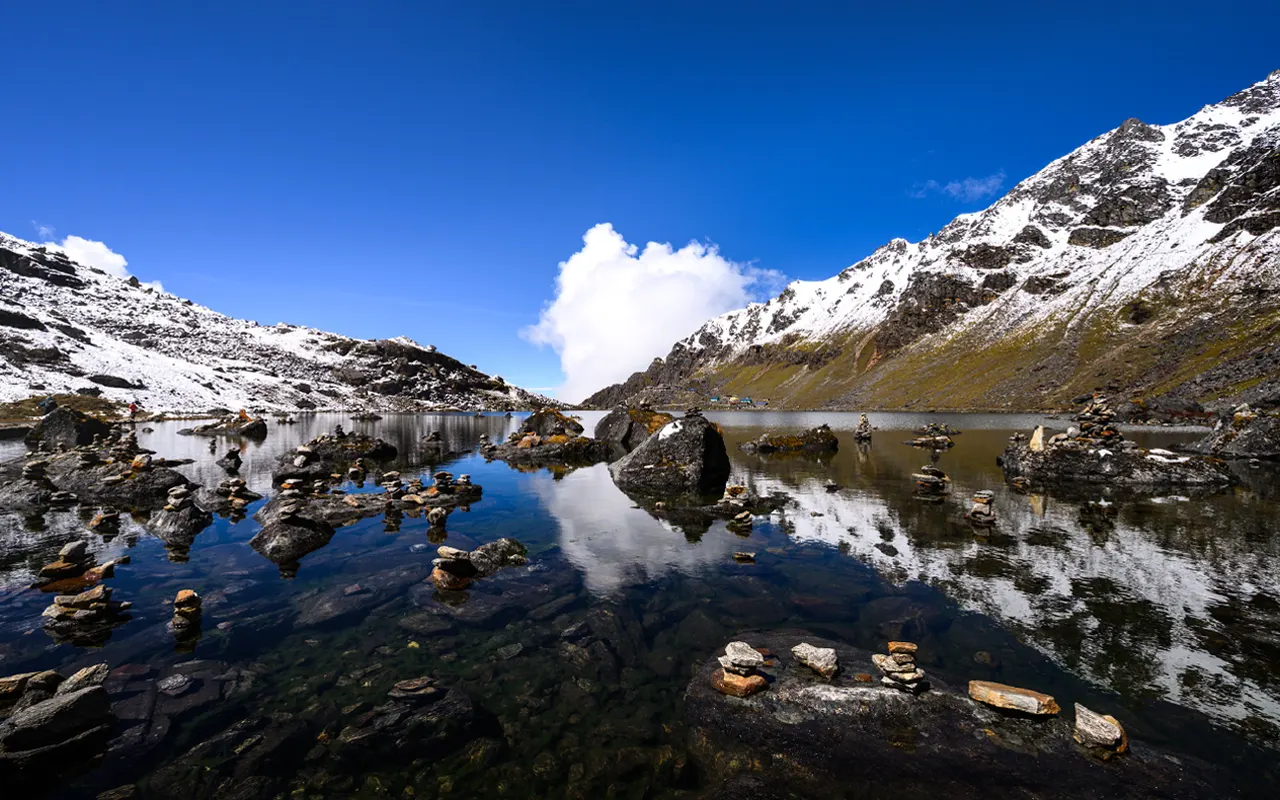
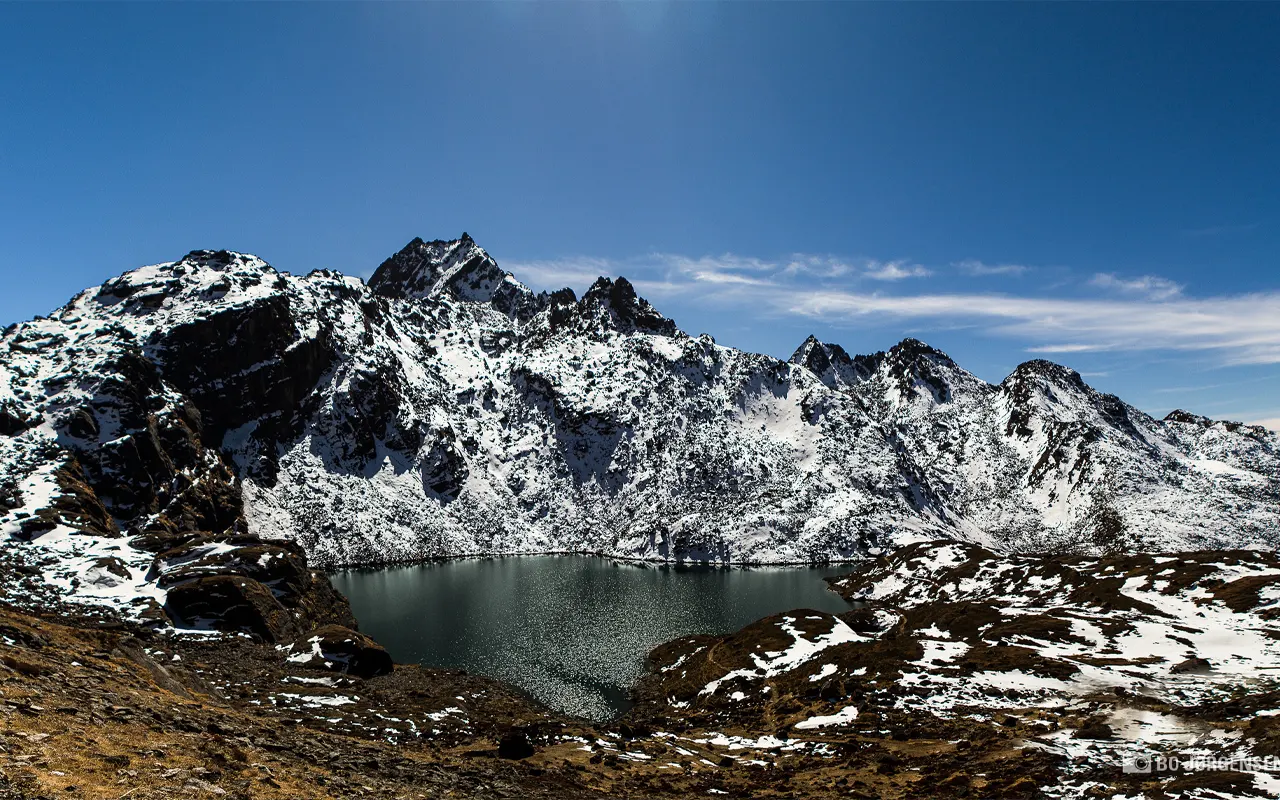
The spring is rivalled by blossoming rhododendrons and pleasant temperatures during the day, though nights are chilly at the altitudes above 3,000 m (9,843 ft). The most popular season is, however, autumn because the air is crisp and the visibility is excellent, particularly around Gosaikunda Lake (4,380 m / 14,370 ft).
Monsoon rain (June-August) is accompanied by heavy rains, muddy tracks, leeches at lower altitudes, and cloudy scenery. Hiking can be done, but not the best. Winter (December-February) is chilly, and snow on high grounds such as Laurebina La Pass (4,610 m / 15,125 ft) might block the road. But the winter presents solitary paths to the well-equipped trekkers.
Food and Drink
The food on the Langtang Gosaikunda Trek is basic, hearty, and it serves to provide you with the energy you need to do the long walks. There are tea houses along the path, whose foods include dal bhat (rice, lentils, and vegetables), noodles, soups, fried rice, pasta, and momos.
Dal bhat is particularly a favourite since it is healthy and, in most cases, it is served with a complimentary follow-up. The breakfast typically consists of porridge, eggs, pancakes or Tibetan bread and jam.
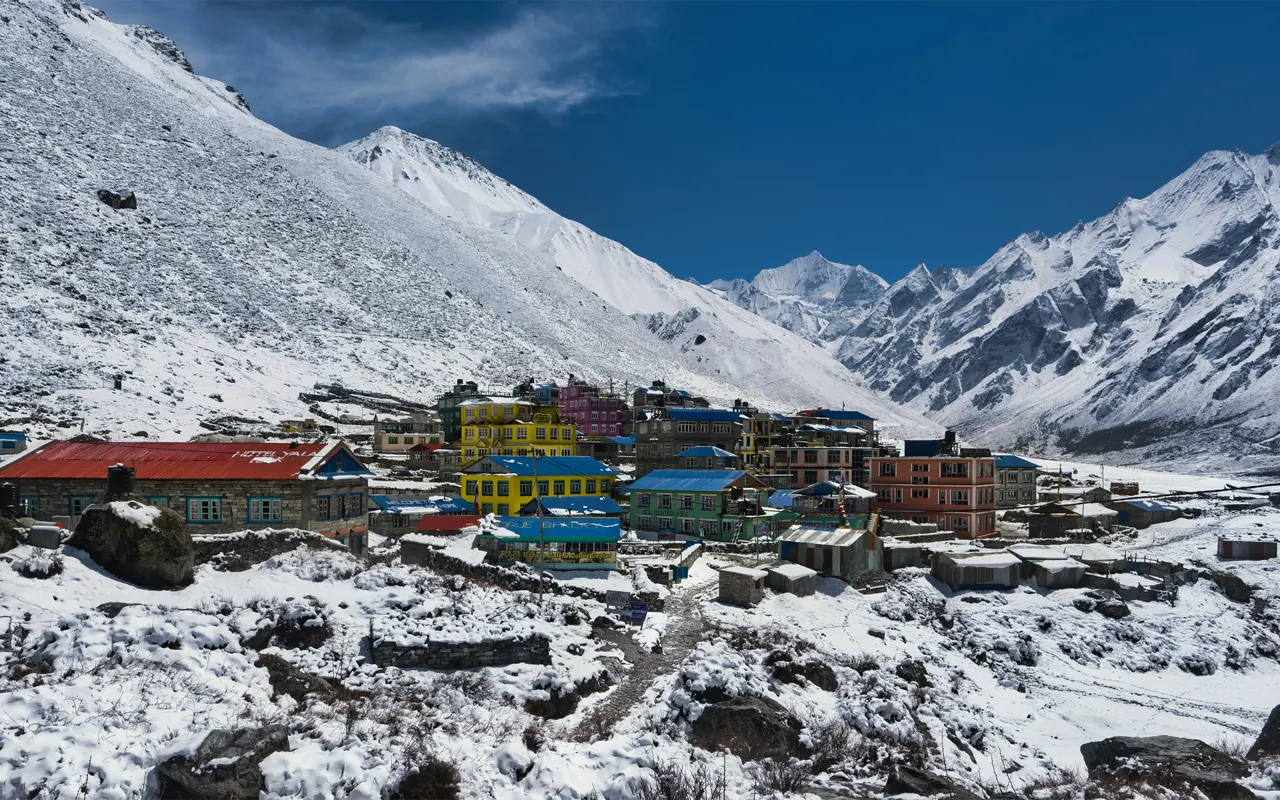
Local yak cheese and yoghurt are fresh and delicious in such locations as Kyanjin Gompa (3,870 m / 12,697 ft) and Sing Gompa (3,300 m / 10,827 ft). Boiled water is common and safe for drinking. It is handy to carry purification tablets or even a filter.
Hot drinks are tea, coffee, ginger tea, and hot lemon, which are found everywhere. Use of alcohol during the trek may affect it has on hydration and acclimatisation.
Altitude Sickness and Suggestions
Altitude sickness is a factor to consider during the Langtang Gosaikunda Trek since the path is very elevated. You will sleep as high as Kyanjin Gompa (3,870 m / 12,697 ft), and cross Laurebina La Pass (4,610 m / 15,125 ft). The air at such heights has lower oxygen levels, and this may cause some symptoms such as headache, nausea, dizziness and fatigue.
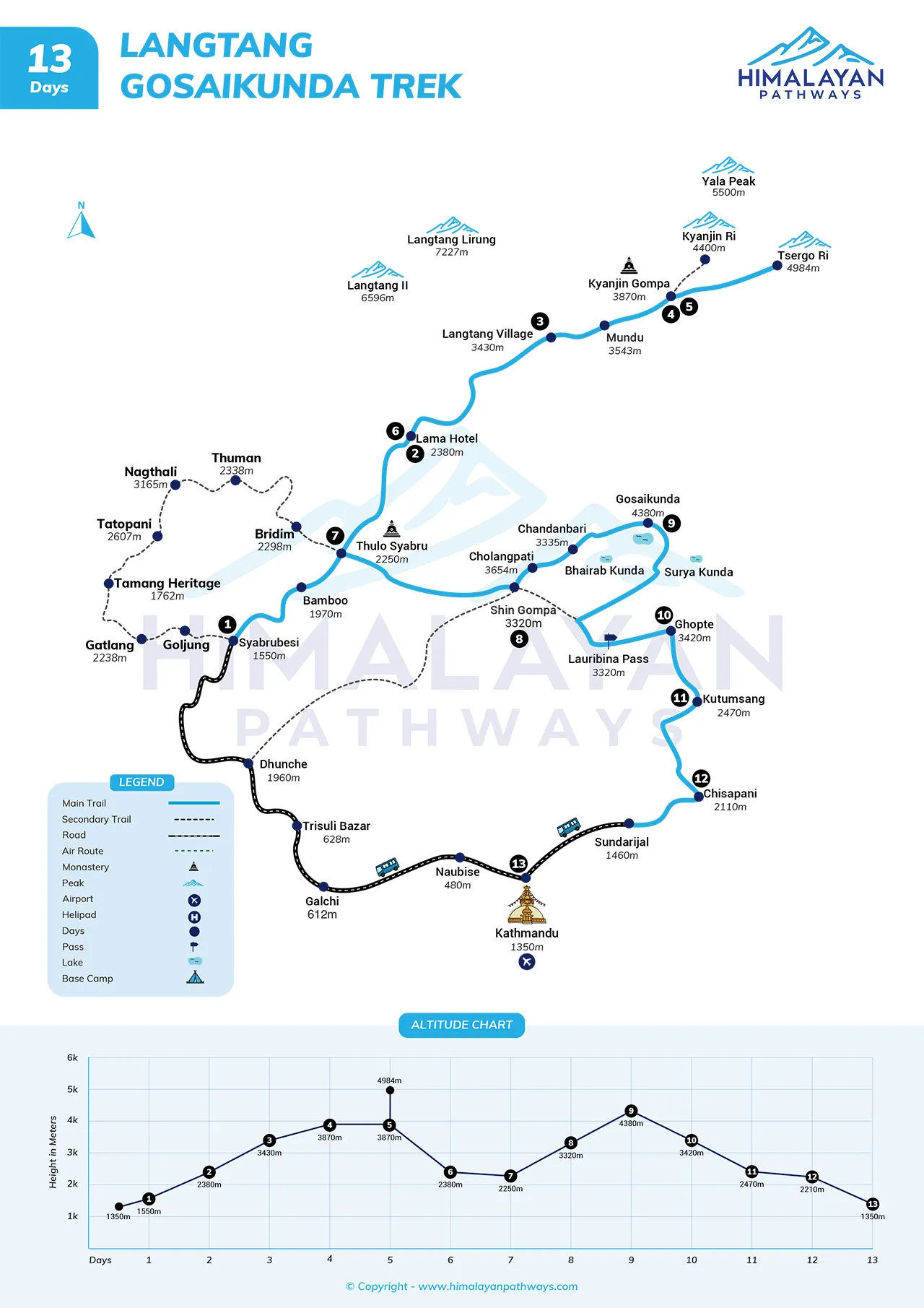
Prevention of altitude sickness is best achieved through adequate acclimatisation. The journey will have one acclimatisation day, during which the group will hike to Tserko Ri (4,984 m / 16,352 ft) and then descend to lower altitudes, where they will sleep.
It is important to walk slowly, drink a lot of water, and have enough food. Do not drink or smoke at high altitude. In case of slight symptoms, rest and inform your guide right away.
Severe symptoms involve direct descent or helicopter evacuation. Himalayan Pathways has guides who are trained to keep a check on the altitude-related problems and take prompt action in case of need.
Preparation and Fitness
The Langtang Gosaikunda Trek is the best with good preparation. There is no necessity for extreme fitness, but you should comfortably walk 5-7 hours a day with a light backpack. Doing regular cardio exercises like walking, hiking, cycling or climbing stairs will help to build stamina. It helps to have strong legs when going up the mountain through steep parts.
The preparation of gear is also important. Wear in your hiking shoes before the trip to prevent blisters. Pack layered clothing to deal with warm days and cold nights above 3,000 m (9,843 ft). Trekking poles aid in balance and reduce strain on knees.
Be psychologically trained to expect the conditions of a simple teahouse, communal bathrooms, and poor electricity. The Langtang Gosaikunda Trek turns into an enjoyable and easy adventure instead of a challenge with reasonable fitness, the right gear, and a positive attitude.
Visa and Permits
To participate in the Langtang Gosaikunda Trek, you must have a Nepal tourist visa and trekking permits. A majority of the travellers will be able to receive a visa at Kathmandu airport. Your passport must be valid for a period of six months. Depending on the travel plans, the visa will be 15 days, 30 days or 90 days.
As far as the trek itself is concerned, there are two permits that are needed: the Langtang National Park Entry Permit and the TIMS card. The national park permit will enable one to enter the safeguarded zones such as Langtang Valley and Gosaikunda Lake (4,380 m / 14,370 ft). The TIMS card assists in monitoring trekkers in order to do the same with their safety. Such permits are inspected at various stages of the trail.
When you trek with Himalayan Pathways, all the permits will be done ahead of time on your behalf. Always remember to take your permits along the trek.
Health and Safety
The Langtang Gosaikunda Trek has much to do with health and safety. High-altitude trekking and emergency evacuation travel insurance are necessary. Your guide must be aware of your insurance information in case of any emergencies. Himalayan Pathways guides also have a first-aid kit and are educated about altitude awareness and simple medical care.
Living in a clean environment is good to stay healthy. Wash hands or sanitise hands before meals, consume only boiled or treated water and consume freshly cooked food. Raw vegetables should be avoided at elevated altitudes.
Along the trail, be careful in steep or landslide-prone places, especially following rain or snow. The weather can change anytime in the mountains, so be prepared for all kinds of weather challenges.
The trail is mostly secure with hospitable villages and tea houses en route. With proper guidance and a touch of common sense, you will be able to complete the trek successfully and without any doubts.
Transportation
The Langtang Gosaikunda Trek is also advantageous in that it does not require flights. The trek starts with a road trip through Kathmandu to Syabrubesi, and this can take 7-8 hours in a local bus or approximately 6 hours in a jeep. The road crosses rivers, terraced lands and villages which provide an excellent impression of rural Nepal.
By the end of the trek, you complete at Sundarijal (1,460 m / 4,790 ft), which is close to Kathmandu. It is approximately one hour to get back to the city. This also makes the trip back easy and convenient, and you can go from the trail to the hotel on the same day.
Himalayan Pathways also organises transportation that is reliable at the beginning and the end of the trek and ensures a successful and comfortable trip in general.
Travel Insurance
The Langtang Gosaikunda Trek requires travel insurance due to the fact that you are trekking in the wilderness and witnessing elevated levels. This should include a medical treatment policy and, above all helicopter rescue to at least 5,000 m / 16,404 ft.
In case of injury or severe altitude sickness in the areas around such sites as the Laurebina La Pass (4,610 m / 15,125 ft) or the Tserko Ri (4,984 m / 16,352 ft), helicopter evacuation can be the quickest means of getting to a hospital. The helicopter flights may cost thousands of dollars; ensure your insurance explicitly covers high-altitude trekking and emergency evacuation. Certain of the standard policies do not cover trekking over 3,000 m / 9,843 ft, and therefore you might require upgrading.
Always have a print of your insurance and emergency contact numbers with you and provide a copy to your guide. Insurance provides relief in the mind so that you can have a good time on the trek.
Alternative Routes
The Langtang Gosaikunda Trek is a combination of Langtang Valley and the sacred lakes, and the departure takes the form of Helambu. In case you desire any alteration, it can be flexible.
The most common shorter option is the Langtang Valley trek by itself, only as far as Kyanjin Gompa (3,870 m / 12,697 ft), and back again. This doesn’t go to the high pass and matches travellers with tight schedules.
The second alternative is a direct Gosaikunda route that begins at Dhunche, to Gosaikunda Lake (4,380 m / 14,370 ft) in fewer days, before proceeding back or further onwards.
When you would like to have a longer cultural trip, you can go further into Helambu beyond Laurebina La Pass (4,610 m / 15,125 ft) into such villages as Tarkeghyang and Sermathang. These extensions give it variety and a slower descent.
The itinerary at Himalayan Pathways can be modified according to your time, fitness and interests without compromising acclimatisation and safety.
Your Extra Expenses
Personal expenses will be incurred even though the major services are included in your package in the Langtang Gosaikunda Trek. Food and beverages such as snacks, soft drinks, and sweets such as chocolate are also sold as extras, which increase with elevation, particularly around Gosaikunda Lake (4,380 m / 14,370 ft).
Most teahouses will offer hot showers and phone charging for a small fee. Wi-Fi can also be expensive, slow or unavailable in isolated locations. It is also customary to tip your guide and porter at the end of the trek in case you are satisfied with the service. You can also use money on gifts, baked goods at such locations as Kyanjin Gompa (3,870 m / 12,697 ft), or even things you overlooked.
There are no ATM after Kathmandu, and you must have enough Nepali money. Most trekkers carry spare money to indulge in and purchase miscellaneous items. Himalayan Pathways will be able to recommend a realistic budgeting range depending on your choice of trekking style.
Language and Communication
The Langtang Gosainkunda Trek is relatively easy when it comes to communication. Most of the locals in the Langtang and Helambu regions are Tamang and Hyolmo. They have their native languages, but the majority know Nepali.
In teahouses and stores, there is the common use of basic English, with particular locations like Syabrubesi and Kyanjin Gompa (3,870 m/12,697 ft). Your guide will be an English speaker who can translate if you require them to talk more.
It is not necessary to know many Nepali words to make the journey more pleasant: Namaste is a nice greeting, and Dhanyabad is the phrase meaning thank you. You can also find the Tibetan-influenced villages where you can hear Tashi Delek. There will be assistance and good communication with Himalayan Pathways so that there is no language barrier during the trek.
Mobile Network, Internet and Charging Facilities
Mobile signal may be on and off according to the weather and the distance on the Langtang Gosaikunda Trek. Smaller villages like Syabrubesi, Langtang Village, and Kyanjin Gompa (3,870 m (12,697 ft) will have partial coverage, and it can be poor.
Past Gosaikunda and beyond higher ridges, the mobile network and internet are very limited and most of the time, unreliable.
Purchasing a domestic SIM card of NTC and Ncell is the best for this trek, yet reliable at higher elevations.
Some places have Wi-Fi, which is charged and is typically slow and only useful when sending simple messages. In most lodges, it is possible to charge phones and cameras, but they usually charge per device, and higher-ups such as Gosaikunda Lake (4,380 m / 14,370 ft) have limited power.
A power bank is a clever idea to save on the expenses of charging. The Himalayan Pathways guides will let you know where the internet connection works.
Don’ts on This Trip
The Langtang Gosaikunda Trek follows the delicate nature and rural traditional villages, and therefore, ethical behaviour is important.
Do not litter; keep the trash with you until you locate a correct bin, particularly in elevated regions around Gosaikunda Lake (4,380 m / 14,370 ft), where rubbish is quite difficult to handle.
Do not disturb the wildlife, observe them from a distance, and never feed them.
Do not show disrespect towards local culture, do not take pictures of people without their permission, remove shoes in monasteries, and wear modest clothes in the villages.
Do not go off the road, especially in the vicinity of landslides or foggy ridges; by remaining on the main road, you will be on the safe side and save vegetation and farming lands.
Do not walk too fast on the altitude. In case you are feeling the symptoms of altitude sickness around high points such as Laurebina La Pass (4,610 m / 15,125 ft), inform your guide and take a rest. Do not take much alcohol since it elevates the dehydration and the risk of altitude sickness.
Do not bargain over prices as deliveries of items in high elevation is expensive.
Trip Extension
Having completed the Langtang Gosaikunda Trek, many tourists decide to make a little extension in Nepal.
Chitwan National Park is a traditional choice for jungle walks and safaris, in case you want wildlife. To relax and sightsee, Pokhara is a good destination to take a rest by the lake and view the Annapurna range at lower altitudes.
In case you are more of a cultural tourist, you can spend more time in UNESCO sites in Kathmandu Valley, such as Boudha and Bhaktapur. To avoid hiking long distances, Nagarkot or Dhulikhel can be chosen to see the sunrise and spend a relaxing day in the peaceful mountains.
You still feel like being adventurous, you can go rafting in the Trishuli River or even go paragliding in Pokhara. All these add-ons are good since the trek finishes towards Kathmandu at Sundarijal (1,460 m / 4,790 ft), and therefore, it becomes easy to travel.
Himalayan Pathways can organise transport and planning in such a way that whatever you are adding in your schedule will work.
Photography and Drone Rules
The Langtang Gosaikunda Trek has plenty of photo opportunities, which include mountains, forests, prayer flags, villages and lakes. You are welcome to take a lot of photos, yet keep simple etiquette.
Never take pictures of local people without their consent, particularly monks or children. At monasteries, photography can be limited, and the signs or instructions of your guide should be taken into consideration.
The use of drones is more complex. Drones are not permitted in the national parks. You need permission to fly drones from the Nepal aviation authorities and the park officials. Unauthorised flying would imply punishments or seizure.
To the majority of the visitors, images along the trail suffice. In case you really require a drone to shoot, you must communicate this at an early stage with Himalayan Pathways to know about the approval procedure.
Tips for First-Time Visitors
If it is the first time you are doing the Langtang Gosaikunda Trek, a couple of basic habits will make it easier. Pre-train by walking, hiking or climbing the stairs to prepare the legs to work long days. Pack light yet carry warm clothing, since it can be chilly over 3,000 m / 9,843 ft. Use broken-in boots, as blisters occur, and carry trekking poles, which are needed on steep runs down.
Take lots of water and eat in abundance, too, even when you lose your appetite at altitude. Adhere to the acclimatisation. Do not hurry, make pauses here and there and take it easy.
Follow the instructions of your guide and admit your pain in the head, nausea, and strange fatigue at the first opportunity. Always be open; the weather and availability of lodges may vary.
The first-time trekkers mostly complete with a feeling of pride and inspiration due to the steady pacing and Himalayan Pathways support.
 Unbeatable Holiday Offers - Save Up to 20% on Your Next Adventure!