notification-icon Unbeatable Holiday Offers - Save Up to 20% on Your Next Adventure!
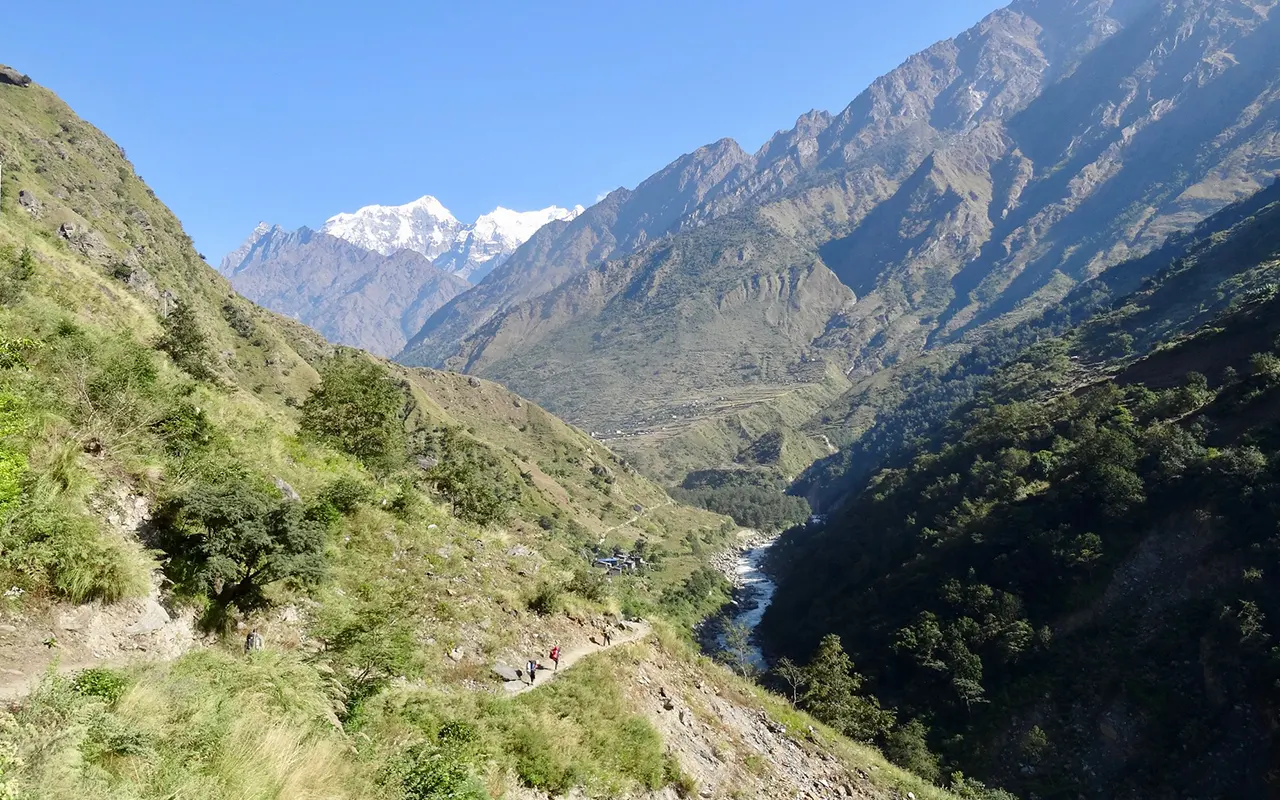
Nar Phu Valley Trek

duration-1

Duration

12 Days
difficulty-icon1

Trip Difficulty

Moderate
best-season

Best Season

Spring (Apr-May), Autumn (Sep-Nov)
max-altitude

Max. Altitude

5306 Metres
group-size-icon

Group Size

2-10 People
transportation

Transportation

Private Car, Public Bus, Rented Jeep
accommodation

Accommodation

Hotel, Teahouses
meals

Meals

Breakfast, Lunch and Dinner
profile-expert

Live Chat 24/7

overview

Trip Overview

Nar Phu Valley Trek – A Journey into Nepal’s Hidden Tibetan Valleys

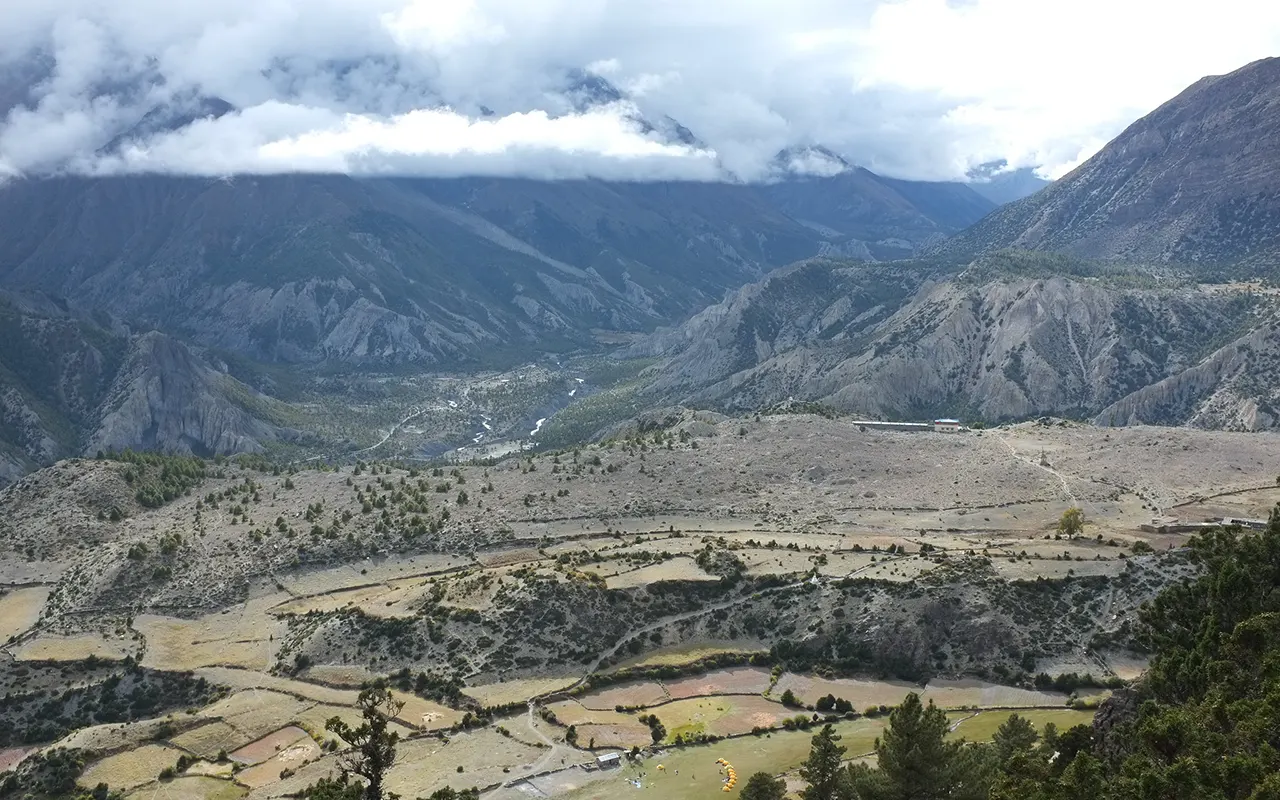
The Nar Phu Valley Trek is a breathtaking journey through the unspoiled and mysterious parts of the Annapurna Region in Nepal. This trek goes deep into the restricted area of Nar and Phu, which is northeast of the popular Annapurna Circuit. Nar and Phu are like medieval villages from a time of history before large-scale rationalising – want to go to another planet? This trek will take you there. Nar and Phu are surrounded by snowcapped peaks, ancient monasteries that take you back in time to a blend of Tibetan Buddhist culture and stone-built villages. The Nar Phu Valley Trek offers awe-inspiring Himalayan nature, as well as an ancient Tibetan culture that has thrived for centuries.

The Nar and Phu valleys area was not opened to trekkers until 2003 and are some of the less traveled regions of Nepal. In this remoteness, the indigenous people of Nepal continue their traditional way of life, significantly undisturbed by the modern world. Geographically and culturally, the Nar and Phu Valleys are very much a part of Tibet. The route passes beneath impressive peaks such as Kang Guru, Himlung Himal, and Annapurna II, while the landscape morphs through alpine forests, glacial moraines and finally dry and wind eroded canyons.

Unlike the busy Annapurna Base Camp or Everest Base Camp treks, you will not run into trekking crowds on this route. The Nar Phu Valley remains distant, calm, and untouched. The fact that this area is restricted territory only adds to the mystique, since trekkers will have to obtain a special permit to enter, in addition to being accompanied by a registered guide.

Food and Accommodations
The teahouses on the route are basic, but friendly and comforting. In Nar and Phu, authentic Tibetan-style foods like tsampa, thukpa, Tibetan bread, potato curry, and sometimes yak meat are available. You can find dal bhat (Nepali lentil rice) just about anywhere.

Elements of the rooms are basic – just two beds with mattress, blankets, and pillows. Amenities will decrease as you go higher. In Nar Phedi expect to sleep in a guesthouse at the neighbouring monastery, where the hospitality is simple, but the kindness of the nuns is warming.Some areas have hot (solar heated) showers, but these might be gas heated or done on the stove. Food might take longer than expected to prepare in the more remote villages and takes longer than you might expect, but will be fresh and infinitely nicer because of this.

Internet and Communication
Do not expect dependable, or even consistent, internet access. Although a few lodges may offer Wi-Fi in Koto and Ngawal, it is typically slow and unreliable. In the restricted zone, expect very poor or non-existent mobile coverage and generally no Wi-Fi coverage. For better connectivity, or emergency communication, many trekkers will carry a satellite phone or personal locator beacon (PLB). Guides typically carry a radio or satellite device for check-in communication.

Emergency Response and Rescue Services
The high altitude and remote area make altitude sickness a serious risk, particularly when moving quickly up to Phu and Nar. All trekkers should be aware of AMS (Acute Mountain Sickness), which means that once you arrive at Phu the trekking heights demand acclimatisation days.

Emergency evacuations by helicopter can be arranged, but they can take hours, depending on the weather and visibility. For these reasons, it is important to have comprehensive travel insurance that covers high-altitude trekking and emergency evacuation services.

While there are no hospitals or permanent medical posts in the Nar Phu Valley there may be basic medicine available through guides or in Manang. Your guide, when trekking, will be trained to perform first aid and carries a first aid kit.

Conclusion
The Nar Phu Valley Trek is more than just an incredible vista experience — it’s an immersion into a cultural realm that seems many hundreds years in the past. The remoteness, spiritual feel, and unrefined Himalayan splendor provide an incredible and life-changing experience for seekers of solitude, authenticity, and wonderment in nature. Whether experienced trekkers or culturally curious travelers, this journey into the Himalaya will be a lifelong memory long after leaving the mountains behind.

Highlights of Nar Phu Valley Trek

  • Experiencing untouched Tibetan Buddhist culture

  • Exploring centuries-old monasteries and fortresses

  • Stunning Himalayan landscapes, from narrow canyons to open valleys

  • Crossing the remote and icy Kang La Pass

  • Lesser-known trail with fewer trekkers

  • Wildlife like blue sheep, Himalayan griffons, and possibly snow leopards

itinerary-icon

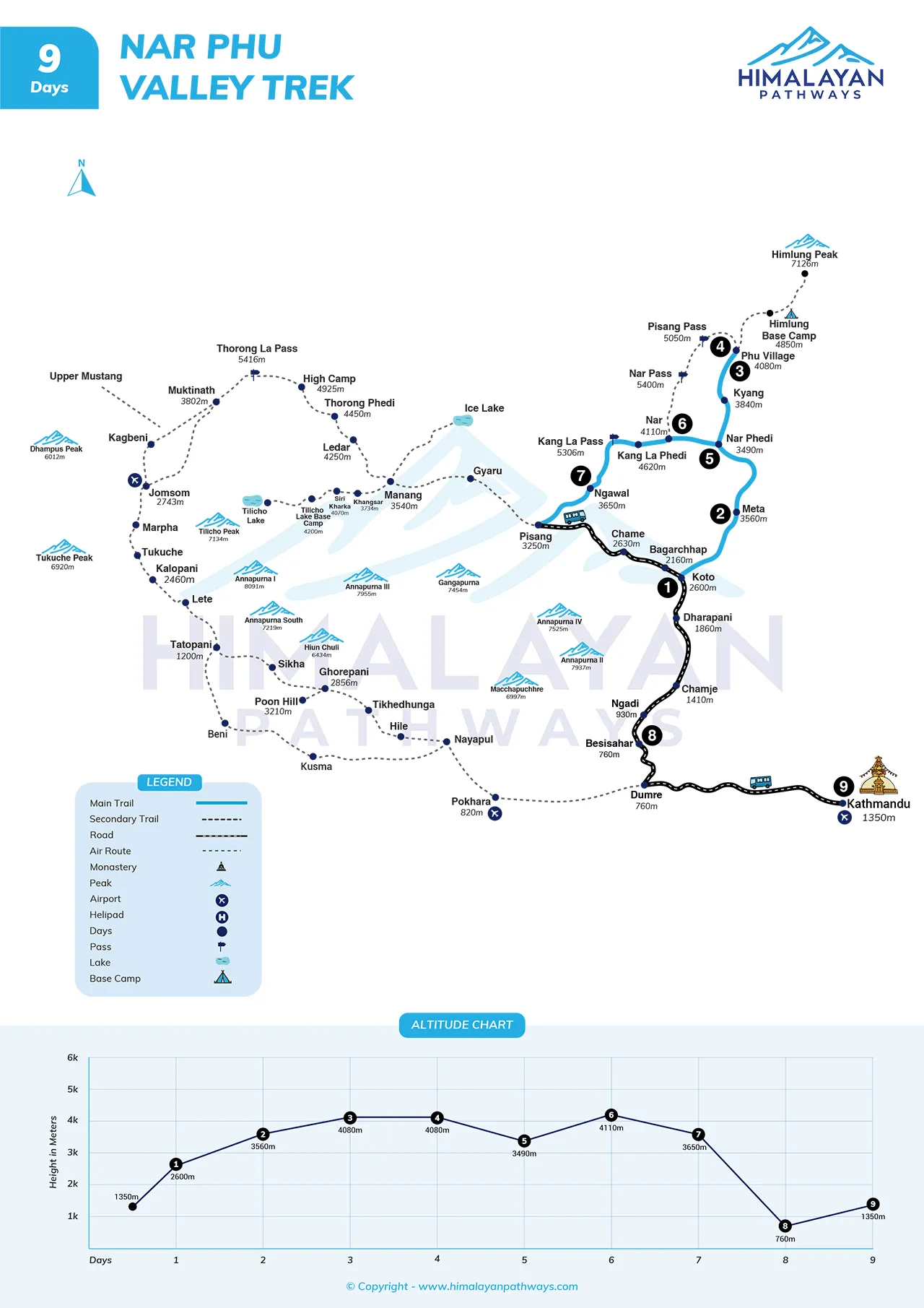
Nar Phu Valley Trek Itinerary

Day 1: Drive from Kathmandu to Jagat

The first day of the Nar Phu Valley Trek does not involve trekking, but this day will be no less special or memorable than any other trekking days to follow. This is a day of transition, from a busy, urban Kathmandu to a calm, rugged land of the mid-hill countryside of Nepal. It is also the start of a journey into one of the remotest, culturally unique areas of the Himalayas.

Morning: Departing Kathmandu
Although your Nar Phu Valley Trek does not officially begin until day 2, whilst you will be in Kathmandu, you may register for your trek starting day, and your day will typical start at the break of the dawn, around 6:00 to 7:00 am. After a final check of your trekking permits, bags and a supply of fuel, trekkers will meet at the starting point, which will be at either the designated tourist bus park, or if you are on a guided trip probably just outside the trekking agency office. The mood is generally one of excitement mixed with quiet anticipation. As the vehicle, which will most likely be a 4WD jeep or a tourist van pulls away from the chaos of the city, the Himalayan journey begins.

As you exit Kathmandu Valley, the landscape starts to change. Within minutes, traffic thins out, houses give way to fields, and hills grow steeper and more verdant. The highway twists along the Prithvi Highway, one of Nepal’s primary road arteries, which runs west alongside the Trishuli River. The first few hours have panoramic views of riverine villages, roadside markets, and hills cloaked with green forests.

Along the Trishuli River Valley
The journey along the Trishuli River is interesting and picturesque. The river, powerful and dynamic, flows parallel to the road in gleaming white currents, often visible just a few meters below. Along one edge of the road, steep cliffs are in close proximity; along the other, gorges and cultivated terraces extend. Here live many different kinds of people—Brahmins, Chhetris, Gurungs, and Magars—in colorful houses atop the hilltops. Some small towns like Malekhu, renowned for its river fish, and Mugling, a busy highway junction, pass by as the trek continues.

On a clear day, you might first glimpse the Himalayas in the distance. Although they are still quite far away and partly concealed behind ridges, their white tops further add to the growing sense of being among mountains.

Midday: Arrival at Besisahar (760m)
Approximately 6 to 7 hours after, the car comes to Besisahar, administrative capital of Lamjung District and traditional starting point of the Annapurna Circuit. This is where the asphalt road terminates and the fun begins as an off-road journey. You may side track here for lunch or snacks. Basic Nepali dishes like dal bhat, noodles, momos, or snacks like boiled eggs and chiya (milk tea) can be found in local restaurants.

The roads from here are much worse. On a season and weather condition, the ride there is bumpy, muddy, or dusty—but scenic. The mode of transportation now shifts to a high-clearance 4×4 jeep to navigate the dirt road, stony trails, and landslide parts of the mountain road.

Afternoon: Off-Road to Jagat
Bringing to an end Besisahar, the trek continues through small villages like Bhulbhule, Ngadi, and Syange, where suspension bridges and waterfalls cascading down are usual spots. The Marsyangdi River now comes into prominence. Its powerful current, chiseling out a deep gorge, is both a sight to behold and scenic. Villages in this place are few and sparse, with old houses made of wood and stone. Architecture starts to change as you ascend in altitude—roofs slope less, and Buddhist prayer flags start to crop up more often.

The road is narrowed to a thin line along cliffsides for much of its course. In some areas, the vehicle is simply bulldozing past the sides of rock or grazing off the edges of steep drops into the gorge below. While the rough road is jarring, the views are spectacular. The scenery shifts from subtropical rainforest to pine and rhododendron woods. The air grows cooler and more refreshing with altitude.

As you approach Jagat, you will notice fewer people, less commotion around, and a relaxed tempo of life. The jungle closes in patches, and waterfalls cascade directly onto or along the road. These places appear particularly beautiful during the post-monsoon months of September–November when the water level is high and the vegetation is lush.

Evening: Arrival in Jagat
And then, finally, after 9 to 10 hours of all the driving, the car rolls into Jagat, a tiny mountain village perched on a rock terrace overlooking the Marsyangdi River. At 1,290 meters’ elevation, Jagat is where the first overnight camp on the trek typically occurs. The village marks the official start of the off-limits area along the route to Nar and Phu, and permits are often questioned at the local check post here many times.

Jagat is a serene village with scarce lodges and teahouses offering basic accommodation. The villagers construct their houses using local stone and wood, normally topped with traditional slate roofs. Chickens, goats, and small gardens are seen in the courtyards. Locals are warm and welcoming, used to receiving trekkers who transit through.

After you get into the teahouse, you are given a cup of tea and perhaps a bowl of soup or plate of fried noodles or dal bhat. Electricity would generally be provided in the lodges, but Wi-Fi, if available, will be slow. Mobile coverage might even be poor or zero, depending upon your operator. But this disconnection from the world of bytes allows you to appreciate the peaceful mountain atmosphere.

A Night Under the Stars
Temperature drops quickly at night, especially away from monsoon months. As you leave the teahouse at night, the village falls under a blanket of stars. The Milky Way is visible if the sky is clear and moonless. You may hear the river booming below or wind rustling through the leaves. It’s a serene end to a long but rewarding day.

The majority of trekkers spend the night following dinner sitting together around the fire or heater (in case it is available) in the shared dining hall, sharing stories with fellow trekkers and guides. Everyone is laid-back and goes to bed early, prepared for the trekking days that begin the next morning.

Reflection on the First Day
Although the day is consumed by traveling, it is a significant component of the entire trekking adventure. It’s a slow transition from the cacophonous din of Kathmandu into the quietude of Jagat. The ride provides you with up-close views into the geography of Nepal, its varying landscapes and cultures, and the reality of rural life. You experience firsthand how life changes from the semi-urban valleys to the inaccessible mountains, and by then, you begin to sense the enormity of the adventure that awaits.

Jagat isn’t an stopping point—it is your first encounter with the wacky Himalayan universe, and expectation only grows as you’re in bed at night hearing the wind whizz by outside realizing that the real trek starts tomorrow.


activity-icon

Activity & Duration

Drive (10 hours)
altitude-icon

Highest Altitude

1,290m/4,232ft. (Jagat, Lamjung)
meals-icon

Meals

Breakfast, Lunch, Dinner
accommodation-icon

Accommodation

Hotel, Tea House

Day 2: Trek from Jagat to Dharapani

The secind day of the Nar Phu Valley Trek is the first real trek on foot, leaving behind the rocky jeep road and stepping into the Nepalese middle hills. The trek from Jagat (1,290m) to Dharapani (1,830m) is a beautiful and rewarding walk through dramatic as well as scenic landscapes. It’s a long day, between 7 to 8 hours depending on rest breaks and your speed, but every step uncovers new aspects of the area—its natural wealth, cultural character, and historical depth.

Early Morning in Jagat
The dawn comes early in the small, stone-studded village of Jagat. The mountain air is cool in the mornings, often with fog hanging over the Marsyangdi River gorge far below. The air is peaceful—save for the far-off roar of the river and the sporadic crowing of roosters, the village lies wrapped in quiet.

After a hearty breakfast—often dal bhat, honey Tibetan bread, or porridge and tea—the trekking gear is packed for the day. The trail to the east promises an uninterrupted climb up and continuing Nepalese village life. Bags rebuckled and walking sticks ready, the group begins the hike for the day with a gentle down slope followed by crossing on a suspension bridge over the Marsyangdi River, which will be the group’s constant companion for most of the trek ahead.

Climbing Over Terraced Fields and Forests
Shortly after leaving Jagat, the trail begins to ascend. You are traversing a scenery of rice paddies supported on hillside slopes with unbelievable precision, often manned by villagers in local attire. These paddies are human masterpieces, nurtured over generations by families utilizing techniques honed exactly to the land. Depending on the season, you can witness farmers sowing, harvesting, or tilling with the help of oxen.

As you ascend further, the subtropical vegetation thrives. Bamboo, alder, and rhododendron forests encircle the trail, offering lapses of shade from the sun. Birds chirp in the treetops above, and butterflies dance over wildflowers along the trail. During the spring, the rhododendrons burst with dazzling reds and pinks, filling the forest with a floral wonderland.

The path continues along thin rock trails and rises over rocky stairs. Along the course, there are some waterfalls falling down the rock face, forming transparent pools and rivulets that run along the path.

Traditional Villages and Cultural Encounters
One of the numerous highlights of the day is traveling through several traditional villages, one giving one an insight into the ethnic and cultural richness of the region. The first sizable village north of Jagat is Chyamje, a charming village at the foot of towering cliffs. There, slate-colored roofs of houses made of stone line narrow streets, and prayer flags wave in the breeze. Tibetan Buddhism’s presence is felt increasingly the further north you go.

Following another suspension bridge, the path climbs steeply through forest to Sattale, a tiny ridge village. The climb is challenging but achievable, and the reward is a stunning vista of the valley below Marsyangdi, lined by steep ridges and remote mountains.

There’s then Tal, a classic village that is a favorite spot to lunch for many trekkers. Tal is singlehandedly beautiful—situated on a wide, flat valley that was gouged out by a glacial lake that long ago burst and flattened the terrain. The village sits on the riverbank, where white sand beaches and teale-blue water provide an almost surreal environment. This is where you officially cross into Manang District, an important milestone to Nar Phu and beyond.

You’ll likely stop here for a well-earned meal. Most teahouses in Tal offer classic trekking fare—dal bhat, Tibetan momo (dumplings), vegetable fried rice, pasta, soups, or boiled potatoes with chili. Refueling here is essential for the trail ahead, which continues to ascend through more rugged terrain.

Landscapes Turn Wilder and Colder
Continuing past Tal, the trail ascends the river upstream, which gets narrower and more turbulent with elevation gain. Subtropical forests are replaced by alpine flora. The atmosphere is cooler and ground rockier.

From Tal, the path crosses over to Kyodo, then climbs gently through fields and rocky outcrops. You’ll see yaks and mules carrying supplies—essential lifelines for the villages further up. These animals are expertly guided by locals, and their presence is a reminder that this trail is not just for tourists, but a lifeline for trade and daily life in the mountains.

Here you begin to notice the higher Tibetan presence in architecture and religion. Small chortens (Buddhist shrines), mani walls (stone walls with mantras inscribed upon them), and prayer flags become increasingly prevalent. Kids run out of doorway ways to flash a smile and say “Namaste.” Geriatric locals trudge along slowly, hand in hand with prayer wheels, softly repeating prayers.

Arrival in Dharapani (1,830m)
After a bit more roller coaster trail—some up and some flat river sections—you finally make it into late afternoon village of Dharapani. Dharapani is one of the larger villages on this portion of trail and lies at the junction of the Annapurna Circuit and the trail north to Nar and Phu. In Nepali, its name means “stream of blessings”, and it’s a well-deserved oasis after a long day on the trail.

There is a peaceful environment in the village, with houses made of stone along the main path, and lodges with basic but comfortable rooms. There are more trekkers in Dharapani since this is also where trekkers arrive from either Chame or continue onward to Manang in the west.

After checking into your teahouse, there’s time to relax—perhaps a warm shower if one is available, followed by hot tea in the dining room as the sun sets behind the hills. Dinner is served early, and trekkers share stories around the fireplace or heater. The temperature drops quickly after sundown, and you’ll want to bundle up in warm layers before retreating to your room for the night.

Reflections for the Day
This initial day of full trekking is not only a test of the body but also of culture and emotion. It is a great welcome to the essence of the Himalayas—it is characterized by its natural scenery, spiritual energy, and human courage.

You walk over suspension bridges hanging above foaming rivers, walk through ancient villages where time moves slow, and meet people who blend with the nature. Every turn in the trail offers another view, another face, or another moment of awe.

By the time your head rests in Dharapani, your body might be feeling the toil of the day, but your heart and mind are completely attuned to the mountains’ rhythm. The Nar Phu Valley Trek has actually set in, and its enchantment is just beginning to reveal itself.

activity-icon

Activity & Duration

Trek (7-8 hours)
altitude-icon

Highest Altitude

1,830m/6,004ft. (Dharapani, Manang)
meals-icon

Meals

Breakfast, Lunch, Dinner
accommodation-icon

Accommodation

Lodge, Tea House

Day 3: Trek from Dharapani to Koto

Day 3 of the Nar Phu Valley Trek is a serene and scenic day trip through Dharapani (1,830m) to Koto (2,610m) with incremental altitude gain while ascending on the world renowned Annapurna Circuit popular route towards the north. Shorter in terms of length than on day 1, it carries with it an apparent change of landscape as of atmosphere. It is cold and of the more dry type of weather, jungles in composition shift, mountains encroach and tower as more formidable bodies. With each passing hour, you experience being more within the realm of the mystique of the high Himalayas.

Early Morning at Dharapani
Day has broken on Dharapani with the cutting edge of altitude already present. The village is subdued with only rings of the sporadic bells of yaks or faraway voices of the morning people getting started for the day. Teahouses bustle as breakfast is consumed—the hot Tibet bread with jam, oats, or eggs with tea or coffee.

Emerging into the chilly morning world, at least an added layer is forthcoming as the sun hasn’t yet had the opportunity of warming the valley. The itinerary of the day is perhaps shorter than the prior day’s, but it’s packed with experiences of beauty and tranquil alone-time. With packs on and gear becoming familiar, you journey north, having now officially left the more temperate middle hills behind for the bottom alpine landscape.

Moving into A Different Climate and Terrain
Descent down through Dharapani at once deposits you in deep groves of firs and pines, dark and cold, with conifer needle smells of earth on the forest floor. The Marsyangdi River, you old friend of the past couple of days, keeps going on by, at places racing through canyons and at places twisting through long rocky river bed.

Here the route is traceable, frequently being alternating sections of hard-packing of terrain, stone steps, and sections of the ancient trade route of ancient saline trade between Tibet and Manang with wintering valleys below. Where at intervals it is parallel with motor roads, it is more characteristically on ancient footpath between ancient villages on forest-ridges with sunny clearings.

You’ll be walking through wood- and stonewalled buildings whose rooftops have streaming prayer flags and minuscule mani walls with Buddhist prayer inscribed on them. The places of worship keep in mind that you’re serially ascending Buddhist terrain—where religion is an aspect of daily life like breathing is. Buddhist chortens can be encountered on the way, or you’ll be walking through obligingly painted prayer wheels set into rock walls that arrivantes rotate in the clockwise direction for good fortune.

Views of the Mountains: A Himalayan Welcome
As the forest recedes bit by bit and gives way to clearer skies, you start looking at first clear views of giant Himalayas. Under clear skies, the snow topped ramparts of Lamjung Himal (6,983m) tower into the sky like a sparkling fortress. Annapurna II (7,937m)–a huge, rock hard pyramid of ice–comes into view soon after on the eastern skyline, whose magnitude it is difficult to put words down on. These mountains tower over the landscape not only through eyes, but demand worship, being ancient keepers watching over the path.

Scenery is supplemented by contrast of dark pine forest at bottom with stark white mountains that tower way on high. It’s one of the mostremembered of points of the day’s hike: thinking that you’re going to the roof of the world.

Traveling through Timang and Thanchok
You’ll be passing through Timang (2,750m) at mid-day of the day’s walking—the photogenic village sits on top of mountain ridge. Timang provides arguably the most scenic mountain view of all of Annapurna’s south districts. Some walkers stop here for lunch, savoring the peace of villages built of stones as much as being awestruck at the vista of peak’s snowy summits. A cup of hot noodle soup or basic Nepali lunch can be savored sitting in the sun while clouds move across summits.

Next after Timang it winds through more unassuming Thanchok, with forest- and stone-walled villages. The inhabitants of such districts being of Tibet origin, their language, culture, and religion is usually trans-Himalyan. The children wave cheerfully through doorways, and you may see mule trains, yaks, or dzopkyos, the latter being crosses of yaks and oxen, with loads of supples.

They have smaller-scale tourism than thelower Annapurna Circuit areas, and their authenticity only serves to heighten the experience. All of it happens at a more relaxed pace here, with the requirements of the seasons and of the ages.

Koto – The Gateway of Nar Phu Arrival

Via agriculture and mixed forest through the last gentle slope, you reach Koto (2,610m), day’s end. The village is on the banks of the Marsyangdi River, a couple of minutes walk before embarking on the descent down into closed Nar Phu Valley. Smaller than it appears, Koto is still a worthy stop for trekkers as it is the gateway of the closed area—the village has a permit office, and you sign in with local government personnel the next morning before entering into the domain of the Nar Phu.

Koto is set amidst mountainside forest and rocky outcroppings, with an image ofDistance as being far down in some mountain valley. Teahouses of the comfortable village have hot dining rooms, hot food, and modest but practical facilities. The accommodation is typically of stone and wood structure, with insulation to keep away the encroaching cold.

Everyone else is relaxing with a hot drink of maybe masala tea, ginger lemon honey, or hot chocolate and thinking back on the day’s ascent. The altitude is becoming quite serious on everyone at this point of the climb: it’s less air, it cools off at night, and the body is adapting to high altitude life.

Dinner lounges of the lodges of Koto contain Tibetan furnishings, mural paintings on the walls, bookshelves with guidebooks of mountains with worn patches to tears. The atmosphere is casual, with talk typically being of the next day’s trail, with managed exuberance of the morning’s break out into previously off-limits Nar Phu Valley.

Altering Environment – A Sense of Change

There is something special with Koto. Technically still within the Annapurna Circuit, but the experience here is not quite the same—it is combined with the edge of the harsh outside world. Here, you finish at the end of land that very few of the trekkers have walked on. The next part of the journey is going to leave the more popular trails behind and enter into one of Nepal’s most remote and culturally-conservative regions.

You can have brief night walks through the village enjoying the mountain environment, watch the sun disappear behind high ridges, or enjoy the silence of the forest valley. The villagers go through their daily rounds—the feeding of livestock, water carrying, prayer wheel spins. The snowline is nearer now, and stars above sparkle clear and sharp as night descends.

Reflctions of the Day The climb is more than a fleeting saunter between villages. It’s an symbolic ascent—from the green, terrace-scarred hills through the portal of Himalayan wild. The forest deepens and darkens, the air is thin and cold, and the mountains almost within grasp. Today’s hike blends nature, culture, and mountain life together in perfect harmony. It’s incredibly gentle yet incredibly realistic transition experience—the body toughening you up for those tougher days later on and the mind seeding you way off in some foreign world. As you get comfortable in the room of the teahouse and roll out your sleeping bag under the light of one light bulb, the waiting is tangible. The next morning is north, off the Annapurna Circuit and into the off-limits world of Nar and Phu, a realm of deep ancient Tibetan culture, Himalayan remoteness, and harsh beauty. The waiting is only starting.

activity-icon

Activity & Duration

Trek (5-6 hours)
altitude-icon

Highest Altitude

2,610m/8,563ft. (Koto, Manang)
meals-icon

Meals

Breakfast, Lunch, Dinner
accommodation-icon

Accommodation

Lodge, Tea House

Day 4: Trek from Koto to Meta

Day 4 of the Nar Phu Valley Trek is the literal about-face of the trek—not only in effort and altitude, but in scene, scenery, and experience of culture. It is the day you leave the Annapurna Circuit far behind and enter the closed world of Nar Phu, the high Himalayan pocket that was closed off to the outside world until 2003. The 7-8 hour vertical climb of the trek from Koto (2,610m) to Meta (3,560m) is hard work, consisting of 7-8 hours of straight ascent through wild and uninhabitable countryside. It is long hard day, but it is first real immersion into the pure, ancient world of the Nar Phu Valley.

Early Morning in Koto – Into the Unknown
The day starts early in Koto, with chill mountain air and adventure on the mind. All trails before embarking on any trek need to register with the Nar Phu permit post, close to the restricted area edge. Here permits are checked and it is here where the Annapurna crowd split is made official. From here on it’s all off the beaten track, as you’re in the realm visited by only a few trekkers annually.

After breakfast—the usual hot Tibetan bread with jam, barley gruel, or hard-boiled eggs—you climb on your pack, cinch boots, and off north, down off the comfortable path. The Meta detour starts by going down the Nar Khola, one of those glacier rivers cutting deep gorges, dark groves of pinewoods, and rock cliff paths. The voice of the river is with you more or less all day.

Into the Forest – The Narrow Trail
In the first hour, the trail is descending through fragrant forest of pine and fir, healthy and green at altitude. The air is damp and redolent with the dark, mossy stench of dead needles. Rock-staired latticed bridges and wood bridges direct you across streams, dangerous roots, and landslide stretches of trail. Here and there the trail walks on the edge of gorges above rushing Nar Khola, with vertical drops down into the gorge.

You’ll experience the first of the morning’s suspension bridges relatively early—a long, groaning span across a deep canyon where the blue-green river rolls deep down. It’s spine-tingling and at times more than a little unnerving, at least for those unaccustomed to high-altitude motion on bridges. It’s far from strange, and you’ll have numerous suspension bridges experiences later in the day. Each is more isolated and scenic than the next.

The higher you go, the lonelier and more isolated is the route. The villages and crops of the Annapurna Circuit have disappeared. It is car-, person-, with the exception of the occasional yak herder and their party of animals or mule train with equipment, uninhabited. Now you’re truly off the beaten path.

Climbing Higher – Wilderness and Silence
With each increment of altitude, forest is replaced. The higher pines yield to juniper and birch. Occasionally the track explodes out of banks of sheer precipices with stupendous vistas down the gorge of the river, vertical rock walls, and distant white summits. On clear days, you have views of the top of Lamjung Himal, Annapurna II, and Kang Guru, brooding in silence on the horizon.

Half way through the daily journey, the forest breaks out into a broader valley, and the switchback climb upwards starts. The steepest of the day—the endless ascending on rocky, hard paths. The track zigzags upwards on the mountainside with sheer rock face on the left and deep-sided Nar Khola flowing down deep down. The combined effect of relativelylow altitude and steep climb begins to tell on every step, and rest halts occur more often.

Above 3,000 meters, the landscape transforms radically. The forest is absent, and hardy shrub, grasses, and alpine mosses only remain. It is dry and expansive landscape with more gusts of breeze and more direct sunlight. But incredibly serene—all cars lost, all talking people lost, only the drift of the water and the breeze, and far away coos of Himalayan birds.

Scattered Settlements and Chortens
There is not any actual villages on the way on the journey through the length between Koto and Meta, but occasionally you might encounter some summer resting huts of yaks or rock huts of summer herding months. These kinds of minimum huts of rock-stacking as well as earth, usually exist empty on winter months and provide the complete trail abandoned ghost-like experience.

You’ll see Buddhist chortens, prayer flags, and mani walls at intervals—you’ll be reminded of the pervading Tibetan Buddhist presence on the landscape. These beacons of protection were left on the way on purpose as blessings on those journeying through. Take time out, spin the prayer wheels clockwise, and absorb the timeless character of distant land.

Final Climbers of Meta

You’ll burst out into a splendid plateau after hours of continuous climbing—the treeless, gusty expanse as far down as high up is the sky. Your night halt is Meta. It is no year-round settlement at 3,560 meters, but rather only an annual camp frequented by yak herders. With years having lapsed, very elementary teahouses have materialized, however, in order to accommodate trekkers on the way to Nar and Phu.

Settlement is little more than rock huts at the fringes of the windy plateau. The vista at Meta is beautiful, stark as it is. The huge mountains surround the valley on every hand, and sun-set frequently dips the savage landscape in gold glory. The Kang Guru, Pisang Peak, and the others of the nomenclatureless giants tower away in the distant background with iced walls sparkling off the high mountain sky.

Life at Meta – Driven. Calm.

Meta’s Tea House is basic but friendly. The rooms themselves are basic, some of them having only the wooden bed frame, thin mattress, and thick blankets. The choice of food is limited as it is very far away, but hot food such as dal bhat, Tibet noodle soup (thukpa), fried rice, or chili and boiled potatoes can be obtained. All gear here is packed in by mules or by porters, and every meal is like being presented with a gift.

As darkness falls, it is very cold. It is possible to sit with other walkers and with guides at the common room, with guidebooks if available at the tee house, with ginger lemon tee or hot chocolate. Out of doors is all breeze blowing across the treeless plateau, and the stars burst out in all their splendor–unfiltered, sparkling, and countelestial. It is as close as the starry sky gets at that high altitude and remoteness.

Reflection of the Day

Today was longer than a long climb up mountains. It was a journey into silence, into isolation, into high altitude—a journey into always-lost terrain—the globe as few men know it. Through green darkness of conifer forest and across treeless spots of high-country landscape, went mountain trail across. Today is the first of fully being within closed off Nar Phu Valley, it cannot be denied. The crowds abandoned you long ago. The suspended-time trails have deposited you here. A world of survival rather than convenience. A world ofThin-ness of air and weightiness of breath. A world of lassitude and awe. You bed down in your usual room of sleeping bags and woolen blankets and hear absolutely nothing—the wind and your own head. The next morning, the trail descends once more, down into the fabled ancient village of Phu. But for now you rest at Meta, on the edge of the world as you know it.

activity-icon

Activity & Duration

Trek (7-8 hours)
altitude-icon

Highest Altitude

3,560m/11,680ft. (Meta, Manang)
meals-icon

Meals

Breakfast, Lunch, Dinner
accommodation-icon

Accommodation

Tea House

Day 5: Trek from Meta to Phu Gaon

Fifth Day of the Trek at the Nar Phu Valley: The most rewarding, unforgettable experience of this trek brings you today from Meta (3,560m) to Phu Gaon (4,080m). It brings you deeper into raw, isolated Himalayan wild, providing you with an intriguing mixture of wild alpine landscape, rainbow-hued rock gorges, old-world architecture, and ancient Tibetan heritage. You will see today the transition gradually but irrevocably from virgin mountain wild into human habitation that seems almost frozen in time.

It’s your entrance into Phu, one of the most isolated and culturally preserved villages in the Himalayas, and it’s like going several centuries into the past.

Departing in the Morning from Meta – Sense of Loneliness
You wake in the tiny village of Meta. The cold early morning is knife-edged at this height, and the pounding wind over the plateau keeps you reminded that you are at altitude in the rain shadow of the Himalayas. Following a hot breakfast—a bowl of tsampa porridge, say, or some Tibetan bread and honey—you get your gear sorted out and set off for Phu.

Later, the track leaves Meta’s patchy villages and enters actual wilderness. For a few kilometers, you follow smooth pastures and scree slopes. The track is secondary, always broken with bouldery stones, but majesty of the big peaks and quiet of the valley are overwhelming. Less than half-a-dozen treks every year are undertaken here; sense of isolation is extreme.

Before long, the landscape has been transformed beyond recognition. Multicoloured rock walls become the theme of the land. The rocks are purple, orange, red, and ochre, complete with stripy sediment and striations that look like waves held in the air. These vivid colours contrast with the arid trails and grey cliffs below, facing the Mars-like landscape.

Ancient Chortens and Cliffsides Trails
It gets rocky and steep higher up. You walk along steep, narrow tracks that curve around narrow Phu Khola gorges. In places, you walk across dry, powdery ridges with steep sides down to the river far, far down. It’s not technically difficult, but step carefully.

Along with it, you’ll pass many chortens—Buddhist stone monuments topped with fluttering prayer flags where it’s windy at the zenith. The religious markers remind you, among other things, that you are in an extraordinarily Buddhist place. Some chortens are aged, worn, constructed with stones upon stones, and mud; others are new ones with vivid, detailed painting. Always walk around them on the left, as it happens, because protocol dictates.

You could get the chance to visit seasonal herding camps or even see yaks graze off thin grasses in isolated meadows. In combination with the Annapurna Circuit, however, you wouldn’t see anything but a shop or teahouse from Meta to Phu—just an occasional footprint where trekkers passed.

Kyang – The Mountain Town
Kyang, K
Mid-morning, you’ll pass through the deserted village of Kyang. Once it had housed Khampa refugees from Tibet, then local pastoralists, but now it lies largely deserted. Its scattered stone houses, set on a ridge above the river, are being gradually reclaimed by the earth. It’s an eerie place—still, lovely, and a strong reminder of impermanence in a wildey world.

Kyang is where you should stop for picnic lunch. There should be a cold snap here, normally, and the sheer clear view down the cliffs off over glaciers creates an inspirational setting. The track becomes steeper higher from here, along steep gorges, over rickety wooden bridges across churning glacial streams.

Entry into Phu Valley – The Timeless Land
The higher you go, the fewer trees there are left almost nowhere. You travel now over an unremitting but bewitched sea of stone, sand, and shattered rock, strewn only with spiny thorn. The rock’s color never varies—fired reds, powder blue cut acutely against the brilliant Himalayan sky. The only spots where you receive a sense of life are spots where you receive, every little while, the blue sheep tenaciously clinging to steep hillfaces, eagle eagles flying overhead.

At last, you reach the village gate of Phu Valley’s chorten, an enormous, stepped stone structure that serves as the village spiritual gate. Walking underneath it’s symbolic—you’re leaving one world, entering into another. The path then continues along the ridge, giving you your first big general look down into Phu Gaon off in the distance.

Entry into Phu Gaon – The Tibetan Hidden World

And then, after an invigorating drive down an uneven ridge, you find yourself at the ancient rock town of Phu Gaon, perched in the valley hollows, with massive ridges towering all about. It’s a painful discovery. You cannot help but wonder why such a place should still exist, unspoiled by ravages of time and tourists.

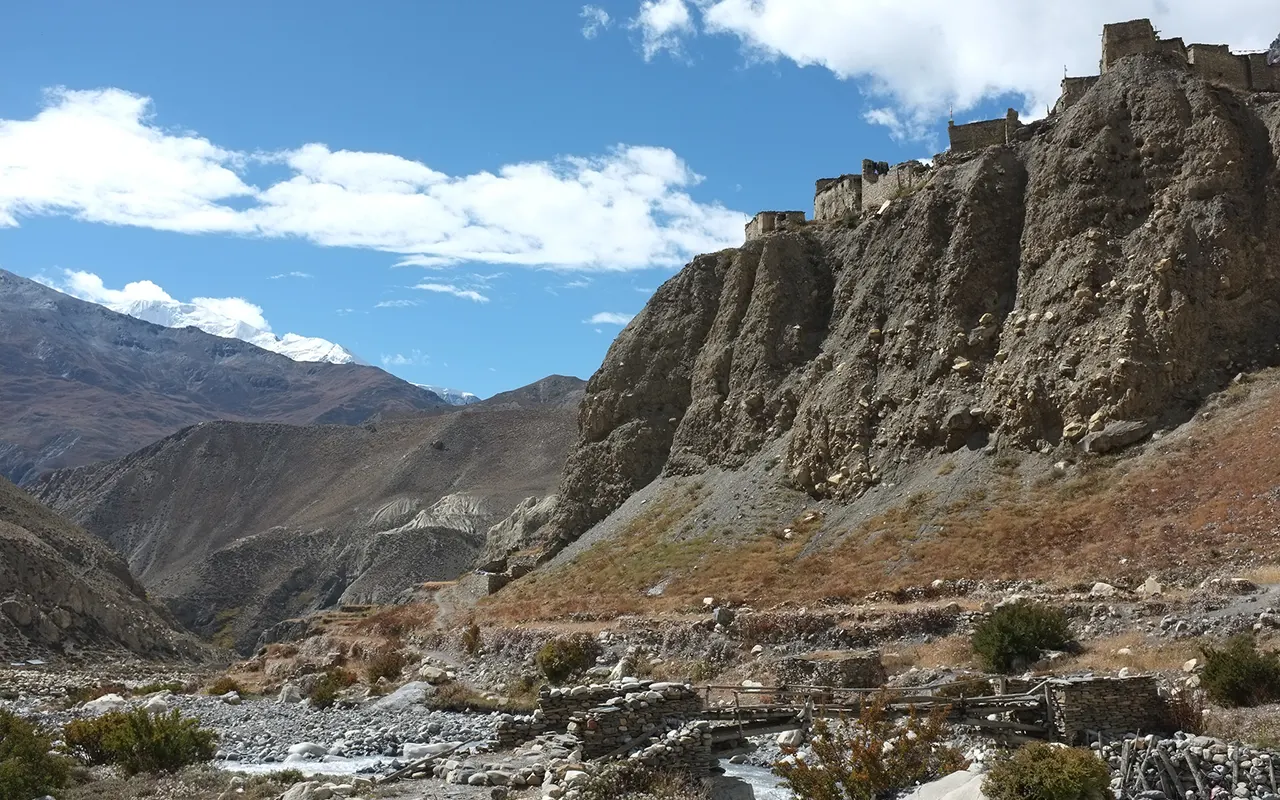
Phu has a population of about 200, comprising mostly Tibetans, living in stone houses piled high on the summit of the hill. The buildings are in old fortress style, constructed defensively against harsh winter and windy conditions. The houses consist of stone and mud-brick construction, sometimes in hillside locations, where roof forms with slopes are employed to dry flaked wood, grain, and yak dung, as fuel.

Phu’s twisting serpentine roads wind through tiers of terracing, chortens, mani walls, and mills. You hear children at play, the far-off mooing of yaks, the wind bearing the chant of monks. You’ve indeed arrived at an actual piece of Tibetan history.

Visiting Phu – Tashi Lakhang Monastery

Prior to sitting down for the night, a visit to one of the area’s most sacred locations—the 300-year-old Tashi Lakhang Monastery, which sits above the village—is well worth it. One of Nar Phu’s oldest and most significant monasteries, the monastery is believed to have been built by 11th-century Tibetan saint Karmapa. It has recently been restored and houses several monks who continue the traditions of their forefathers.

You’ll discover bright thangka paintings, softly glowing butter lamps, and depictions of Padmasambhava and other gods revered here. The head monk himself might even give you an impromptu tour, explaining its past along with its role in the valley’s religious life.

From the monastery, the landscape over Phu Gaon and ridges surrounding it is just breathtaking. You look down into the valley that you first came from and get a better understanding of just how far you really walked.

Nightfall at Phu – Silence, Rest

You overnight in one of Phu’s spare teahouses, cozy but primitive. You must expect spartan accommodations with wooden beds and thick blankets. There may be no showers, electricity, but the warm welcome spread over your hosts, home-cooked meals (buckwheat chapatis, yak stew, dal bhat), and idyllic location make absence of luxury well worth it. As sun withdraws behind mountains and cold creeps in, the village slips into a silence of stillness. Skies burst with stars, unmarred and crystalline. Under stars, sitting, with walls sanctified by centuries and infinite stillness all around you, you begin to feel what many trekkers describe—a sense of identification with something eternal. Closing Remarks for Day 5 Your hike today from Meta to Phu Gaon was not about effort—it was about unearthing a concealed world. You traversed surreal rock ridges, strolled along once-worn trails that were trodden on by monks and nomads, and entered an ancient medieval Tibetan village that defies time. Phu isn’t where—you sense it. Concealed but thriving, old but lasting, it sheds light upon what has been lost with civilization. For the majority, it’s the emotional pearl of the whole trekk around Nar Phu. The subsequent day you trek deeper into the valley or get set for trek into Nar. Today, you sleep in Phu, among stone walls, centuries-old prayers, and silence of the Himalayas.

activity-icon

Activity & Duration

Trek (7-8 hours)
altitude-icon

Highest Altitude

4,080m/13,386ft. (Phu Gaon, Manang)
meals-icon

Meals

Breakfast, Lunch, Dinner
accommodation-icon

Accommodation

Tea House

Day 6: Acclimatization Day in Phu Gaon

The fifth day of the trek into Nar Phu Valley provides you with one of the most rewarding and most memorable parts of the entire trek—from Meta (3,560m) to Phu Gaon (4,080m). This part subjects you more to isolated Himalayan wilderness and you are rewarded with a bewitching mix of rugged alpine scenery, multi-national rock gorges, ancient buildings, and centuries-old Tibetan culture. You sense the gradual drift from sheer mountain wilderness towards habilitation by man and the landscape is frozen almost in time.

You then visit Phu, one of the most remote and culturally untainted villages of the Himalayas, and feel as though you’ve stepped back a few centuries into the past.

Early Morning Departure from Meta – Feeling Lonely
You wake up at the small village of Meta. Pre-dawn cold bites at this elevation, and the wind whistling over the plateaus reminds you where you are currently, far up into the Himalayan rain shadow. You refuel with a big breakfast—such as tsampa porridge or Tibetan bread and honey—and then break camp and start your trek on to Phu.

The trail soon escapes Meta’s dispersed villages and heads back into dead-backcountry. You walk the entire first half of the trail over open meadow and rugged ridge tops. The trail is bad, frequently broken and covered with loose stone, but the majesty of peaks and peace of the valley are stunning. The only humans that you will meet passing upon this trail are rarely people, and you enjoy an immense solitude.

The terrain shifts suddenly at this point. You are now trekking over multi-coloured stretches of rock, one of the features that set the Nar Phu valley apart. The rocks are red, orange, purplish and ochre-hued here, and striated sediment and striations that resemble frozen waves. This beautiful ruggedness is a dramatic contrast to the grey cliffs and dusty path below, and the scenery here is almost Martian.

Cliffs and Ancient Chortens Trails
The trail grows steeper androcky as you climb to the high point. You go up steep, cliff-sided trails that climb up narrow gorges carved by the Phu Khola. Part of it is traversing dry, dusty ledges with precipitous drops to the river far below. It isn’t technically risky, but you need to be careful where you step and pay attention to your feet.

You’ll pass by numerous chortens—Buddhist stone shrines sporting fluttering prayer flags on the breeze of the mountain. The religious stops are an indication you’ve reached one extremely Buddhist spot. The chortens range from ancient and worn, constructed from stacked stone and mud, to new and brightly decorated with extensive paint work. Pass them all on your left side, as one does.

You may pass seasonal herder enclosures or observe yaks grazing on thin grasses at remote pasture fields. Though there are no shops and teahouses like there are on the Annapurna Circuit from Meta to Phu, there are just sporadic tracks of one’s forbears.

Kyang – The Ghost Town of Mountains
At midday, you drive through an abandoned village named Kyang. Once a sanctuary for Khampa Tibetans and then for local herders, Kyang is now nearly abandoned. Its rock houses, sitting on a ridge overlooking the river, are being slowly covered in earth. It’s bizarre—a serene, lovely place and an immediate reminder of impermanence in rough terrain.

Kyang is just as good a place as any to take an integral lunch. There is here most commonly an energetic puff of wind, and the stunning sweep of cliff and remote glaciers affords an ideal setting. The trail continues from here, over narrow gorges and rickety wooden bridges over torrenty streams of glacial water.

Arrival at Phu Valley – The Land of Missing Time
As height increases, forest vanishes pretty much all around. You now travel through a barren but strange terrain of sand, rock, and scree, only studded by hardy saplings. The rock colors still remain diverse—smoldering red and dusty blue with superlative contrast under an empty Himalayan sky. The only living beings are the occasional blue sheep hugging rocky slopes and eagles flying high overhead.

Finally, you arrive at Phu Valley’s gate chorten, a massive, multi-story stone monument that guards the religious approach to the village. Passing beneath it is crossing from one world to another—crossing from one and into the other. From here, the path continues along the ridge, and you have your first complete vista out over Phu Gaon in the distance.

Arrival at Phu Gaon – A Secret Tibetan Kingdom

Following one last drop down through a thin ridge, you arrive at Phu Gaon, an ancient stone village knotted up with valley folds and crowned with high peaks. You feel awed to be here. You question whether it exists at all and yet remains immune from time and tourist exploitation.

Phu has around 200 inhabitants, all being Tibetans, and they inhabit stone dwellings stacked one on top of another on the mountain side. The dwellings are fortress-like and old-school, made to withstand snowy winter and windy weather. The building materials consist of mud brick and stone, frequently incorporating the hill side as part of the construction with flat roofs to dry fuel wood, grain, and yak dung as fuel.

These are twisting, small streets through terracing levels, chortens, mani walls, and water mills. In the distance, on the breeze, there are sounds of laughing children, an occasional mooing of the yak, and chanting of holy men. You’ve certainly come to one of Tibet’s earliest books.

Traveling to Phu – Tashi Lakhang Monastery

Before returning to settle in for the night, spend some time visiting one of the area’s most sacred sites—the Tashi Lakhang Monastery, far up above the village. This 300-year-old-old monastery—which legend has it was established by the 11th-century Tibetan saint Karmapa—is one of the oldest and most significant in Nar Phu. The monastery was recently restored and now has monks stationed there living and continuing the religious tradition of their forebears.

There will be thangkas of resplendent colours, smoldering butter lamps, and paintings of Padmasambhava and deities from the higher realms of heaven. The older monk will whirl you around on a descriptive circuit, discussing founding legends of the establishment of the monastery and its role in the spiritual life of the valley.

The views from the monastery across Phu Gaon and successive summits are just magnificent. You can look all the way back down the valley from where you’ve just climbed and be amazed how far you’ve walked.

Evening at Phu – Rest and Reflection

You will overnight at one of Phu’s extremely rare teahouses, simple and warm. You will get basic rooms with wood beds and thick blankets. The shower and electricity are likely not working or spotty, but the host’s warmth, hearty food (buckwheat chapatis, yak stew or dal bhat), and peaceful ambiance completely make up for the absence of luxury. As the sun dips behind the hills and the chill descends, the village retreats into immovable, quiet sleep. The stars replace the sky, untroubled and cloudless. Seated under stars, under walls which are themselves old and under stillness which is itself old, you can start to receive what so many walkers have borne witness to—a profound feeling of being connected with something timeless. Final Reflections on Day 5 Today’s trek from Meta to Phu Gaon was more than just one of exercise, it was an excursion into a world unknown. You hiked through an extraterrestrial landscape of boulders and stone walls, walked routes followed by monk and by ancient nomadic tribesmen, and ended the day in an undisturbed medieval Tibetan village. Phu is something more than somewhere—it’s an experience. Remote and colorful, ancient and timeless, it grants us a glimpse into the lifestylelost to modernity. For most people, this day will be the high note emotionally of the entire approach up to Nar Phu. You’ll linger over the rest of the valley tomorrow or maybe look ahead and take the trek up to Nar. Tonight, however, you settle into Phu, amongst stone walls, centuries-old prayer and Himalayan silence.

activity-icon

Activity & Duration

Visit Tashi Lekhang Monastry, (1-2 hours)
altitude-icon

Highest Altitude

4,080m/13,386ft. (Phu Gaon, Manang)
meals-icon

Meals

Breakfast, Lunch, Dinner
accommodation-icon

Accommodation

Tea House

Day 7: Trek from Phu Gaon to Nar

Having enjoyed a highly rewarding acclimatization day at Phu Gaon behind you, you wake up on Day 7 of the trek to the Nar Phu Valley feeling refreshed. You trek for the day out of the peaceful sanctum of Phu into another highly cultured village: Nar, at the same altitude but diverse landscape and geography. Relatively close to each other as the crow flies, the trek from Phu to Nar is twisting, secluded, and taxing, and will consume the better part of the day since you downward-trek a river gorge and then upward-trek onto the highlands.

It’s no longer a question of distance anymore—it’s a journey through scenic scenery, varied altitudes, and ancient Tibetan culture, and your arrival at arguably the most beautiful village in the high Himalayas.

Exiting Phu – Retracing on the Ancient Trail
Exiting Phu
It’s an early start. You breakfast at your teahouse—some warm buckwheat pancakes or tsampa porridge perhaps—you set off down the steep, rough track from Phu Gaon. You know the first section of the track but it’s no less spectacular: ancient chortens, multicolored prayer flags, and bare cliffs lead your eye downward to the Phu Khola (river).

We move across at Kyang, an ethereal winter village formerly grazed by the yaks. The dry stone humps against jagged cliff backgrounds is an evocative scenic sight, a mutely testifying witness to man kind’s ancient connection with this unforgiving terrain.

As you walk, winds tend to blow down the valley, and the sight of the rear in the direction of Phu and surrounding summits is unforgettable. Here is the last view of Himlung Himal, the white peak glistening in the morning sun.

Down Through the Valley Floor – Across Suspensions Bridges
Following a couple of hours’ hike along the narrow gorges and river curves, the trail plunges sharply down to Phu Khola’s confluence with Nar Khola, where a chain of suspension bridges provide exhilarating crossings as well as great photo shots. Swaying high above the river with a distinct movement underfoot, the roar of meltwater below you accompanies the echoes off canyon walls.

The bridges themselves are sturdy but adventure-granola-sounding—some with flying prayer flags streaming across them, others simple and serene, offering views into the untamed and distant heart of this sanctuary. Walking across them, the ground changes. The grass-open valley near Phu yields to grassier slopes, sprinklings of alpine scrub, more gently sloping slopes towards Nar.

Climbing towards Nar – A Climber’s Serene Ascent
Having crossed the bridges, you begin climbing ascentively towards Nar, rising again in elevation. It is a less sharp path than early climbs at the beginning of the trek but the altitude claims an additional share of effort. Thankfully, the scenery and peaceful surroundings keep you going.

It’s also less populated with trekkers compared with the more popular Annapurna Circuit, so you’ll be alone with the natural world—the wind, the distant calls of Himalayan birds, the far-off ringing of yak bell ringers, and your boots crunching on stone track. You’ll pass occasional small mani walls and chortens along the way, a reminder you’re actually trekking through a sacred-looking region with a centuries-long history as a Buddhist-bathed land.

The trail traverses rolling Himalayan pastures, and if you walk there in summer, you can be sure to encounter villagers and their yaks or dzos harvesting the robust but poor vegetation. These are deeply rural Nepalese villages, and they live hard on the land.

arrival at Nar – Cultural Gem of the Himalayas After 6–7 walking hours or so, you reach at least the village of Nar, which is a slightly larger and more populated village than Phu but still a small place with about 300 residents. It lies on a scenic but windy plateau surrounding ridges, farmlands, and snow-capped views. Although out at high altitude and quite off the main track, the village is warm and cordial.

Nar is tidy, spotless, and colorful. While Phu’s homes sit cheek-to-jowl together, at Nar the homes sit a short distance from one another with neat lines and narrow stone alleyways between them with stacked wood for fires along with barley drying racks and herb drying racks. These structures remain old Tibetan-style with flat roofs, wooden beams, and colorful window panels.

On reaching the village, you are welcomed with smiling faces—wool spinners, older men whirling prayer wheels, and children playing with handmade dolls. There are yaks grazing neighboring green fields, and the vibe here is relaxed yet strongly religious.

Monasteries and Chortens of Nar

Nar has a couple of monasteries and chortens, some of them new and some of them old. Most prominent among them is Samten Pol Monastery, a little higher than the village, which has panoramic views of the valley and the surrounding countryside. Visiting there will give you a peek into the religious life of the locals—you may get to witness monks chanting their prayers, children studying, or butter lamps set alight in quiet corners.

Nar appears more active and systematic than Phu, who sounds old-fashioned and solemn with more communal participation in everyday life and religion.

The Wind and the Light – Late Afternoon in Nar

It gets windy in the afternoon with winds blowing across the barley fields and whipping prayer flags against their flagpoles. It’s a great time to sit comfortably in your teahouse, sip your hot tea, and put your feet up after your day’s activity.

You can view the light streaming gold over stone walls and terrace fields from the rooftops or the outside benches. Peaks start to sparkle in the distance, and the wind gets cool fast. Supper is hot and filling—possibly dal bhat, buckwheat roti, or yak meat stew if they have any. Thinking about the Day
Imagine Easier than days to come but a taxing day of travel on an emotional and physical scale, Day 7 is an important connection between two of Nepal’s most historically preserved and culture-dense villages of the country’s most distant trekking district. A detour down into the valley of the river with an subsequent ascent up to Nar provide maybe rawest of the breathtaking views, but the juxtaposition of Phu’s isolation with the warmth of Nar suggests the quantity of life achievable even at the end of the Himalayas. Until this point, the inhabitants of Nar have preserved their Tibetan Buddhist culture, autonomy, and relationship with the mountains essentially undisturbed with any external contact. You’ll be sleeping tonight within this ancient village but be ready for what’s awaiting you—you’ll be undertaking most importantly travel across the Kang La Pass, still within days in the future.

activity-icon

Activity & Duration

Trek (6-7 hours)
altitude-icon

Highest Altitude

4,110m/13,484ft. (Nar, Manang)
meals-icon

Meals

Brekfast, Lunch, Dinner
accommodation-icon

Accommodation

Tea House

Day 8: Acclimatization Day in Nar

After seven consecutive days of continuous trekking over scenic Himalayan country and isolative Tibetan-style village settings, a welcome respite comes on Day 8 at Nar—a day for your body’s acclimatization of thin mountain air along with a possibility of sightseeing at the rich cultural characteristics and distinct way of life at this high-altitude village.

It’s not only a day of body but also mind and spirit refuelling. Ahead of us is the formidable Kang La Pass (5,320m), an adrenaline rush but testing pass which needs energy, stability, and acclimatisation. This thus necessitates your rest day at Nar to be more than a convenience but a necessity.

A Quiet, Serene Morning
S
Your day starts later in the day compared with most parts of the world. Without the hastle of closing down shop and an early departure you can rise at your leisure, have a sturdy breakfast and absorb the fresh clean mountain air. At Nar the atmosphere is subdued and reflective with a distant chiming of yak bells or distant murmuring of chanting prayers along the rock alleyways.

It is the choice of trekkers generally to spend the morning at your leisure with nothing at all to do but sit with a mug of Tibetan butter tea or hot tsampa porridge and bask in the serenity of this little gem. You have fine views of high mountains and arid hills from your teahouse but with golden morning light on them. When the sun rises over the eastern ridges, prayer winds blow with the banners, and the atmosphere of monkhood over the village appears particularly real.

Unveiling Nar – A Tibetan Museum of Living Culture
A quiet respite over, a nice day is ideal for casual sightseeing around villages near Nar village. Though Phu is far off and mysterious a bigger populated more efficient Nar has a clearly defined village form with sturdy stone built houses and vigorous community life.

When you walk down the narrow stone alleyways, you will notice:

Women spinning yarn and weaving wool in the doorway of their houses.

Men in the fields, preparing for the brief growing season.

Children running in the alleys, laughing and rushing with their self-made toys.

Prayer wheels affixed to village walls, slowly revolving in the hands of old villagers.

It is not an ordinary village but a site of history of the ancient trans-Himalayan trade route connecting Tibet and Nepal. From the population to the clothes, the foodstuffs, and the traditions, everything speaks of a strong Tibetan Buddhist tradition upheld with seclusion from the world for the villagers.

Visit at Samten Pol Monastery
It’s
One of the highlights of the day is a hike up to Samten Pol Monastery sitting atop a small ridge about over the village. It’s an extremely brief climb but provides a spectacular view of Nar and the countryside. Since there’s no heavy backpack to carry along with you, you can relax and actually enjoy the vista—rolling ridges with grazing yaks, far-off snow-peaks in over-dominant sway over the horizon.

The monastery itself is plain but profoundly spiritual. Inside, the walls feature vibrant thangkas (Buddhist wall paintings) and the wafting scent of incense and butter lamps fills the air. You may see monks chanting morning prayers or reading texts or sit respectfully in contemplative silence, absorbing the serene atmosphere that fills this holy place.

If you are lucky, a local resident or a monk will provide an explanation of the symbolic meaning of what you see, the history of the monastery, and why you have to cross Kang La Pass ahead of you. Most find that completing crossing high passes such as Kang La is not just physical but that it is a stint of spiritual cleansing and rebirth.

Cross-Culture Interaction and Learning
A

One of the wealthiest parts of the acclimatization day at Nar is being able to interact with locals. Since you’re not rushing off to the next camp, you have the time to actually connect with them.

Nars are humble, quiet, and warm but not necessarily talkative English or even Nepali-speaking. A smile, a hand wave, a meal can speak more effectively than words themselves. You may even be privy to stories convention-bound elders have been relating for years—about winter village life, travel with yak string caravan possibly over high passes for weeks at a time, or keeping their culture separate even in an ever-changing world with a guide or interpreter.

A few of these guides even set up a trip to a local’s house, at which point you can enjoy salted butter tea, self-churned yoghurt, or even a glass of chhang (barley beer) brewed at the village. Discussion, of course, naturally focuses on Buddhism, agriculture and rural life, and the tremendous respect they have for the mountains.

Optional Hike for Acclimatization

For trekkers who merely happen to be in decent physical condition and who wish to get further acclimatized a little higher, a little climb up from the village is strongly urged. To acclimatize higher in the daytime and return lower down to rest is healthy for the body—a good method of reducing the danger of Acute Mountain Sickness (AMS).

The hills north of Nar offer breathtaking views of:

Pisang Peak (6,091m),

Kang Guru (6,981m),

The path towards Kang La Pass.

They indicate encouragement and a heads-up about what’s in store for us tomorrow in the test. It blows stronger here, and even a short couple of hundred meter’s ascent reduces the air’s density. It’s a good testing ground for your stamina for the big show tomorrow.

Rest, Hydration, and Mental Preparation

Afternoons will be spent relaxing. Nar is more than 4,100 meters above sea level, and a short walk will exhaust you. You have to:

Drink plenty of liquids or rehydration salts.

Avoid alcohol.

Consume routinely (carbohydrates help at high altitude).

Monitor for symptoms of AMS: headache, nausea, dizziness, lassitude

You can be short of breath or have a headache, not an infrequent event at this altitude but still be certain your guide reports any non-normal symptoms of illness for you. This rest day today significantly minimizes the possibility of altitude illness for crossing the high pass.

Psychologically, the trekkers also start acclimatizing Kang La Pass of Day 9 (5,320m). Maps are again read, gear reviewed again—particularly warm clothes, headlamps, gloves, and crampons or snow trekking poles. You might sleep early with the knowledge of the next day’s hike starting before dawn.

Atmosfera de la Now the sun is setting, even deeper peace descends on Nar. Warm colors kiss the stone houses with shiny gold, prayer flags swing freely on the cold evening wind. It gets cold fast, so you bundle up in a few layers, sip hot soup out of a cup, and stop for a bit to look out over all that you’ve trekked from—from Dharapani to the faraway Nar valleys. Dinner is shared with other trekkers. There is thrilling fear and a sense of thankfulness to be so fortunate to be able to venture so far and to such a very remote and spiritual part of the Himalayas. You complete an opening day’s trek weary but impressed. Tomorrow will be the most challenging but rewarding day so far on the trek.

activity-icon

Activity & Duration

Rest and Exploration in Nar
altitude-icon

Highest Altitude

4,110m/13,484ft. (Nar, Manang)
meals-icon

Meals

Breakfast, Lunch, Dinner
accommodation-icon

Accommodation

Tea House

Day 9: Trek from Nar to Ngawal via Kang La Pass

It’s Day 9, trek into the Phu Valley, the physically toughest but emotionally most thrilling, day of the whole trek. It’s the day you get over the Kang La Pass, an intimidating pass between off-the-map Phan Nagarayan, Nar, and trekker’s paradise Annapurna Circuit. Owing to its steep climb,high-alpine landscape, and unmatched view into the massif of Annapurna, this day’s not merely trek, it’s an accomplishment.

Pre-Dawn Thrill: A Pursuit of the First
You set out much earlier than it’s light, usually 4:00 or 5:00 AM. It’s important that you set out early for the reason that the pass is over 5,300 meters relative sea level, where afternoon winds and unstable weather will challenge passage. Under blue darkness before dawn, headlamps shine, boots crunch against cold earth, breathed exhalations drift upon the air like smoke.

Layer upon layer each for them in the group—the thermal base layers, insulated jackets, caps, gloves—all wrapped up against the cold but resolute. The stars keep twinkling above, and the moon can give snowy peaks a silver sheen, imposing an unearthly beauty on the start of this long, unforgettable day.

Ascension Climbing to Kang La Pass: Challenge and Reward
It’s
It steepens precipitously from Nar, 1,200m vertical ascent, to the ridge beyond Kang La. It’s an endurance, grit, and deliberate breathing sort of place, where you are acclimating to thin altitudes. The track twists its way along scree, stone roads, and alpine meadows. Horses and yaks never ascend this far—this remains wild, virgin territory.

Every move is work but each halt contains more and more theatrical landscape. While sun rises in your background, soft warm light starts to highlight Pisanga Peak, Chulu East, and Himlung Himal ridge lines and glaciers. Early-riser sunrises bring warmth and psychological payoff, propelling you forward even with thin cold air.

Your guide will likely take you at a steady, moderate pace—”bistari bistari” (slowly slowly)—so that you expend your energy without suffering from altitude sickness. Frequent short halts, not only to rest, but to soak up the majesty of the surrounding view.

It steepens again and is fully exposed as you make your way down the last leg to the pass. Off-monsoon, once the snow has melted, or in the early spring, when you may still find small patches of snow, you will need trekking poles, or microspikes, for grip.

Kang La Pass Trek – 5,306 meters
Cresting Kang La Pass is an experience of exhilaration and awe. There’s little sign at the pass, topped with flailing prayer flags whipping about in thin mountain winds, sending mantras heavenward. You’ve just risen to an altitude that few earthly creatures ever get to see with your own two feet.

And the view down at the pass is beautiful—one of the best in the entire country of Nepal. Looking south, you get the raw AnnapurnaRange directly in your face, from snowy-crowned mass of Annapurna II down through pyramid-topped Tilicho Peak, with Gangapurna glacier sparkling beneath it. The Upper Manang valley plunges down under you, and you can spot the narrow line of the trek down the Annapurna Circuit making its winding route down through forest and grass.

Everyone lingers a good 20 to 30 minutes at the top, snapping pictures, resting, and quietly sipping in the grandeur of the Himalayas. It’s no wonder you’ll feel dizzy or weepy at the pass—less because you literally are higher up, but because you soak up both the sheer beauty and the feeling of accomplishment that you made it.

Descend into Ngawal: From Wilderness Heights to Cultural Tranquillity

And finally, having been at the summit, descent takes an equally long but steep course of almost 1,700 meters. The track steeply down at first over loose scree, where trekting poles become mandatory. The knees complain, but the track becomes gentle slopes gradually, with alpine grasses, then pasture meadows, rhododendron thicket as it gets forestier.

It gets greener, redder, and goldener the farther down you trek. The harsh whites and greys of the higher peaks get eroded into blooming wildflowers in certain seasons, and you get glimpses off into the far distance beyond blue sheep herds. The trek has constant panoramic views, and you even get sight of other trekkers, possibly the first time in days, as you connect into the Annapurna Circuit.

Finally, you arrive at the scenic village of Ngawal (3,675m). Hospitable, green, and vibrant after the harsh seclusion at Nar and Phu, but with its devout Buddhist traditions.

Arrival at Ngawal: A Seamless Arrival

Up above the Marsyangdi River, it’s situated on a high ridge with great view over Annapurna III, Gangapurna, and Tilicho Peak. It’s among the most beautiful villages in the Manang region, with whitewashed houses, wood neatly stacked, and beautiful monasteries.

Relatively younger than Nar, Ngawal has many attached bathrooms with electricity, better menus, etc, luxury after days’ treks in isolated valleys. There you’ll find:

Busy teahouses-complete with hot showers and dinners.

Bakeries with apple pie, freshly baked, coffee, adnd freshly baked bread.

Wi-Fi internet connections (which are typically slow), which enable you to talk with loved ones.

After such a strenuous day, one enjoys sitting up in one’s higher lodge levels, holding a cup of tea, and gazing at the last light of day give the snow peaks a rosy hue—a serene end to an electrifying day.

REFLECTIONS AFTER THE DAY

Instead Day 9 is not a walk—certainly not a hike. Day 9 is an odyssey, spiritual and physical. The rugged long ride up to Kang La Pass challenges your lungs, your legs, and your will. But the reward—a picturesque 360-degree Himalayan panorama, remoteness from the world, and the unrestrained spiritual energy of the mountains—is all worth the agony. It’s been termed the highlight of this trek into the Nar Phu Valley, both because of the landscape, but also because it’s the watershed: from the remote, other-worldly valleys of Phu and Nar into the cosmopolitan hustle of the great Annapurna trail. You retire to bed that night with tight muscles, a full stomach, yet with the heart full of thankfulness and joy.

activity-icon

Activity & Duration

Trek (8-9 hours)
altitude-icon

Highest Altitude

5,306m/17,408ft. (Ngawal, Manang)
meals-icon

Meals

Breakfast, Lunch, Dinner
accommodation-icon

Accommodation

Tea House

Day 10: Trek from Ngawal to Manang

A Gentle Descent from Ngawal
The tenth day of the Nar Phu Valley Trek starts in the peaceful village of Ngawal, which is at an altitude of 3,675 meters. Following the physically exhausting crossing of Kang La Pass the previous day, the tenth day is a day when the pace is more leisurely. The day in Ngawal is quiet, and golden sunlight shines on the stone buildings and prayer flags waft gently in the air. The village is perched high above the Marsyangdi Valley, and trekkers are served an extensive view of the Annapurna massif, including Annapurna II, III, IV, Gangapurna, and Tilicho Peak.

Transition into the Annapurna Circuit
As the trek begins, the trail gradually descends, crossing dry hills, sporadic juniper bushes, and small clusters of alpine forest. This is a noticeable transition from the bleak, high-altitude terrain of Nar and Phu to a more hospitable and fertile landscape. The atmosphere is noticeably thinner, easier to breathe, and the trek more leisurely. Trekkers come across small villages, old mani walls, and traditional chortens deeply rooted in Buddhist culture en route.

Passing Through Scenic and Cultural Attractions
The path is scenic and culturally enriched because it passes through local villages and pine forests. You will find yourself passing by herders with yaks, locals to dry herbs for medicine, or children playing at the track. Before Manang, you pass by the picturesque village of Braga that contains the old Braga Monastery (Braga Gompa). If time allows, a visit to this centuries-old monastery, which is carved out of a cliff face, is highly recommended. It has ancient Buddhist relics and has a breathtaking view of the whole valley and surrounding mountains.

Arrival at Manang – A Mountain Centre
You arrive in Manang after trekking for about 4 to 5 hours at an altitude of 3,540 meters—a thriving and well-developed town, which appears as a mountain oasis. Located on the Marsyangdi River and protected by mighty mountains, Manang is a popular acclimatization place for trekkers going on further to Thorong La Pass along the Annapurna Circuit. As compared to the remote villages of Phu and Nar, Manang boasts teahouses, bakeries, cafes, equipment shops, and even a cinema hall, offering trekkers a welcome taste of comfort and civilization.

A Blend of Culture, Comfort, and Himalayan Grandeur
Manang has a population of mixed Gurung and Tibetan individuals. They are friendly and generally eager to talk about life at high altitude. You can spend the day strolling around town, getting warm apple pie or coffee at one of the local bakeries, or simply relaxing in your lodge. For those concerned about altitude sickness, the Himalayan Rescue Association’s local post is there to provide helpful tips and treatment.

Reflection and Rest
As you sleep, the peaceful environment of Manang and the snow-covered peaks in the distance, all ready to be dreamed about, invite you to reflect. The journey from the secluded, culturally rich valleys of Nar and Phu to the vibrant hub of the Annapurna region is a satisfying sense of accomplishment. Day 10 is not a transition but a victory of survival, exploration, and the ever-changing beauty of the Himalayas.

activity-icon

Activity & Duration

Trek (4-5 hours)
altitude-icon

Highest Altitude

3,540m/11,614ft. (Manang, Manang)
meals-icon

Meals

Breakfast, Lunch, Dinner
accommodation-icon

Accommodation

Tea House
reviews-icon

Reviews on Nar Phu Valley Trek

An excellent trip of my life

The Everest Base Camp Trek with Helicopter return is a popular trek that takes you to the base camp of Mount Everest, the highest mountain in the world. Everest Base Camp Trek (5364m) usually takes about 14 to 15 days on foot, but with the added convenience of a helicopter return, you can complete the journey in 11 days.

profile

David James, USA

verified

Purchase Verified

An excellent trip of my life

The Everest Base Camp Trek with Helicopter return is a popular trek that takes you to the base camp of Mount Everest, the highest mountain in the world. Everest Base Camp Trek (5364m) usually takes about 14 to 15 days on foot, but with the added convenience of a helicopter return, you can complete the journey in 11 days.

profile

David James, USA

verified

Purchase Verified

An excellent trip of my life

The Everest Base Camp Trek with Helicopter return is a popular trek that takes you to the base camp of Mount Everest, the highest mountain in the world. Everest Base Camp Trek (5364m) usually takes about 14 to 15 days on foot, but with the added convenience of a helicopter return, you can complete the journey in 11 days.

profile

David James, USA

verified

Purchase Verified

An excellent trip of my life

The Everest Base Camp Trek with Helicopter return is a popular trek that takes you to the base camp of Mount Everest, the highest mountain in the world. Everest Base Camp Trek (5364m) usually takes about 14 to 15 days on foot, but with the added convenience of a helicopter return, you can complete the journey in 11 days.

profile

David James, USA

verified

Purchase Verified

profile-expert

Live Chat 24/7