How Difficult is Upper Mustang Trekking?
The Upper Mustang Trek is regarded as a moderate trek. It is not technical climbing, although trekkers cover 5-7 hours per day on uneven ground at high altitude. Its summit is 4,200 m (13,780 ft) at Marang La Pass, and the highest overnights are 3500-3840 m (11483-12598 ft) in Lo Manthang. The trails are usually well-defined, and a few steep up-and-downs, such as Taklam La and Nyi La, are in play, yet nothing can be considered dangerous. Challenges are endurance and acclimatisation.
Fit trekkers, including beginners, can finish the Upper Mustang with preparation. Himalayan Pathways guarantees a relaxed rhythm with the rest stops and adequate assistance. The average distance is 10-15km/day, and therefore stamina is required. Moving slowly, staying hydrated and pacing oneself make the trek fun. All in all, the challenge is moderate: not too difficult for most healthy tourists, and the reward is impressive with its fantastic scenery and appealing culture.
Weather and Best Season
Upper Mustang is also in the trans-Himalayan rain shadow; the climate is predominantly dry. The Upper Mustang Trekking is most suitable during spring (March- May) and autumn (September-November). Spring has a pleasant climate with temperatures of 10-20 °C (50-68degF) during the day and 0- 5 °C (32- 41°F) at night, and the Tiji Festival of Lo Manthang is renowned. Other places are monsoon (June- August), but in Upper Mustang, it is mostly dry; day temperatures range 15-25°C (59-77°F); high winds may be experienced, particularly along the Jomsom-Kagbeni.
Autumn is cool, clear, with a daytime temperature of 10-20 °C (50- 68 °F), and nights of -5 °C (23°F). It is cold in winter (December-February) with a daytime high of 5- 10 °C, 41- 50°F, and a nighttime low of less than -10 °C, -14°F, so the trekking is only doable by the experienced adventurers.
Himalayan Pathways suggests spring or autumn as the time of stable weather, clear skies, and cultural experiences. Never leave without a windbreaker, sun protection, and layers, no matter what time of the year it is.
Food & Drink during Upper Mustang Trekking
In Upper Mustang Trekking, Himalayan Pathways will organise accommodation in teahouses that serve Nepali, Tibetan, and simple Western food. The set of rice and lentils is called Dal bhat and gives strength to one to work long days. There are other alternatives such as momos, thukpa, noodles, pancakes, and yak cheese. The amount of meat is minimal, vegetarian food is widespread, healthy and safe.
Beverages are milk tea, butter tea, ginger-lemon honey tea, coffee and local apple cider now and then. It is necessary to be hydrated; 3-4 litres of water per day. There is safe drinking water and purification pills that are offered by the Himalayan Pathways. During the times of trekking, snacks such as nuts or chocolate are useful.
Food is plentiful to sustain trekking at high altitude, and the food options offered include breakfast, lunch, and dinner, usually daily. A healthy and comfortable experience of the Upper Mustang Trekking is ensured by eating balanced meals and being hydrated.
Altitude Sickness and Suggestions
Top Mustang Trekking has no more than 4,200 m (13,780 ft) with an overnight stay of less than 4,000 m (13,123 ft), which minimises the risks of severe high altitude. Other less severe symptoms of AMS are headache, fatigue and breathlessness. Himalayan Pathways organises the trek such that it is possible to acclimatise, with one rest day in Lo Manthang at 3,840 m (12,598 ft).
Prevention involves having a slow pace, hydration, carbohydrates, and avoiding alcohol. Guides carry pulse oximeters and first aid kits to check on the trekkers. Severe AMS is uncommon, but there is an option of evacuation on a jeep or a helicopter. In case the symptoms increase, it is necessary to descend.
There is case where trekkers use Diamox only with medical advice. Listening to your body, taking a rest and talking with guides are the key to a safe and pleasant trip on the Upper Mustang Trek.
Preparation and Fitness
Physical fitness is important in the case of Upper Mustang Trekking. Training before the trip in the form of cardio training, long walks and leg and core strengthening exercises is recommended by Himalayan Pathways. Hill climbing or climbing steps can also replicate day-to-day elevation changes.
Mental training is also relevant: accept remote living with the bare minimum of facilities and communication. It is also important to pack the appropriate equipment: layered clothing, insulated jackets, warm hats and gloves, sunglasses, sunscreen and trekking poles. Pack a 30-40 L Day pack of essentials; porters carry major luggage. The trek should be hydrated and slept beforehand to help with the acclimatisation.
These preparations would make the Upper Mustang Trekking experience an enjoyable, safe, and memorable experience, and you would get to enjoy the spectacular views and the unique Tibetan culture instead of exhaustion.
Visa and Permits
In order to hike Upper Mustang, you require a Nepal tourist visa and special permits. The majority of the travellers obtain their visa at Tribhuvan International Airport, Kathmandu or on land borders. The visa fee is USD 30, 50 and 125, respectively, on 15 days, 30 days and 90-day basis. You should have a passport of not less than six months.
The places of Upper Mustang are restricted, and therefore Restricted Area Permit (RAP) is compulsory. The standard rate of RAP is USD 500 in the first 10 days and USD 50 per additional day. All the permit arrangements are done by Himalayan Pathways, including the Annapurna Conservation Area Permit (ACAP, approximately USD 25), which is mandatory.
They do not allow independent trekking, and you will need to have a licensed guide. Your guide carries the permits on the trek, where they are produced at checkpoints in Kagbeni, Lo Manthang (3840 m, 12598 ft) and other villages. At Himalayan Pathways, you will not need to worry about your paperwork and can simply enjoy the adventure of the Upper Mustang Trek.
Health & Safety
The Upper Mustang Trekking is health and safety conscious. Himalayan Pathways will make sure that you are well guided by highly trained first aid and altitude safety-trained guides. Mustang Upper Mustang is 4,200 m / 13,780 ft at Marang La Pass; therefore, altitude sickness may occur; the guides test oxygen levels, rate your ascent, and provide oxygen when necessary. High-altitude trekking and emergency helicopter evacuation travel insurance is obligatory.
Special attention must be given to the hygienic food and water: the teahouses are chosen to have quality food, and drinking water is also purified. Individual health requirements, like asthma or allergies, are met by prior notification. The trails are usually secure, but there is also loose gravel and a few rockfalls, which can cause injuries with the assistance of trekking poles and precautions.
Precautions to use during the night are to bring a flashlight and know where to go during a fire in a teahouse. Himalayan Pathways is not an exception, and it also has COVID-19 protocols and emergency communication networks. Under good guidance and training, the Upper Mustang Trekking is a safe and enjoyable experience.
Transportation
Access to Upper Mustang takes several stages. Transfers from Kathmandu to Pokhara or by short domestic flight via Himalayan Pathways. Himalayan Pathways organises Kathmandu (1,300 m / 4 265 ft) to Pokhara (200km/7-8hours by tourist bus) transfers. Out of Pokhara, a picturesque flight to Jomsom (2,700m/8,858ft) provides excellent scenes of Annapurna and Dhaulagiri. Flights are in the morning so that there is no strong wind; 15 kg baggage.
In case of cancelled flights, there is also an option of a jeep ride (approximately 9-10 hours). The expedition is primarily a walking one, but pack animals or horses may also be hired. An emergency vehicle can be accessed by a recently constructed road that has been constructed between Jomsom and Lo Manthang, and walking the footpaths is the best experience.
Back travel is also there from Jomsom to Kathmandu to Pokhara. Himalayan Pathways makes sure that all the ground transfer, flight, and luggage arrangements are smooth, and the trekkers can enjoy Upper Mustang without any logistics concerns.
Travel Insurance
Upper Mustang Trekking will need travel insurance. Himalayan Pathways needs policies of trekking up to 4 500 m / 14 764 ft, emergency medical care and helicopter transport. The highest point of the Upper Mustang is 4,200 m / 13,780 ft; thus, high altitude coverage is essential. Insurance is in case of accidents or illness, theft, as well as trip interruptions.
Evacuation of isolated villages such as Lo Manthang by helicopter may cost 3000-5000 USD, and therefore, insurance is mandatory. Hospital treatment in Pokhara or Kathmandu should also be included in policies. Himalayan Pathways ensures your insurance information is verified before you leave, and maintains a copy, required in the event of an emergency.
Always have your number and emergency contacts in the trek. Travel insurance gives one the freedom of mind, knowing that unexpected occurrences, such as altitude sickness or accidents, are not going to be turned into a financial and logistical nightmare. Under the right cover, the trekkers are able to enjoy the upper Mustang experience safely and without fear.
Alternative Routes
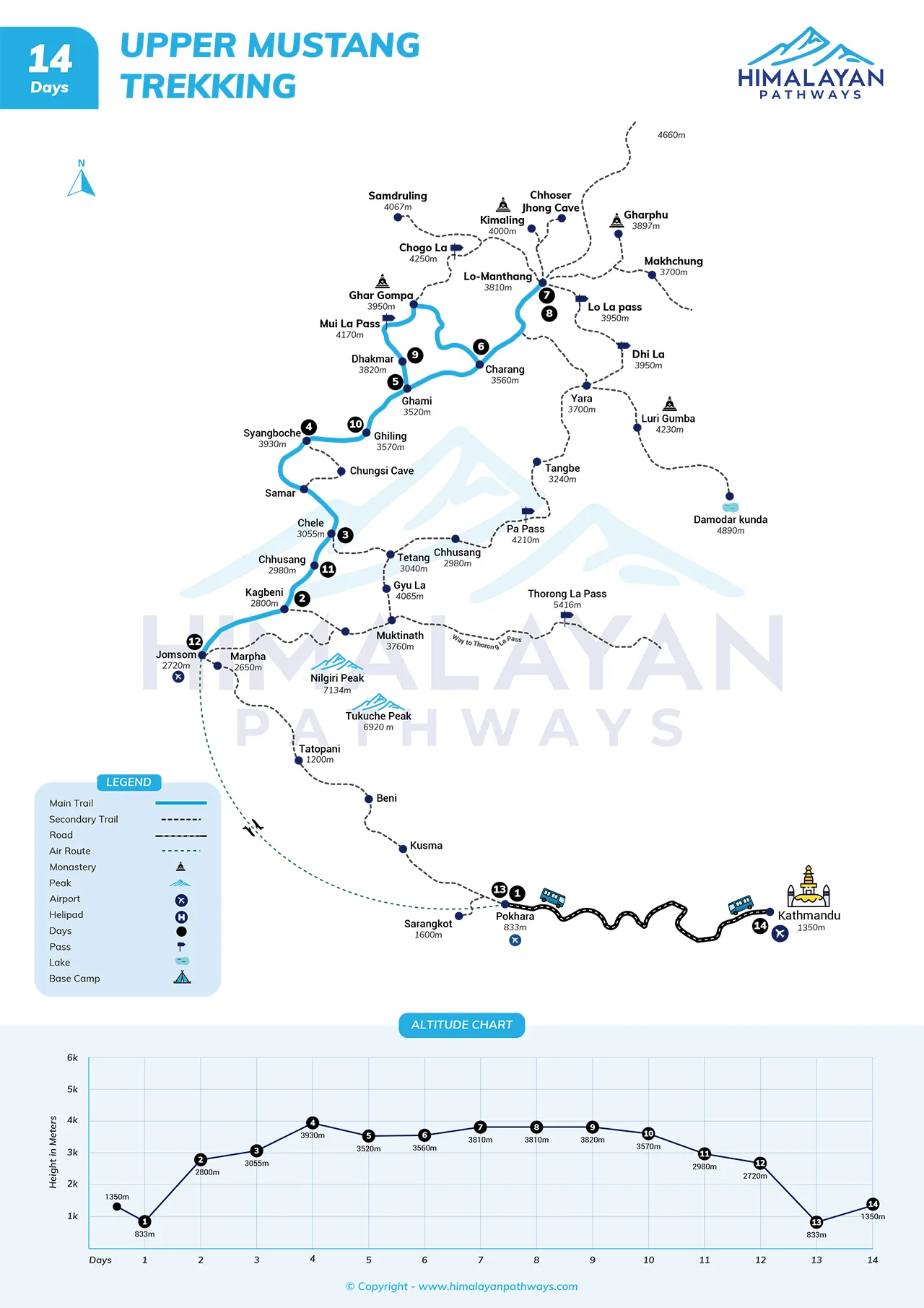
There are a number of route choices at Upper Mustang Trekking. The typical 14-day itinerary from Jomsom to Lo Manthang (3,840 m / 12,598 ft) can be offered by Himalayan Pathways. Shorter routes (10 days) do not cover all the villages, but include highlights. Longer paths venture to the eastern Mustang with cave monasteries at Luri Gompa, a necessary extension of 2-3 days. Others combine treks of Upper Mustang and Annapurna Circuit, including Thorong La Pass (5,416 m / 17,769 ft), which takes additional fitness and time.
In the Lower Mustang trek, Jomsom, Kagbeni and Muktinath (3,800 m / 12,467 ft) are the main attractions in the experience of 5-7 days. Seasonal routes can also be conducted, such as the Tiji Festival in Lo Manthang, a colorful 3 days event. Himalayan Pathways will be able to organise jeep, horse, or mountain biking activities in case one wants to have alternative means of transport or spend fewer days. These choices allow the trekkers to personalise their Upper Mustang Trekking adventure to suit time, fitness and adventure.
Your Extra Expenses
Although the package of the Upper Mustang Trekking offered by Himalayan Pathways includes everything but the trekkers also need to anticipate additional costs. Meals and beverages in Kathmandu (1300m/4265 ft) or Pokhara (820m/2690 ft) are also not included, and they cost approximately $5 -10 per meal at middle-income restaurants.
Drinks and snacks on the trek, in particular in the Upper Mustang villages such as Lo Manthang (3,840m/12,598ft), can be very expensive because of the cost of transport, which is approximately NPR 200-1,000 per person, water, tea or a local beer. Teahouses have charging facilities or Wi-Fi connections, which cost another NPR 200-500 per device or per day.
Guide and porter tips, hot shower and souvenirs are also additional. Trekkers can also incur expenses of $50-200 outside the package on average, according to their habits. Himalayan Pathways recommends that one come with small amounts of Nepali rupees to cover these costs. To be on the safe side, it is always important to plan before you get into the Short Upper Mustang Trek and incur some unexpected expenses.
Language & Communication
The national language is Nepali which is common among the locals, the guides, and the teahouse owners. Simple words, such as Namaste (hello) and Dhanyabad (thank you), come in handy. The culture of Mustang villages, such as Lo Manthang (3,840m/12 598ft), is to the extent that the villagers speak Tibetan dialect, Loke, and greet each other with words like Tashi Delek (good luck) or Thuji chhey (thank you).
English is popular in the tourism industry, with an understanding that mainly guides and younger villagers have, though, in smaller villages, the communication might be based on the use of gestures and smiles. It is quite normal that non-verbal communication is used, such as a slight head tilt indicating yes. Himalayan Pathways makes sure that your guide helps overcome the linguistic barriers.
They will educate you to learn some local terms that will help in making the cultural experience richer. Courteous gestures, requests to take pictures and civil treatment can transform your Short Upper Mustang Trek into a culturally immersive experience, which you would never forget.
Mobile Network, Internet & Charging Facilities
The preparation is necessary to remain in touch when trekking with Himalayan Pathways in Upper Mustang. The cell phone service is mostly through Nepal Telecom (NTC) in Jomsom (2,720m/8,923ft) and occasional in the remote villages of Upper Mustang like Lo Manthang (3,840m/12,598ft). There are a few teahouses, which have Wi-Fi (costs roughly NPR 500/day), but the connections are slow.
Lodges have a simple electricity supply with solar panels or micro-hydro, and charging of devices is NPR 100-500 per gadget. According to Himalayan Pathways, one should bring a power bank, a universal adapter, spare batteries, and wrap them to prevent cold drainage. Solar charging opportunities in the high villages are expected, but electricity can be a problem after 9 pm.
By accepting substandard connectivity, the trekkers can enjoy the landscapes of Mustang. By planning your power consumption and establishing digital downtime, you will be able to make your Upper Mustang Trek with Himalayan Pathways safe and more comfortable and at the same time allow you to make the necessary communications.
Don’ts on This Trip
Himalayan Pathways Upper Mustang Trekking is a special adventure that requires one to respect the culture, environment and safety of the locals. Check that you do not walk out without permission or a guide registered and off-trail. Wear simple clothes in villages and monasteries, take off your shoes before going inside the any religious site and walk in clockwise directions around mani walls and stupas.
Do not litter, destroy wildlife or livestock, or overstrain in high places. Do not take risks and dangers with selfies, do not walk on ancient buildings, and do not take photos of military or places of high importance. Respectfully, it is important to bargain during a shopping session and also never assume that luxury is attainable in teahouses. Do not harm animals or insects, and obey the regulations of the drones.
The Himalayan Pathways place safety at the forefront, and they encourage the trekkers to move slowly and listen to the warnings of the altitudes. This don’ts will guarantee that you have a culturally sensitive, environmentally responsible and safe experience in Mustang.
Trip Extension
Himalayan Pathways provides trip extensions to the Upper Mustang Trek. When you are in Pokhara (820m/ 2,690ft), you can unwind by Phewa Lake, have spa treatments, paraglide or even short hikes to Sarangkot to see the sunrise over the Annapurna range. Chitwan National Park (200m/656ft) is the place to visit and have 2-3 days of safaris to see Bengal tigers, rhinos, and elephants. Kathmandu Valley sightseeing (1, 300m/ 4, 265ft) will cover places such as Boudhanath Stupa, Pashupatinath Temple, Swayambhunath, and the Durbar Squares of Patan or Bhaktapur.
Among spiritual pilgrims, Lumbini (150m/492ft), the birthplace of Buddha, is available. The possibilities of adventure are white water rafting or short treks available in the area, such as Ghorepani Poon Hill. Scenic relaxation to places such as Nagarkot (2,175m/7,136ft) or Dhulikhel (1,550m/5,085ft) can be found in the mountain resort towns.
Himalayan Pathways has the opportunity to organise all extensions and secure travel, guiding services, and local knowledge. These extras make your Upper Mustang adventure more complete, with contrasting scenery and cultural richness, other than the expedition itself.
Photography & Drone Rules
Upper Mustang, which is organised by Himalayan Pathways, is a photographer’s heaven. When taking pictures of landscapes and other cultural places, observe the local culture. Seek consent to take photographs of individuals, particularly in Lo Manthang (3,840m/12,598ft) and in other villages. Never flash in monasteries, e.g., in Thubchen and Jampa Gompas, since this will destroy old murals.
Photography is forbidden in military areas, checkpoints, and limited border areas. The use of drones needs special permissions from the Civil Aviation Authority of Nepal, and Himalayan Pathways recommends discretion, as the borders are sensitive. The sacred objects should be respected; monuments should not be climbed. It is recommended to use the golden hours (early in the morning or late in the afternoon) when the natural light is the most favourable.
Bring extra batteries, memory cards, and electronics use up quite a bit of energy at high altitude. Striking the right balance between photography and presence enables the trekkers to take photographs and have the chance of experiencing the landscapes, monasteries and culture of Mustang responsibly and safely.
Tips for First-Time Visitors
Preparation makes a pleasant adventure for first-time trekkers of Upper Mustang crossing the Himalayan Pathways. Begin early, to walk in cooler weather and have fun exploring the village. Drink a lot (3-4 litres per day) and eat regularly, despite a lack of appetite at high altitude. Take your time (Bistaarai, Bistaarai) on steep parts, with the rest step technique of uphill and dawdling to the downhill.
Bring snacks such as energy bars or chocolate, and drink alcohol or caffeine in moderation. Follow your guide’s advice on altitude safety and acclimatisation. Wear in layers in case of cold in the morning and sunny afternoons, and good trekking boots.
Himalayan Pathways secures the backup, advice and local knowledge. These tips will allow beginners to safely explore the Upper Mustang Trek between Kagbeni (2,800m/9,186ft) and Lo Manthang (3,840m/12,598ft) and see some of the most breathtaking views and great Tibet-influenced culture.
 Unbeatable Holiday Offers - Save Up to 20% on Your Next Adventure!